DSA / Democratic Party / Politics / Policy
What Matters Most to America's Democratic Socialists?
The DSA’s growing influence within the Democratic Party and what 25 years of political platforms reveal about its priorities.
Article
The Democratic Socialists of America (DSA), once described as little more than a book club, is making inroads into the Democratic Party. While New York Representative Alexandria Ocasio-Cortez (AOC) and Michigan Representative Rashida Tlaib are currently the only DSA members in Congress, following Zohran Mamdani’s 2025 election as New York City mayor, the group has gained newfound political prominence. According to a July 2026 CNN poll, a third of Democrats and Democratic-leaning U.S. adults identify as democratic socialists. Indeed, according to Ballotpedia, after winning Democratic primaries, five additional DSA-backed candidates — Melat Kiros, Donavan McKinney, Darializa Avila Chevalier, Claire Valdez, and Chris Rabb — are heavily favored to win their elections on November 3.
The jump in the number of DSA-aligned candidates reflects increasing dissatisfaction with the Democratic Party. Despite being favored to win the U.S. House and the U.S. Senate in the upcoming midterms, Democrats have only about a 70% approval rating amongst Democratic voters, with a net approval rating of -16 percentage points amongst U.S. adults.
Yet, despite the DSA’s appeal as an alternative to mainstream Democrats, the ideological boundaries between the two are not always clear. While the seven DSA candidates likely to serve in Congress are all sharply to the left of the median Democrat, divining the exact distinction between them and progressive Democrats can seem esoteric. For example, while Abdul El-Sayed, a progressive Democrat running for the U.S. Senate in Michigan, is a self-described capitalist, he has drawn strong support from DSA members and advocates DSA-aligned policies such as “Medicare for All” and free childcare. AOC’s campaign even transferred $1 million to a political account, the Michigan Victory Fund, to help elect him.
While their shared policy positions can sometimes blur the distinctions between the DSA and progressive Democrats, the publicizing of DSA’s more radical positions can also sometimes bring their differences into sharp relief. For example, in a recent interview on Fox News Sunday, DSA National Co-Chair Megan Romer acknowledged several far-reaching positions, including “eliminating the U.S. Senate,” “defunding the Pentagon,” “abolishing prisons,” and “government or public ownership of most large corporations.” The interview went viral — largely due to Romer’s cavalier manner — drawing criticism from both within and from outside the organization. Commentators described Romer as “lost” and “clueless,” with Arash Azizi of The Atlantic writing that her interview made the DSA leadership appear “extremist, unserious, and unprepared.”
Further complicating efforts to understand the DSA’s positions is the panoply of viewpoints and factions within the 120,000-member organization. Insiders have described it as containing everything from FDR-style Democrats to avowed Maoists. The DSA is composed of a national organization, more than 250 local chapters, and at least 13 different ideologically divergent “caucuses,” ranging from the Red Star Caucus, a self-declared Marxist-Leninist group within the DSA, to the Socialist Majority Caucus that primarily advocates for electing DSA candidates. If you are curious about the positions and dynamics of the caucuses, I made an interactive visualization here. Megan Romer herself belongs to the Red Star Caucus, which stands in stark opposition to Groundwork, the pragmatist caucus to which the other national co-chair, Ashik Siddique, belongs.
Indeed, reflecting the ideological diversity of the DSA, only four of the seven congressional DSA members up for election this year were endorsed by the national DSA organization, with AOC, Rashida Tlaib, and Darializa Avila Chevalier not receiving an endorsement. Even though AOC is immensely popular within the DSA’s New York City chapter, the national organization withdrew its endorsement of her in 2024, citing her vote for a House resolution stating that denying Israel’s right to exist is a form of antisemitism.
However, if AOC’s views do not merit a national DSA endorsement, what views do? What does the national DSA organization, to which 120,000 members pay dues, believe and advocate for? What policy positions does the DSA devote more time to compared to Republicans and Democrats?
What Sets the DSA Apart?
To better understand what the DSA believes, prioritizes, and advocates as an organization, I extracted claims and positions from its national platforms and policy documents and compared them directly with those of the Republican and Democratic parties. I will not bore you with the methodology here — it consists mostly of collecting national platforms since 2000, extracting individual claims and positions using a local LLM, and performing some amount of semantic clustering — but if you are curious, you can find a full overview here: https://github.com/hanshanley/dsa.
As noted earlier, the national DSA platform does not encompass all the beliefs held within the organization, and individual DSA-endorsed candidates may disagree with certain positions (as is also true of Republican and Democratic candidates). Further, as I do not have the space to cover every possible political issue — I have a job after all — I decided to narrow the scope of this post to the five issues that receive greater relative attention in the DSA’s national documents than in those of the other two major American parties, the Democrats and the Republicans. This analysis will thus focus on which issues receive relatively greater attention from the DSA than from the two major parties, rather than on the absolute importance of those issues.
For a full overview of the DSA’s positions and how they differ from those of Republicans and Democrats, I built a corresponding interactive analysis page on my website: https://www.themarginoferror.com/party-platforms/.
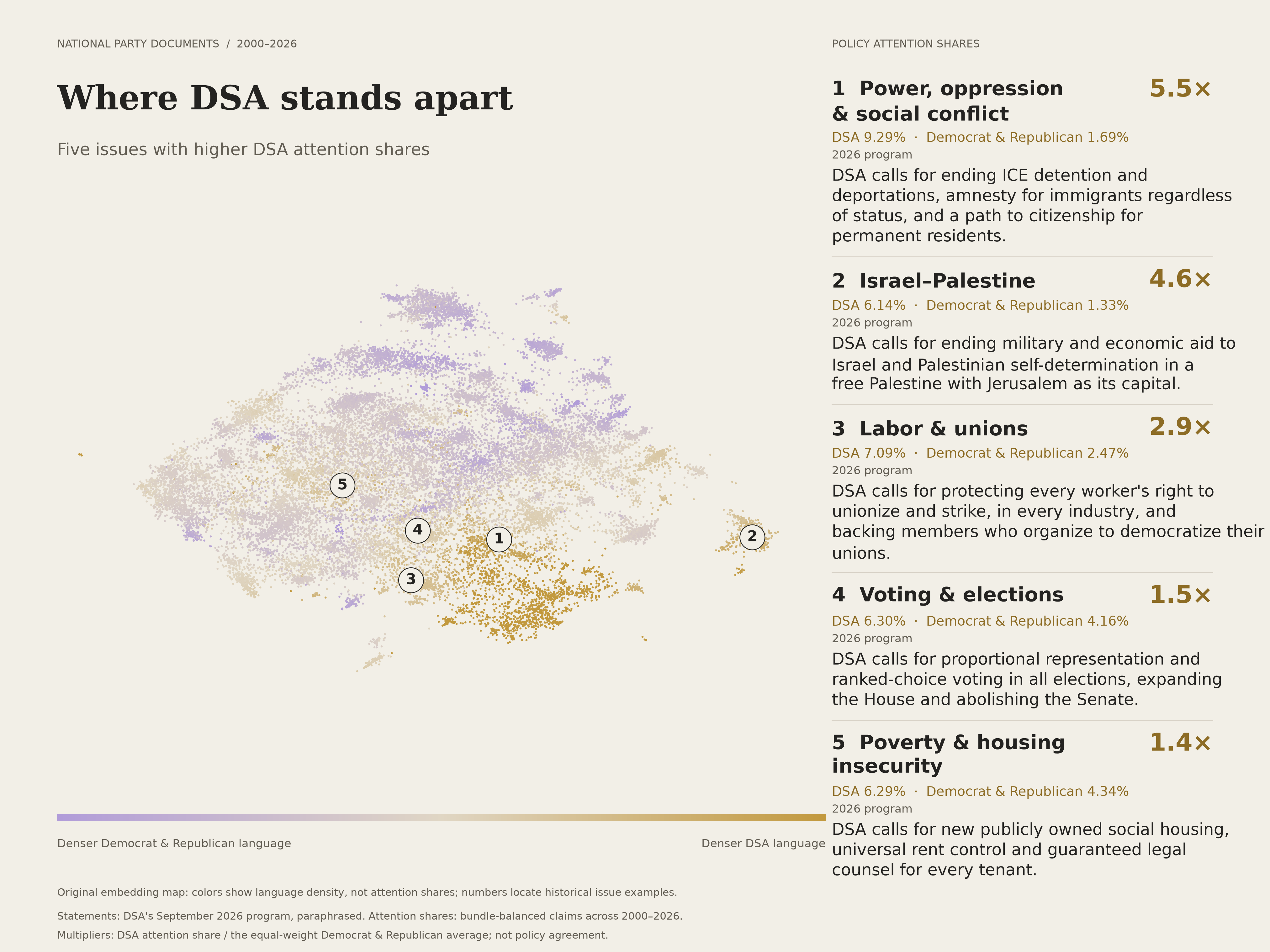
Drawing on an analysis of claims extracted from the DSA’s, the Republicans’, and the Democrats’ national platforms, programs, and policy statements from 2000–2026, the five issues to which the DSA devotes a greater proportion of its attention are:
-
Institutional power, oppression, and social conflict
-
Israel–Palestine
-
Labor rights and unions
-
Voting rights and representation
-
Poverty and housing insecurity
Power and Oppression: Most notably, the DSA’s national documents discuss structures of power, oppression, and social conflict more than five times as often as those of the two major parties. As a socialist organization, a main organizing principle of the DSA centers around the power imbalances that arise from the private ownership and accumulation of capital. Starting from this organizing principle, the DSA traces issues ranging from discrimination and economic insecurity to policing and immigration enforcement back to concentrations of economic and political power. Its 2026 program states:
Our enemies are not just individual bosses, but the entire global system of capital; not just this or that cop, judge, or president, but the entire anti-democratic structure of our society.
This worldview has translated into the DSA’s proposals for public ownership of the largest corporations, police reforms explicitly framed as steps toward removing the need for the police and prison system, and ending ICE detention and deportations and granting amnesty to immigrants regardless of status.
Israel–Palestine: Over the last three years, the conflict between Israel and Hamas in Gaza has become a central focus of the DSA. In the month after October 7, 2023, DSA members reportedly made over 275,000 calls to the U.S. Congress to advocate for a ceasefire. While the DSA’s view of Israel has changed over time, with the organization viewing Zionism as a national liberation movement in the 1980s, its 2024 national program called for “an end to military and economic aid, and weapons sales to Israel.” In 2024, the national branch of the DSA also voted to rescind its national endorsement of AOC following concerns about her “conflating opposition to Israel’s ‘right to exist’ with antisemitism.” Its 2026 program further called for the Palestinians’ right of return to lands currently in Israel and a Palestinian state with Jerusalem as its capital.
This emphasis is reflected in its national documents, which devote approximately 4.6 times as much relative attention to Israel–Palestine as those of the Republican and Democratic parties. Indeed, the national DSA’s own endorsement criteria include specific “anti-Zionist requirements”: support for the Boycott, Divestment, and Sanctions (BDS) movement; “refraining from any affiliation with the Israeli government or Zionist lobby groups”; and a pledge to “oppose legislation that harms Palestinians and support legislation that advances Palestinian liberation.”
Labor Rights and Unions: Although the DSA gives “labor unions” approximately 2x the relative attention in its national platform compared to the Democrats (4.5x compared to Republicans), the DSA and the Democratic Party share strong support for the organizations. However, while both the DSA and the Democrats vociferously support labor unions, the DSA specifically draws on the historical ties between socialist leaders like Eugene V. Debs and A. Philip Randolph and the labor movement. The DSA specifically urges its members to build new, stronger relationships with the 14 million remaining union members in the U.S. The DSA, in its 2021 platform, even states:
The socialist movement and the labor movement will rise or fall together.
Specifically, the DSA argues that its members and candidates should take and support union jobs, organize workplaces, and support strikes. The DSA combines this support for labor unions’ organizing efforts with calls for a federal jobs guarantee, a 32-hour working week without reduced wages or benefits, and the repeal of laws restricting union power.
Voting and Representation: Unlike the Democratic and Republican parties, the DSA also proposes dramatic changes in how Americans vote and the process by which officials are elected. In its 2024 program, for example, the DSA called for “a multi-party democracy through proportional representation elections” — a change from the current U.S. system of single-member congressional districts to one similar to those used in the Netherlands or Spain. Alongside this proposal, the 2024 platform argued for noncitizen voting rights, a larger House of Representatives, and a national popular vote for president. The 2026 program goes a step further, calling for “abolishing the Senate” and “replacing the presidency and Supreme Court with an executive and judiciary chosen by, and subordinate to, Congress.”
Poverty and Housing Insecurity: Finally, as a major aspect of its platform, the DSA highlights a need to ameliorate housing insecurity. This priority is also reflected in DSA member and New York City Mayor Zohran Mamdani’s own “Block by Block” agenda, which calls for building 200,000 affordable rental units, freezing rents for tenants in rent-stabilized apartments, and providing $5.6 billion in new funding for public housing.
The DSA’s housing policy, however, extends beyond simple affordability. Published in 2012, in A Social and Economic Bill of Rights, the DSA argued that housing should be treated as “a social good rather than as a profit-producing commodity.” More recently, the DSA’s 2026 national program proposes universal rent control and the construction of publicly owned social housing, stating:
Housing is a human right. Build new, publicly-owned social housing, strictly regulate investment properties, establish universal rent control, and guarantee right to counsel for all tenants.
As seen, this emphasis on fundamentally changing existing institutions is not limited to housing. Across issues ranging from housing to Israel–Palestine, the DSA platform calls for substantial changes to the status quo. The five issues looked at here, of course, represent only a subset of the DSA’s broader political agenda (selected because the organization devotes relatively greater attention to them than the Democratic and Republican parties do). Again, if you are curious about more of the DSA’s positions — and what the Democratic and Republican positions are — I have created an interactive visualization here.
While this analysis shows what the national DSA advocates more than Democrats or Republicans, the organization itself does not necessarily view its role as simply advocating for these policies or progressive ideas in general. Rather, its ambitions extend to building a broader socialist political movement — an objective that cannot be fully understood by looking at the DSA’s policy positions alone. This distinction between simply supporting progressive policies and building a socialist political movement is made explicit in the DSA’s own guidance for electoral campaigns:
The DSA’s national endorsement criteria even require candidates to “view themselves as socialist organizers first, and legislators second.” As stated in its eight criteria for national endorsement, a commitment to socialism, growing the socialist movement, and — somewhat incongruous to the rest — anti-Zionism are central requirements for receiving the organization’s support.
The DSA and the Democratic Party
The Democratic Socialists of America have undoubtedly become an increasingly influential movement within the Democratic Party. Nearly a third of Democrats and Democratic-leaning independents expressed that they “liked” when their elected officials described themselves as “democratic socialists”. In addition to the seven DSA members heavily favored to serve in Congress and New York City Mayor Zohran Mamdani, democratic socialists have also become increasingly prominent in major American cities. Seattle’s current mayor, Katie Wilson, identifies as a democratic socialist; Janeese Lewis George, a DSA member, is favored to become Washington, D.C.’s next mayor; and Los Angeles City Council member Nithya Raman, a democratic socialist, is challenging incumbent Mayor Karen Bass in a closely contested mayoral race.
However, despite the DSA’s increasing influence and popularity, many within the Democratic Party do not see its rise within their ranks as beneficial. Despite Democratic laymen increasingly warming to the DSA, according to Pew, Americans overall tend to “dislike elected leaders who identify as democratic socialists” (38% vs. 17%). Many Democrats have thus condemned this surge in DSA candidates. On his campaign website, Democratic Congressman Tom Suozzi puts simply: “Democrats Must Reject the DSA.” Worried about the potential influence of the DSA within Congress if the Democrats won a slim majority, Democratic strategist James Carville even confessed that he preferred the Republicans to win those seats. Democratic presidential hopeful and former Obama White House Chief of Staff Rahm Emanuel further argued that the Democrats “are not open to being taken over,” stating:
“You’ve got a set of [people for] defunding, decriminalizing, open borders. We have run that play and gotten our butts kicked. We don’t need to do it a second time to see if it turns out if the movie turns out any different.”
According to a 2026 Brookings Institution analysis, the DSA endorsed at least 282 candidates nationwide, including 104 running for state legislatures and 99 for local offices. Of these, Ballotpedia identified 131 DSA-endorsed candidates who made it onto the 2026 midterm general-election ballots across 30 states and Washington, D.C. These candidacies reflect the DSA’s growing presence in Democratic Party electoral politics, even as questions remain about the relationship between the two organizations and their respective political agendas. While the DSA and the Democratic Party overlap and share goals on some issues, the DSA remains a distinctive and particular movement separate from most Democratic politicians. As its candidates appear on ballots across the nation in a few days, it will ultimately be up to American voters to decide how much of that vision they want reflected in their politics and within the Democratic Party.