Community Investment, Housing, and Social Support Link
Democratic7.4%
The Democratic Party supports housing, education, health, infrastructure, income, and community-development investments directed toward low-income, rural, underserved, minority, and disaster-affected communities.
Republican5.9%
The Republican Party supports safety-net providers, veterans, foster families, local partnerships, training, transportation, child care, housing, and state or community responses to need.
DSA6.3%
DSA supports preserving social programs, expanding housing and infrastructure, meeting material needs, and organizing for working-class, poor, disabled, minority, and neglected communities.
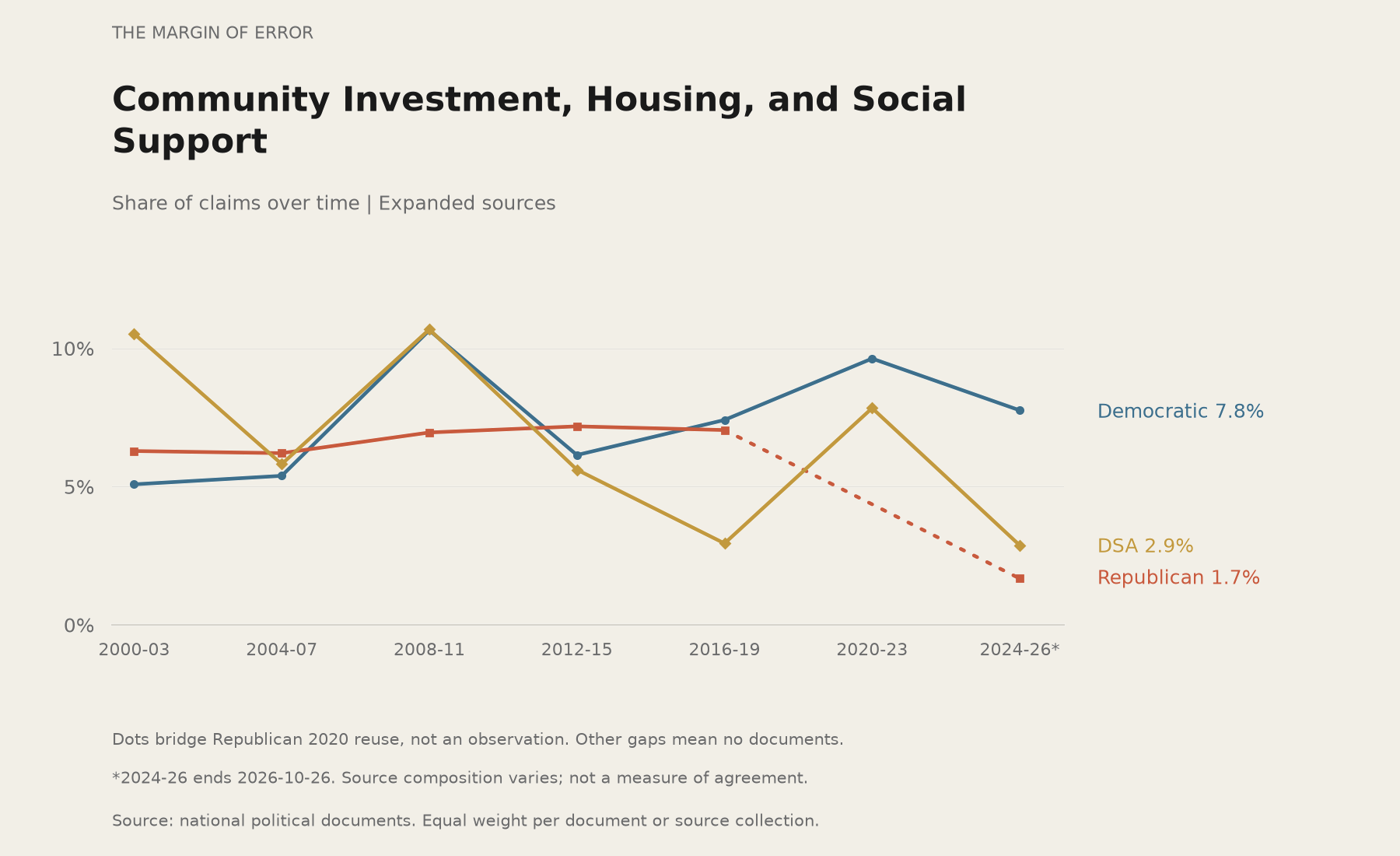
Over time
Weighted attention · *partial period. Republican dots bridge the reused 2020 platform; other gaps mean no documents.
Community Investment, Housing, and Social Support: share of attention in observed periods
Period
Democratic
Republican
DSA
2000–03
5.1%
6.3%
10.5%
2004–07
5.4%
6.2%
5.8%
2008–11
10.7%
7.0%
10.7%
2012–15
6.1%
7.2%
5.6%
2016–19
7.4%
7.0%
2.9%
2020–23
9.6%
Not observed
7.8%
2024–26*
7.8%
1.7%
2.9%
The cluster mixes targeted benefits, broad anti-poverty commitments, local capacity, and public-private delivery models; sampled documents differ on beneficiaries, scale, and administration.
Weighted policy-claim shares across 2000–2026, not language density or policy agreement. Ratios use unrounded shares; 1× means equal attention. The combined baseline gives Democrats and Republicans equal weight. A zero baseline has no defined ratio.
Counterterrorism, Military Readiness, and War Strategy Link
Democratic5.2%
The Democratic Party's sampled documents combine counterterrorism, intelligence, alliances, military readiness, nonproliferation, veterans' support, and selective force with diplomacy, oversight, and ending particular wars.
Republican5.8%
The Republican Party's sampled documents emphasize military strength, readiness, missile and nuclear defense, counterterrorism, intelligence, support for troops, and preserving force options against identified threats.
DSA4.3%
DSA's sampled documents oppose war, occupation, military intervention, nuclear escalation, surveillance, and expansive defense spending while supporting demilitarization, diplomacy, and antiwar organizing.
Over time
Weighted attention · *partial period. Republican dots bridge the reused 2020 platform; other gaps mean no documents.
Counterterrorism, Military Readiness, and War Strategy: share of attention in observed periods
Period
Democratic
Republican
DSA
2000–03
4.3%
5.8%
18.8%
2004–07
13.8%
10.9%
2.3%
2008–11
6.4%
5.5%
1.3%
2012–15
6.7%
5.8%
3.5%
2016–19
2.3%
4.9%
3.5%
2020–23
1.3%
Not observed
1.9%
2024–26*
1.4%
2.0%
2.5%
Threat assessments and preferred tools conflict sharply; the topic mixes operational policy, retrospective war judgments, civil-liberties concerns, and support for service members.
Weighted policy-claim shares across 2000–2026, not language density or policy agreement. Ratios use unrounded shares; 1× means equal attention. The combined baseline gives Democrats and Republicans equal weight. A zero baseline has no defined ratio.
American Power, Leadership, and National Purpose Link
Democratic6.5%
The Democratic Party portrays American strength through collective effort, democratic values, alliances, principled leadership, prosperity, diplomacy, and partners capable of addressing shared challenges.
Republican7.6%
The Republican Party portrays America as an exceptional leader whose military, economy, ideals, alliances, and resolve should preserve security, freedom, prosperity, and global influence.
DSA1.1%
DSA criticizes U.S. empire, military dominance, intervention, and territorial control while supporting international solidarity, self-determination, and independence for peoples under U.S. power.
Over time
Weighted attention · *partial period. Republican dots bridge the reused 2020 platform; other gaps mean no documents.
American Power, Leadership, and National Purpose: share of attention in observed periods
Period
Democratic
Republican
DSA
2000–03
8.2%
8.7%
0.8%
2004–07
8.3%
7.7%
2.6%
2008–11
9.2%
8.7%
0.4%
2012–15
8.5%
8.8%
1.3%
2016–19
4.0%
5.9%
1.2%
2020–23
3.5%
Not observed
0.6%
2024–26*
3.9%
5.9%
1.2%
The cluster mixes patriotic narratives, alliance claims, economic competitiveness, military power, and anti-imperialist critique; it is broader than diplomacy or any single administration.
Weighted policy-claim shares across 2000–2026, not language density or policy agreement. Ratios use unrounded shares; 1× means equal attention. The combined baseline gives Democrats and Republicans equal weight. A zero baseline has no defined ratio.
Cross-Policy Opposition and Institutional Critiques Link
Democratic3.5%
The Democratic Party's sampled documents criticize Republican administrations and policies across war, economics, rights, environment, governance, and public services while sometimes pairing objections with alternative commitments.
Republican7.1%
The Republican Party's sampled documents reject Democratic administrations, federal expansion, spending, judicial or executive actions, international constraints, military cuts, and selected trade, social, or security policies.
DSA4.4%
DSA's sampled documents criticize Democratic and Republican administrations, capitalism, militarism, austerity, policing, intervention, and institutional failures while advancing socialist or movement-based alternatives.
Over time
Weighted attention · *partial period. Republican dots bridge the reused 2020 platform; other gaps mean no documents.
Cross-Policy Opposition and Institutional Critiques: share of attention in observed periods
Period
Democratic
Republican
DSA
2000–03
3.5%
10.6%
4.5%
2004–07
7.3%
2.9%
8.8%
2008–11
4.5%
4.5%
4.7%
2012–15
3.3%
10.9%
6.2%
2016–19
1.9%
12.2%
6.2%
2020–23
1.6%
Not observed
2.3%
2024–26*
2.2%
1.7%
2.5%
This is a heterogeneous criticism cluster rather than a coherent policy program; some samples also state preferred alternatives, historical comparisons, or narrow sovereignty objections.
Weighted policy-claim shares across 2000–2026, not language density or policy agreement. Ratios use unrounded shares; 1× means equal attention. The combined baseline gives Democrats and Republicans equal weight. A zero baseline has no defined ratio.
Economic Hardship, Poverty, and Housing Insecurity Link
Democratic4.3%
The Democratic Party describes poverty, job loss, housing unaffordability, racial wealth gaps, health costs, disaster burdens, and pandemic-era fiscal strain across successive election periods.
Republican4.4%
The Republican Party describes poverty, uninsured families, housing collapse, inflation, trade deficits, unemployment, health disparities, and fiscal distress, sometimes assigning partisan or public-cost blame.
DSA6.3%
DSA connects hardship to low wages, austerity, weak labor standards, privatization, capitalism, housing costs, incarceration, and crises, emphasizing burdens on workers and marginalized communities.
Over time
Weighted attention · *partial period. Republican dots bridge the reused 2020 platform; other gaps mean no documents.
Economic Hardship, Poverty, and Housing Insecurity: share of attention in observed periods
Period
Democratic
Republican
DSA
2000–03
3.8%
4.5%
4.5%
2004–07
4.7%
3.7%
12.8%
2008–11
4.7%
4.1%
4.7%
2012–15
3.7%
6.5%
12.1%
2016–19
4.5%
6.3%
4.5%
2020–23
5.8%
Not observed
5.6%
2024–26*
3.0%
1.1%
3.4%
The sample includes domestic and international crises, health and disaster burdens, macroeconomic indicators, and partisan causal claims rather than one anti-poverty program.
Weighted policy-claim shares across 2000–2026, not language density or policy agreement. Ratios use unrounded shares; 1× means equal attention. The combined baseline gives Democrats and Republicans equal weight. A zero baseline has no defined ratio.
Healthcare Coverage, Affordability, and System Design Link
Democratic5.7%
The Democratic Party's sampled platforms seek broad affordable coverage, stronger Medicare and Medicaid, lower costs, prescription access, public-program equity, and reduced disparities across communities and territories.
Republican5.3%
The Republican Party's sampled platforms support affordable access through choice, competition, consumer control, targeted credits, Medicare and Medicaid changes, community care, prevention, and private provision.
DSA3.8%
DSA's sampled documents treat healthcare as a right and favor Medicare for All, single-payer coverage, public investment, universal eligibility, comprehensive benefits, and care without point-of-use charges.
Over time
Weighted attention · *partial period. Republican dots bridge the reused 2020 platform; other gaps mean no documents.
Healthcare Coverage, Affordability, and System Design: share of attention in observed periods
Period
Democratic
Republican
DSA
2000–03
3.1%
6.8%
0.0%
2004–07
6.8%
5.5%
4.2%
2008–11
6.9%
7.9%
2.1%
2012–15
4.3%
5.6%
5.9%
2016–19
6.1%
4.2%
5.9%
2020–23
6.7%
Not observed
5.3%
2024–26*
6.3%
2.0%
2.8%
The topic also spans direct care, long-term care, territorial disparities, reproductive and gender-affirming care, addiction treatment, provider regulation, and historically changing systems.
Weighted policy-claim shares across 2000–2026, not language density or policy agreement. Ratios use unrounded shares; 1× means equal attention. The combined baseline gives Democrats and Republicans equal weight. A zero baseline has no defined ratio.
Voting Rights, Election Rules, and Representation Link
Democratic3.3%
The Democratic Party supports voting-rights enforcement, restored ballot access, opposition to suppression, campaign-finance reform, representative institutions, and broader democratic accountability.
Republican5.0%
The Republican Party supports voter identification, citizenship checks, paper ballots, state authority, representation rules, secret ballots, and selected constitutional safeguards.
DSA6.3%
DSA supports expanded voting rights, proportional representation, full democratic participation, anti-suppression measures, and limits on corporate influence over democracy.
Over time
Weighted attention · *partial period. Republican dots bridge the reused 2020 platform; other gaps mean no documents.
Voting Rights, Election Rules, and Representation: share of attention in observed periods
Period
Democratic
Republican
DSA
2000–03
2.5%
3.9%
9.8%
2004–07
3.2%
2.6%
2.3%
2008–11
4.1%
5.2%
1.7%
2012–15
2.8%
7.0%
3.0%
2016–19
4.5%
7.8%
2.6%
2020–23
4.3%
Not observed
6.1%
2024–26*
2.0%
3.4%
12.6%
The cluster also contains broader constitutional rights, governmental constraints, and democratic-governance claims; it does not present one uniform election system or establish current group consensus.
Weighted policy-claim shares across 2000–2026, not language density or policy agreement. Ratios use unrounded shares; 1× means equal attention. The combined baseline gives Democrats and Republicans equal weight. A zero baseline has no defined ratio.
The Democratic Party commits to American values, opportunity, nondiscrimination, public safety, social insurance, community strength, homeland security, and public investment.
Republican5.1%
The Republican Party commits to dignity, families, efficient government, American workers, national strength, anti-discrimination enforcement, social insurance, and economic stability.
DSA1.7%
DSA supports economic democratization, public investment, social movements, expanded rights, working-class organization, climate responsibility, and reduced military spending.
Over time
Weighted attention · *partial period. Republican dots bridge the reused 2020 platform; other gaps mean no documents.
Public Protections and National Commitments: share of attention in observed periods
Period
Democratic
Republican
DSA
2000–03
2.5%
2.2%
3.0%
2004–07
7.6%
1.4%
0.0%
2008–11
11.5%
1.8%
3.0%
2012–15
3.5%
2.5%
1.4%
2016–19
13.7%
1.3%
1.2%
2020–23
12.1%
Not observed
1.8%
2024–26*
3.7%
21.2%
1.6%
This is a heterogeneous cluster of values, protections, and organizational goals rather than a single policy field; specific commitments and their intended beneficiaries vary substantially by document and period.
Weighted policy-claim shares across 2000–2026, not language density or policy agreement. Ratios use unrounded shares; 1× means equal attention. The combined baseline gives Democrats and Republicans equal weight. A zero baseline has no defined ratio.
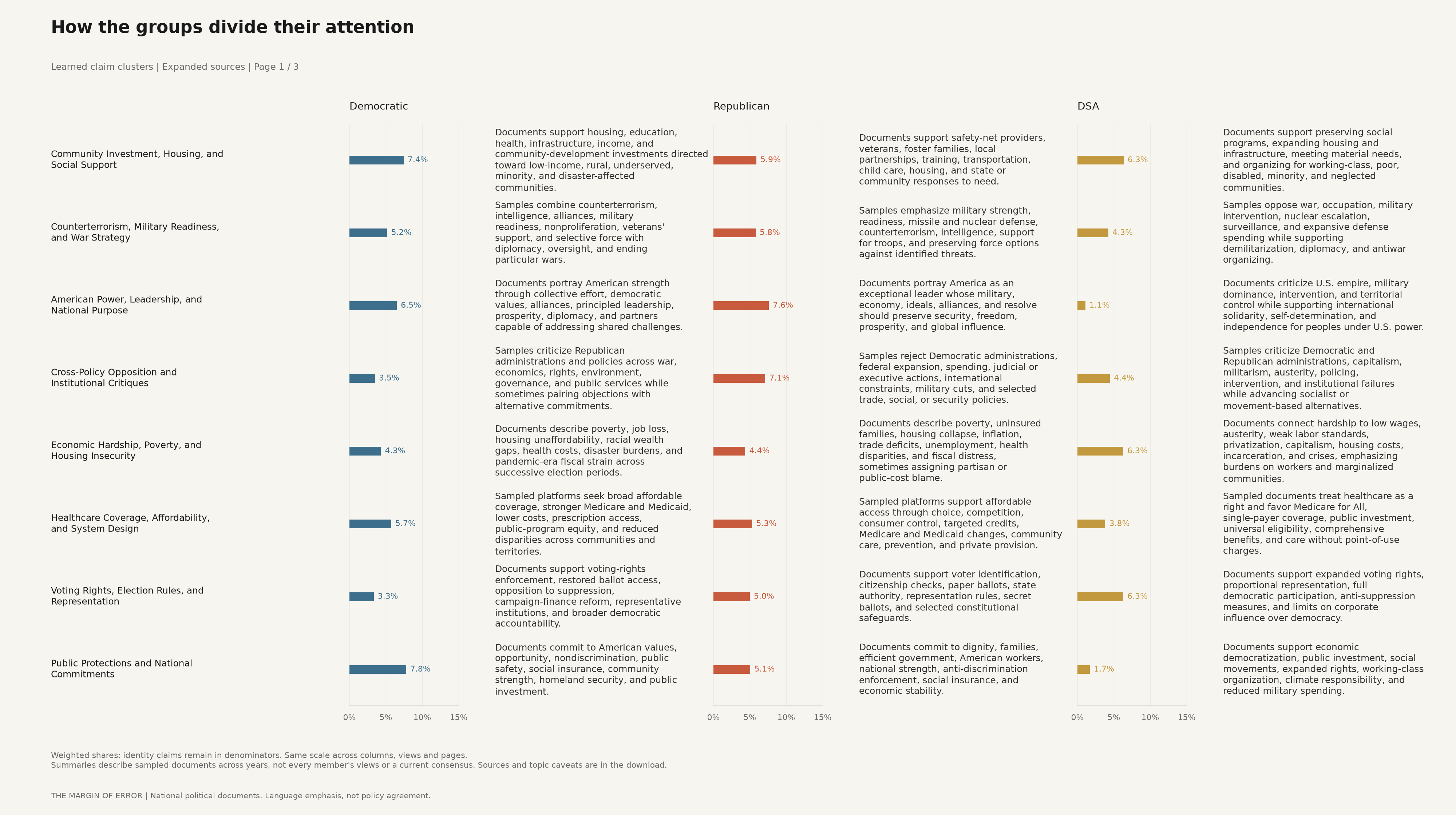
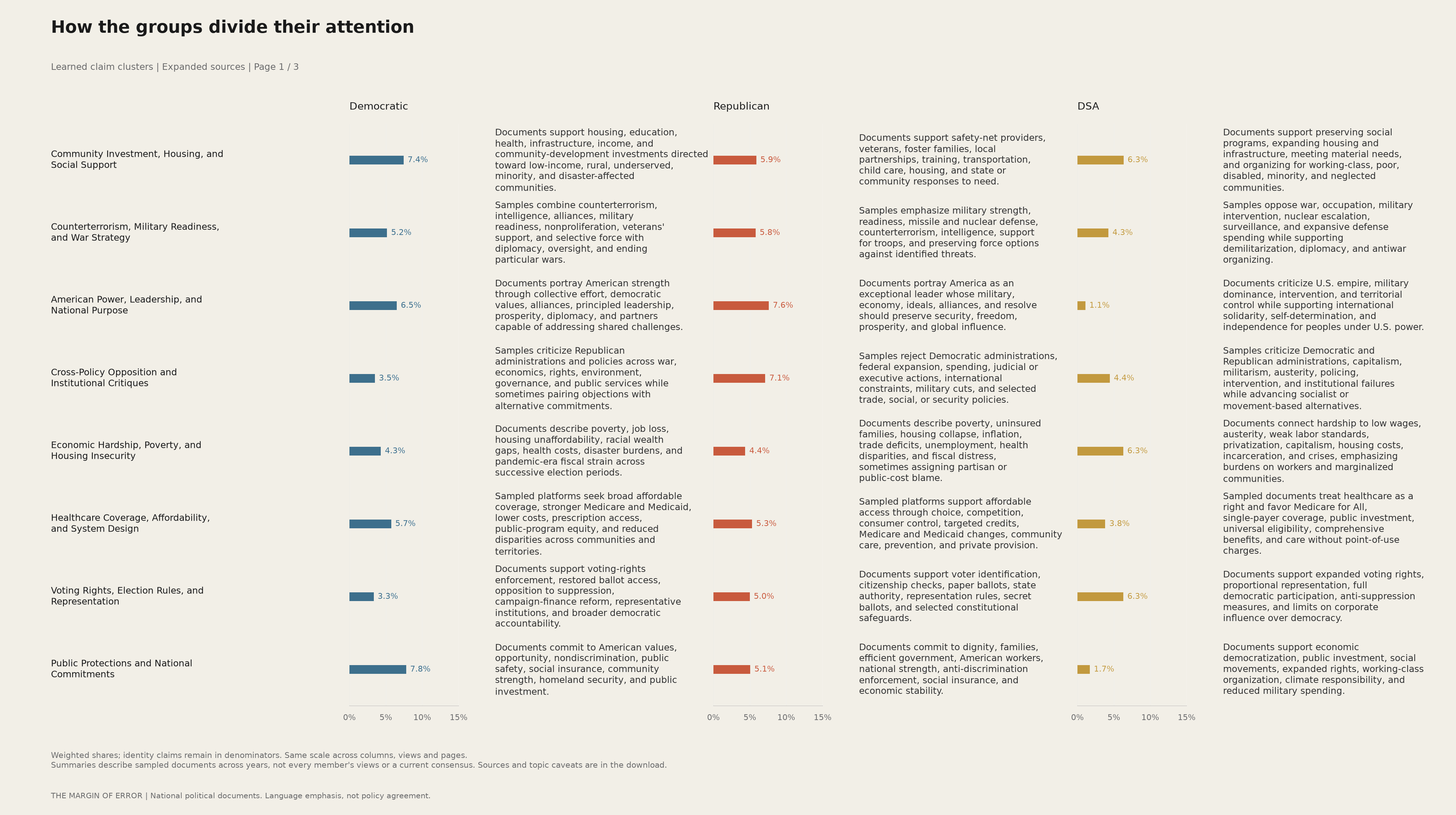
Share of attention, page 1 of 3. All organizations use the same subjects and chart scales.
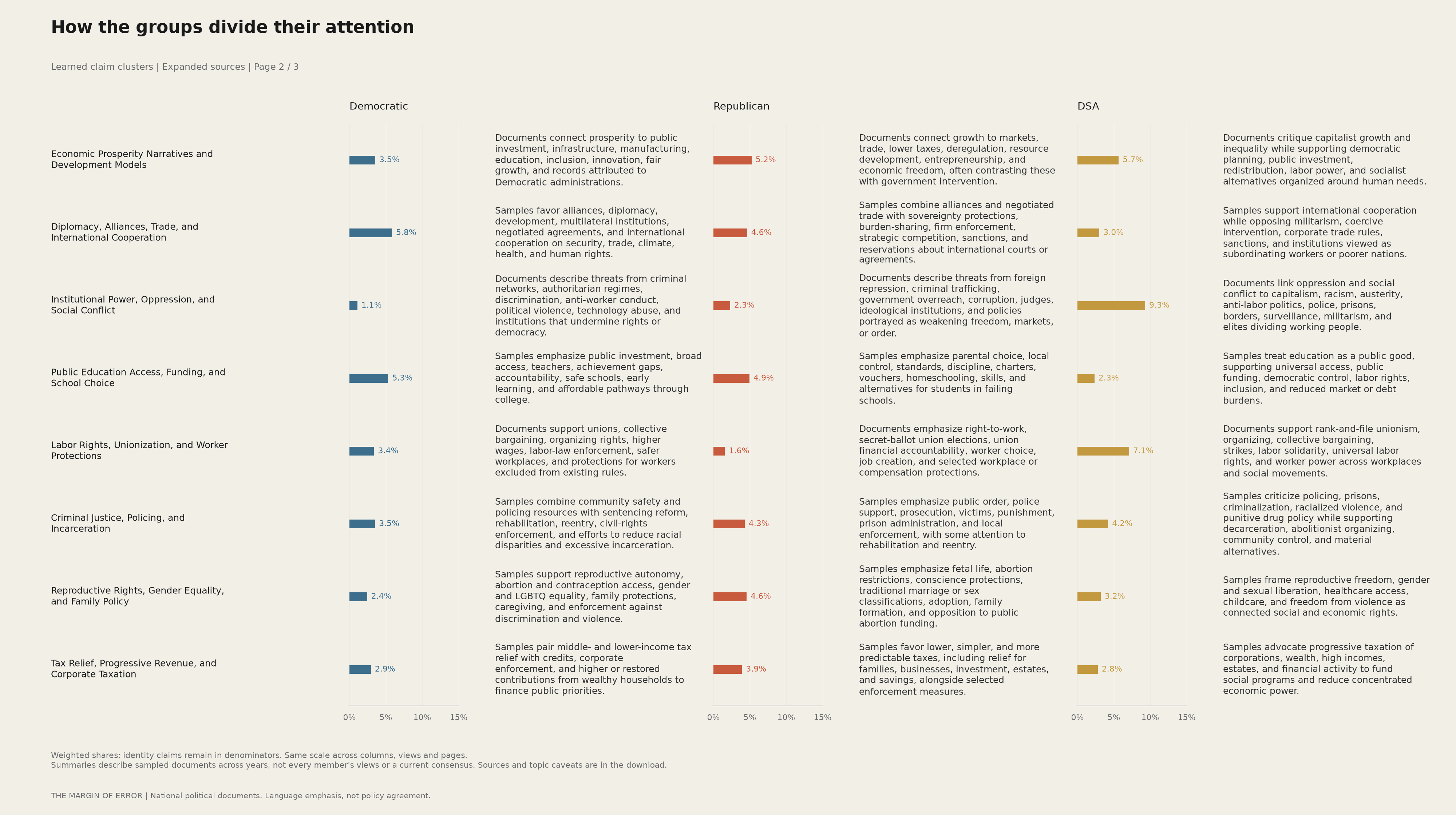
Share of attention: page 2
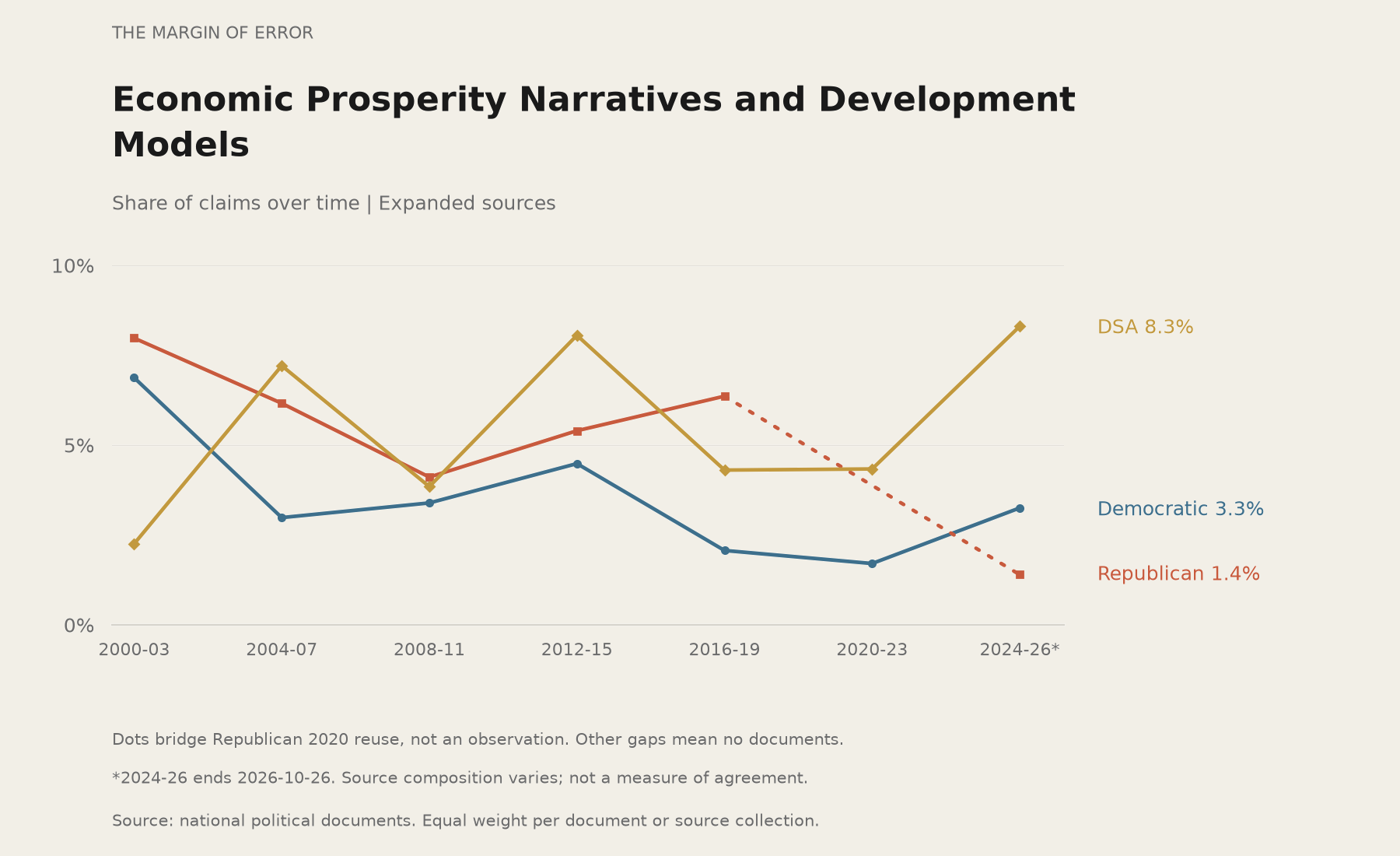
Economic Prosperity Narratives and Development Models Link
Democratic3.5%
The Democratic Party connects prosperity to public investment, infrastructure, manufacturing, education, inclusion, innovation, fair growth, and records attributed to Democratic administrations.
Republican5.2%
The Republican Party connects growth to markets, trade, lower taxes, deregulation, resource development, entrepreneurship, and economic freedom, often contrasting these with government intervention.
DSA5.7%
DSA critiques capitalist growth and inequality while supporting democratic planning, public investment, redistribution, labor power, and socialist alternatives organized around human needs.
Over time
Weighted attention · *partial period. Republican dots bridge the reused 2020 platform; other gaps mean no documents.
Economic Prosperity Narratives and Development Models: share of attention in observed periods
Period
Democratic
Republican
DSA
2000–03
6.9%
8.0%
2.3%
2004–07
3.0%
6.2%
7.2%
2008–11
3.4%
4.1%
3.8%
2012–15
4.5%
5.4%
8.1%
2016–19
2.1%
6.4%
4.3%
2020–23
1.7%
Not observed
4.3%
2024–26*
3.3%
1.4%
8.3%
The heterogeneous cluster mixes retrospective records, causal claims, aspirations, and policy models; it should not be read as one coherent theory within or across groups.
Weighted policy-claim shares across 2000–2026, not language density or policy agreement. Ratios use unrounded shares; 1× means equal attention. The combined baseline gives Democrats and Republicans equal weight. A zero baseline has no defined ratio.
Diplomacy, Alliances, Trade, and International Cooperation Link
Democratic5.8%
The Democratic Party's sampled documents favor alliances, diplomacy, development, multilateral institutions, negotiated agreements, and international cooperation on security, trade, climate, health, and human rights.
Republican4.6%
The Republican Party's sampled documents combine alliances and negotiated trade with sovereignty protections, burden-sharing, firm enforcement, strategic competition, sanctions, and reservations about international courts or agreements.
DSA3.0%
DSA's sampled documents support international cooperation while opposing militarism, coercive intervention, corporate trade rules, sanctions, and institutions viewed as subordinating workers or poorer nations.
Over time
Weighted attention · *partial period. Republican dots bridge the reused 2020 platform; other gaps mean no documents.
Diplomacy, Alliances, Trade, and International Cooperation: share of attention in observed periods
Period
Democratic
Republican
DSA
2000–03
5.5%
4.9%
9.8%
2004–07
6.2%
6.6%
1.6%
2008–11
6.4%
5.1%
0.9%
2012–15
8.2%
3.3%
1.1%
2016–19
6.1%
3.9%
1.6%
2020–23
6.9%
Not observed
2.7%
2024–26*
1.5%
3.9%
3.4%
The topic mixes cooperative, market-opening, sovereignty-protective, and anti-imperialist positions; agreement on international engagement does not imply agreement on its institutions, terms, or use.
Weighted policy-claim shares across 2000–2026, not language density or policy agreement. Ratios use unrounded shares; 1× means equal attention. The combined baseline gives Democrats and Republicans equal weight. A zero baseline has no defined ratio.
Institutional Power, Oppression, and Social Conflict Link
Democratic1.1%
The Democratic Party describes threats from criminal networks, authoritarian regimes, discrimination, anti-worker conduct, political violence, technology abuse, and institutions that undermine rights or democracy.
Republican2.3%
The Republican Party describes threats from foreign repression, criminal trafficking, government overreach, corruption, judges, ideological institutions, and policies portrayed as weakening freedom, markets, or order.
DSA9.3%
DSA links oppression and social conflict to capitalism, racism, austerity, anti-labor politics, police, prisons, borders, surveillance, militarism, and elites dividing working people.
Over time
Weighted attention · *partial period. Republican dots bridge the reused 2020 platform; other gaps mean no documents.
Institutional Power, Oppression, and Social Conflict: share of attention in observed periods
Period
Democratic
Republican
DSA
2000–03
1.6%
2.2%
3.0%
2004–07
0.6%
1.3%
11.4%
2008–11
0.7%
2.5%
6.4%
2012–15
1.2%
2.3%
9.5%
2016–19
1.3%
3.8%
13.4%
2020–23
1.3%
Not observed
11.7%
2024–26*
0.9%
1.7%
8.3%
The assignment mixes domestic and international conflicts, state and private actors, justice systems, labor struggles, technology, migration, and broad ideological criticism without one policy program.
Weighted policy-claim shares across 2000–2026, not language density or policy agreement. Ratios use unrounded shares; 1× means equal attention. The combined baseline gives Democrats and Republicans equal weight. A zero baseline has no defined ratio.
Public Education Access, Funding, and School Choice Link
Democratic5.3%
The Democratic Party's sampled documents emphasize public investment, broad access, teachers, achievement gaps, accountability, safe schools, early learning, and affordable pathways through college.
Republican4.9%
The Republican Party's sampled documents emphasize parental choice, local control, standards, discipline, charters, vouchers, homeschooling, skills, and alternatives for students in failing schools.
DSA2.3%
DSA's sampled documents treat education as a public good, supporting universal access, public funding, democratic control, labor rights, inclusion, and reduced market or debt burdens.
Over time
Weighted attention · *partial period. Republican dots bridge the reused 2020 platform; other gaps mean no documents.
Public Education Access, Funding, and School Choice: share of attention in observed periods
Period
Democratic
Republican
DSA
2000–03
9.5%
4.2%
0.0%
2004–07
6.2%
5.0%
3.7%
2008–11
5.0%
5.9%
3.0%
2012–15
2.4%
4.1%
3.0%
2016–19
6.1%
3.5%
1.2%
2020–23
5.6%
Not observed
2.6%
2024–26*
2.5%
7.0%
2.5%
The topic spans early childhood through higher education and includes conflicting views on testing, federal authority, nonpublic options, discipline, and democratic governance.
Weighted policy-claim shares across 2000–2026, not language density or policy agreement. Ratios use unrounded shares; 1× means equal attention. The combined baseline gives Democrats and Republicans equal weight. A zero baseline has no defined ratio.
Labor Rights, Unionization, and Worker Protections Link
Democratic3.4%
The Democratic Party supports unions, collective bargaining, organizing rights, higher wages, labor-law enforcement, safer workplaces, and protections for workers excluded from existing rules.
Republican1.6%
The Republican Party emphasizes right-to-work, secret-ballot union elections, union financial accountability, worker choice, job creation, and selected workplace or compensation protections.
DSA7.1%
DSA supports rank-and-file unionism, organizing, collective bargaining, strikes, labor solidarity, universal labor rights, and worker power across workplaces and social movements.
Over time
Weighted attention · *partial period. Republican dots bridge the reused 2020 platform; other gaps mean no documents.
Labor Rights, Unionization, and Worker Protections: share of attention in observed periods
Period
Democratic
Republican
DSA
2000–03
3.9%
0.8%
6.8%
2004–07
2.6%
2.0%
6.3%
2008–11
4.6%
1.6%
6.4%
2012–15
3.7%
1.9%
5.4%
2016–19
3.3%
2.0%
6.1%
2020–23
3.6%
Not observed
8.2%
2024–26*
1.8%
1.1%
8.2%
The packet spans distinct labor institutions and periods, and includes some economic or occupational policies that do not amount to a comprehensive labor platform.
Weighted policy-claim shares across 2000–2026, not language density or policy agreement. Ratios use unrounded shares; 1× means equal attention. The combined baseline gives Democrats and Republicans equal weight. A zero baseline has no defined ratio.
Criminal Justice, Policing, and Incarceration Link
Democratic3.5%
The Democratic Party's sampled documents combine community safety and policing resources with sentencing reform, rehabilitation, reentry, civil-rights enforcement, and efforts to reduce racial disparities and excessive incarceration.
Republican4.3%
The Republican Party's sampled documents emphasize public order, police support, prosecution, victims, punishment, prison administration, and local enforcement, with some attention to rehabilitation and reentry.
DSA4.2%
DSA's sampled documents criticize policing, prisons, criminalization, racialized violence, and punitive drug policy while supporting decarceration, abolitionist organizing, community control, and material alternatives.
Over time
Weighted attention · *partial period. Republican dots bridge the reused 2020 platform; other gaps mean no documents.
Criminal Justice, Policing, and Incarceration: share of attention in observed periods
Period
Democratic
Republican
DSA
2000–03
5.6%
3.8%
3.0%
2004–07
2.2%
2.4%
0.5%
2008–11
2.2%
5.8%
0.9%
2012–15
1.9%
4.7%
5.7%
2016–19
4.5%
4.5%
4.6%
2020–23
4.7%
Not observed
8.8%
2024–26*
3.4%
4.5%
2.8%
The packet contains punitive, rehabilitative, abolitionist, civil-rights, and victim-centered strands; documents differ sharply over police authority, capital punishment, and incarceration.
Weighted policy-claim shares across 2000–2026, not language density or policy agreement. Ratios use unrounded shares; 1× means equal attention. The combined baseline gives Democrats and Republicans equal weight. A zero baseline has no defined ratio.
Reproductive Rights, Gender Equality, and Family Policy Link
Democratic2.4%
The Democratic Party's sampled documents support reproductive autonomy, abortion and contraception access, gender and LGBTQ equality, family protections, caregiving, and enforcement against discrimination and violence.
Republican4.6%
The Republican Party's sampled documents emphasize fetal life, abortion restrictions, conscience protections, traditional marriage or sex classifications, adoption, family formation, and opposition to public abortion funding.
DSA3.2%
DSA's sampled documents frame reproductive freedom, gender and sexual liberation, healthcare access, childcare, and freedom from violence as connected social and economic rights.
Over time
Weighted attention · *partial period. Republican dots bridge the reused 2020 platform; other gaps mean no documents.
Reproductive Rights, Gender Equality, and Family Policy: share of attention in observed periods
Period
Democratic
Republican
DSA
2000–03
2.2%
2.6%
0.0%
2004–07
1.4%
2.9%
0.0%
2008–11
2.8%
5.4%
2.1%
2012–15
2.9%
5.2%
4.0%
2016–19
2.9%
6.5%
5.2%
2020–23
2.4%
Not observed
2.8%
2024–26*
2.4%
4.7%
5.9%
Reproductive policy is central, but the cluster also contains broader equality and family-policy claims; positions differ within and across documents over rights, funding, and institutions.
Weighted policy-claim shares across 2000–2026, not language density or policy agreement. Ratios use unrounded shares; 1× means equal attention. The combined baseline gives Democrats and Republicans equal weight. A zero baseline has no defined ratio.
Tax Relief, Progressive Revenue, and Corporate Taxation Link
Democratic2.9%
The Democratic Party's sampled documents pair middle- and lower-income tax relief with credits, corporate enforcement, and higher or restored contributions from wealthy households to finance public priorities.
Republican3.9%
The Republican Party's sampled documents favor lower, simpler, and more predictable taxes, including relief for families, businesses, investment, estates, and savings, alongside selected enforcement measures.
DSA2.8%
DSA's sampled documents advocate progressive taxation of corporations, wealth, high incomes, estates, and financial activity to fund social programs and reduce concentrated economic power.
Over time
Weighted attention · *partial period. Republican dots bridge the reused 2020 platform; other gaps mean no documents.
Tax Relief, Progressive Revenue, and Corporate Taxation: share of attention in observed periods
Period
Democratic
Republican
DSA
2000–03
2.5%
4.6%
0.0%
2004–07
3.1%
4.5%
4.0%
2008–11
2.4%
4.8%
5.1%
2012–15
4.6%
3.4%
4.2%
2016–19
2.4%
3.6%
3.1%
2020–23
1.7%
Not observed
1.8%
2024–26*
3.9%
2.5%
2.6%
Tax bases, beneficiaries, and stated purposes vary widely; the cluster also includes critiques of loopholes, deductions, tax avoidance, and distributional effects.
Weighted policy-claim shares across 2000–2026, not language density or policy agreement. Ratios use unrounded shares; 1× means equal attention. The combined baseline gives Democrats and Republicans equal weight. A zero baseline has no defined ratio.
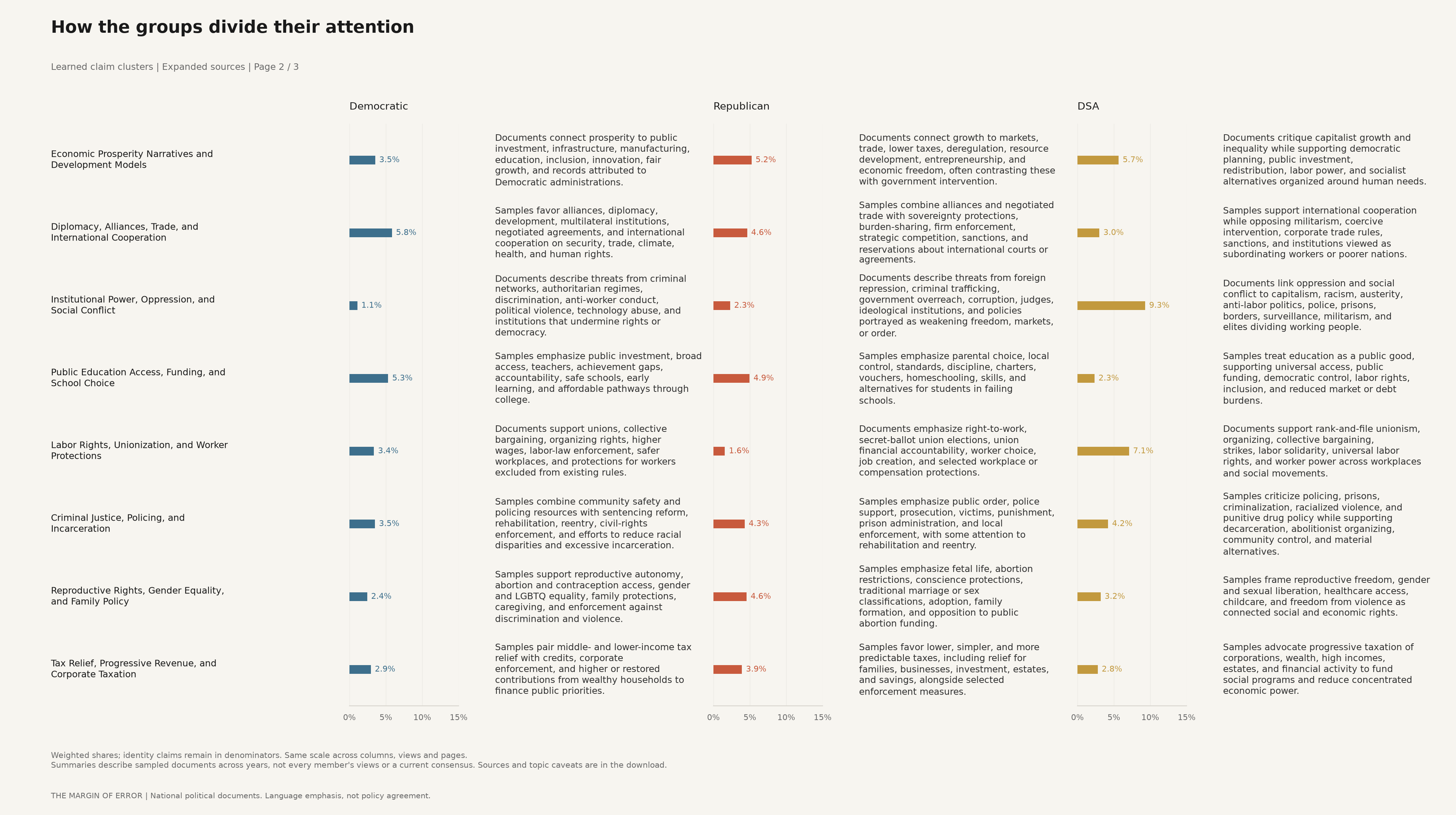
Share of attention, page 2 of 3. All organizations use the same subjects and chart scales.
Share of attention: page 3
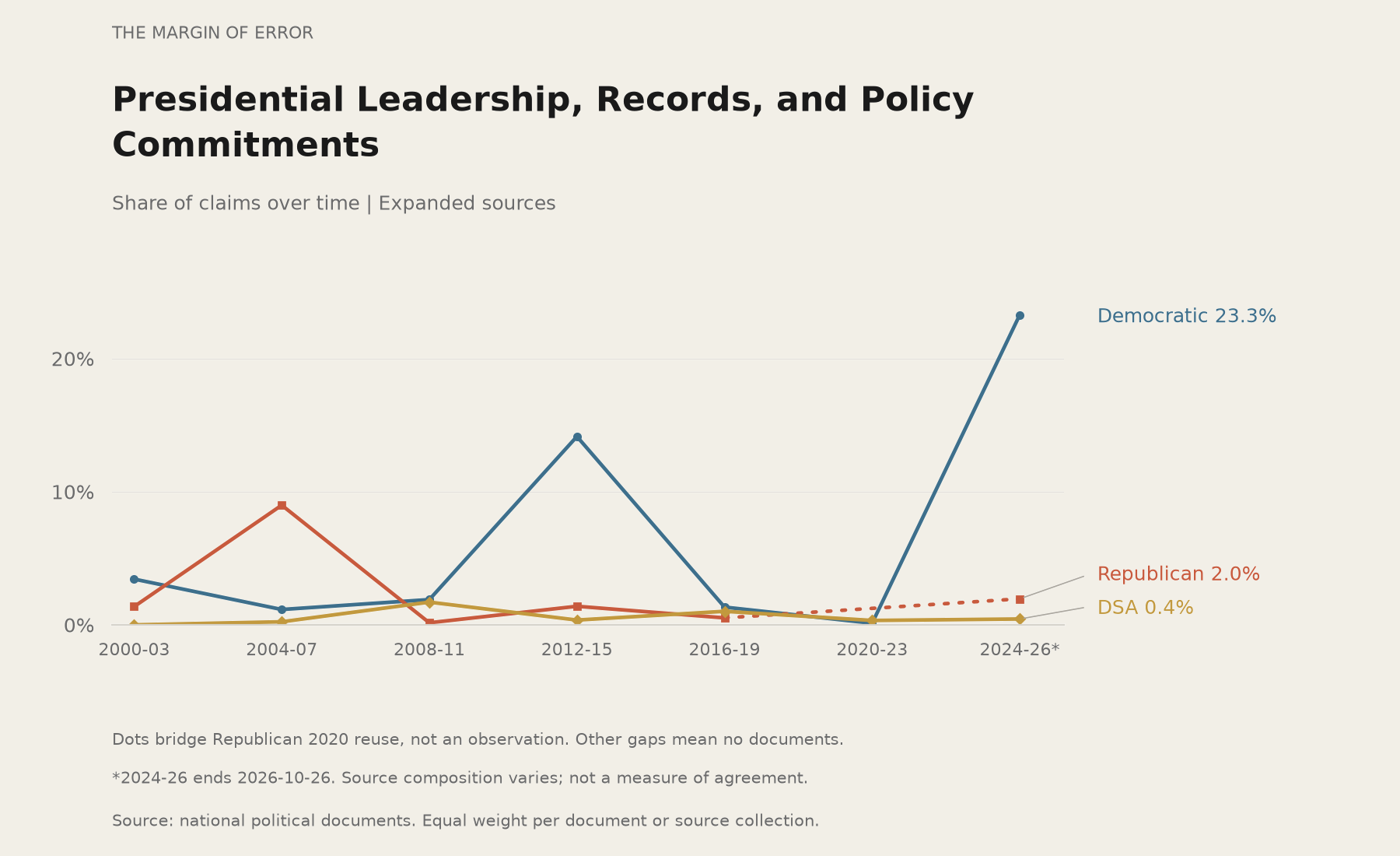
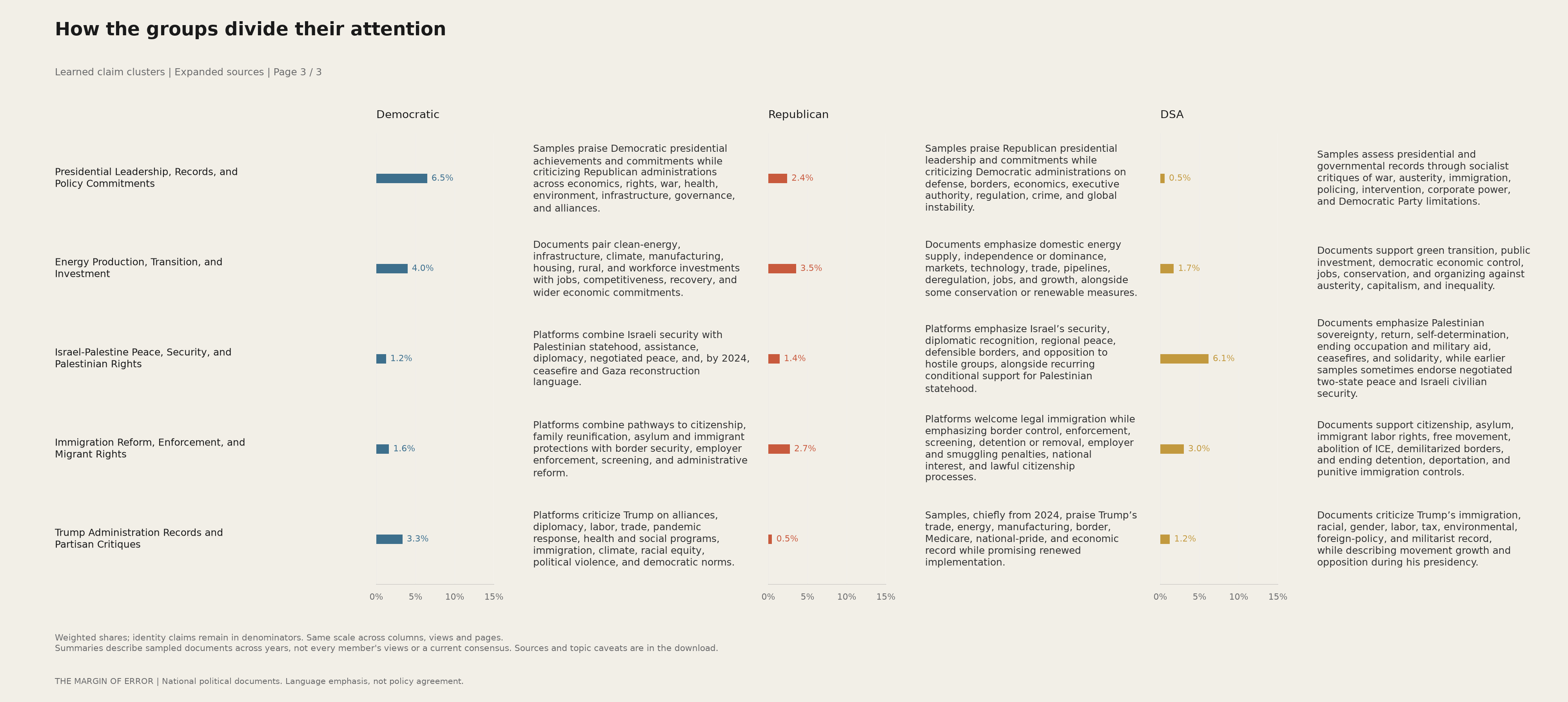
Presidential Leadership, Records, and Policy Commitments Link
Democratic6.5%
The Democratic Party's sampled documents praise Democratic presidential achievements and commitments while criticizing Republican administrations across economics, rights, war, health, environment, infrastructure, governance, and alliances.
Republican2.4%
The Republican Party's sampled documents praise Republican presidential leadership and commitments while criticizing Democratic administrations on defense, borders, economics, executive authority, regulation, crime, and global instability.
DSA0.5%
DSA's sampled documents assess presidential and governmental records through socialist critiques of war, austerity, immigration, policing, intervention, corporate power, and Democratic Party limitations.
Over time
Weighted attention · *partial period. Republican dots bridge the reused 2020 platform; other gaps mean no documents.
Presidential Leadership, Records, and Policy Commitments: share of attention in observed periods
Period
Democratic
Republican
DSA
2000–03
3.4%
1.4%
0.0%
2004–07
1.2%
9.0%
0.2%
2008–11
1.9%
0.2%
1.7%
2012–15
14.1%
1.4%
0.4%
2016–19
1.3%
0.5%
1.0%
2020–23
0.1%
Not observed
0.3%
2024–26*
23.3%
2.0%
0.4%
This attribution-centered cluster is not a single issue area: it mixes praise, criticism, campaign commitments, and retrospective claims whose accuracy is asserted by the sampled documents.
Weighted policy-claim shares across 2000–2026, not language density or policy agreement. Ratios use unrounded shares; 1× means equal attention. The combined baseline gives Democrats and Republicans equal weight. A zero baseline has no defined ratio.
Energy Production, Transition, and Investment Link
Democratic4.0%
The Democratic Party pairs clean-energy, infrastructure, climate, manufacturing, housing, rural, and workforce investments with jobs, competitiveness, recovery, and wider economic commitments.
Republican3.5%
The Republican Party emphasizes domestic energy supply, independence or dominance, markets, technology, trade, pipelines, deregulation, jobs, and growth, alongside some conservation or renewable measures.
DSA1.7%
DSA supports green transition, public investment, democratic economic control, jobs, conservation, and organizing against austerity, capitalism, and inequality.
Over time
Weighted attention · *partial period. Republican dots bridge the reused 2020 platform; other gaps mean no documents.
Energy Production, Transition, and Investment: share of attention in observed periods
Period
Democratic
Republican
DSA
2000–03
3.4%
2.9%
0.0%
2004–07
5.4%
2.3%
2.6%
2008–11
4.5%
7.4%
0.9%
2012–15
3.2%
3.2%
0.8%
2016–19
3.9%
2.9%
1.0%
2020–23
3.7%
Not observed
3.0%
2024–26*
3.8%
2.5%
2.0%
The cluster also contains broader housing, rural, trade, and economic commitments; it does not establish a single energy program or a current consensus within any group.
Weighted policy-claim shares across 2000–2026, not language density or policy agreement. Ratios use unrounded shares; 1× means equal attention. The combined baseline gives Democrats and Republicans equal weight. A zero baseline has no defined ratio.
Israel-Palestine Peace, Security, and Palestinian Rights Link
Democratic1.2%
The Democratic Party's platforms combine Israeli security with Palestinian statehood, assistance, diplomacy, negotiated peace, and, by 2024, ceasefire and Gaza reconstruction language.
Republican1.4%
The Republican Party's platforms emphasize Israel’s security, diplomatic recognition, regional peace, defensible borders, and opposition to hostile groups, alongside recurring conditional support for Palestinian statehood.
DSA6.1%
DSA emphasizes Palestinian sovereignty, return, self-determination, ending occupation and military aid, ceasefires, and solidarity, while earlier samples sometimes endorse negotiated two-state peace and Israeli civilian security.
Over time
Weighted attention · *partial period. Republican dots bridge the reused 2020 platform; other gaps mean no documents.
Israel-Palestine Peace, Security, and Palestinian Rights: share of attention in observed periods
Period
Democratic
Republican
DSA
2000–03
1.1%
1.3%
3.0%
2004–07
2.0%
2.2%
8.6%
2008–11
1.3%
2.1%
17.9%
2012–15
1.3%
1.0%
4.1%
2016–19
1.3%
1.7%
2.5%
2020–23
0.3%
Not observed
4.9%
2024–26*
1.2%
0.3%
4.6%
The packet also includes Syria, Iraq, Yemen, terrorism, antisemitism, and wider Middle East policy; these adjacent conflicts should not be treated as equivalent positions.
Weighted policy-claim shares across 2000–2026, not language density or policy agreement. Ratios use unrounded shares; 1× means equal attention. The combined baseline gives Democrats and Republicans equal weight. A zero baseline has no defined ratio.
Immigration Reform, Enforcement, and Migrant Rights Link
Democratic1.6%
The Democratic Party's platforms combine pathways to citizenship, family reunification, asylum and immigrant protections with border security, employer enforcement, screening, and administrative reform.
Republican2.7%
The Republican Party's platforms welcome legal immigration while emphasizing border control, enforcement, screening, detention or removal, employer and smuggling penalties, national interest, and lawful citizenship processes.
DSA3.0%
DSA supports citizenship, asylum, immigrant labor rights, free movement, abolition of ICE, demilitarized borders, and ending detention, deportation, and punitive immigration controls.
Over time
Weighted attention · *partial period. Republican dots bridge the reused 2020 platform; other gaps mean no documents.
Immigration Reform, Enforcement, and Migrant Rights: share of attention in observed periods
Period
Democratic
Republican
DSA
2000–03
1.0%
0.6%
0.8%
2004–07
0.8%
1.1%
2.1%
2008–11
1.6%
2.2%
0.9%
2012–15
1.0%
2.2%
3.1%
2016–19
1.9%
1.9%
1.8%
2020–23
2.6%
Not observed
4.2%
2024–26*
2.3%
8.4%
5.0%
Approaches change across years and include narrower outliers involving expatriate voting, Cuba, civil-rights history, trade enforcement, healthcare eligibility, and foreign asylum disputes.
Weighted policy-claim shares across 2000–2026, not language density or policy agreement. Ratios use unrounded shares; 1× means equal attention. The combined baseline gives Democrats and Republicans equal weight. A zero baseline has no defined ratio.
Trump Administration Records and Partisan Critiques Link
Democratic3.3%
The Democratic Party's platforms criticize Trump on alliances, diplomacy, labor, trade, pandemic response, health and social programs, immigration, climate, racial equity, political violence, and democratic norms.
Republican0.5%
The Republican Party's sampled documents, chiefly from 2024, praise Trump’s trade, energy, manufacturing, border, Medicare, national-pride, and economic record while promising renewed implementation.
DSA1.2%
DSA criticizes Trump’s immigration, racial, gender, labor, tax, environmental, foreign-policy, and militarist record, while describing movement growth and opposition during his presidency.
Over time
Weighted attention · *partial period. Republican dots bridge the reused 2020 platform; other gaps mean no documents.
Trump Administration Records and Partisan Critiques: share of attention in observed periods
Period
Democratic
Republican
DSA
2000–03
0.0%
0.0%
0.0%
2004–07
0.0%
0.0%
0.0%
2008–11
0.0%
0.0%
0.0%
2012–15
0.0%
0.0%
0.1%
2016–19
3.8%
0.1%
5.3%
2020–23
6.7%
Not observed
1.0%
2024–26*
12.8%
2.8%
1.8%
Coverage begins near the 2016 campaign, Republican evidence is overwhelmingly from 2024, and accusations or achievements remain attributed historical partisan claims rather than independently verified findings.
Weighted policy-claim shares across 2000–2026, not language density or policy agreement. Ratios use unrounded shares; 1× means equal attention. The combined baseline gives Democrats and Republicans equal weight. A zero baseline has no defined ratio.
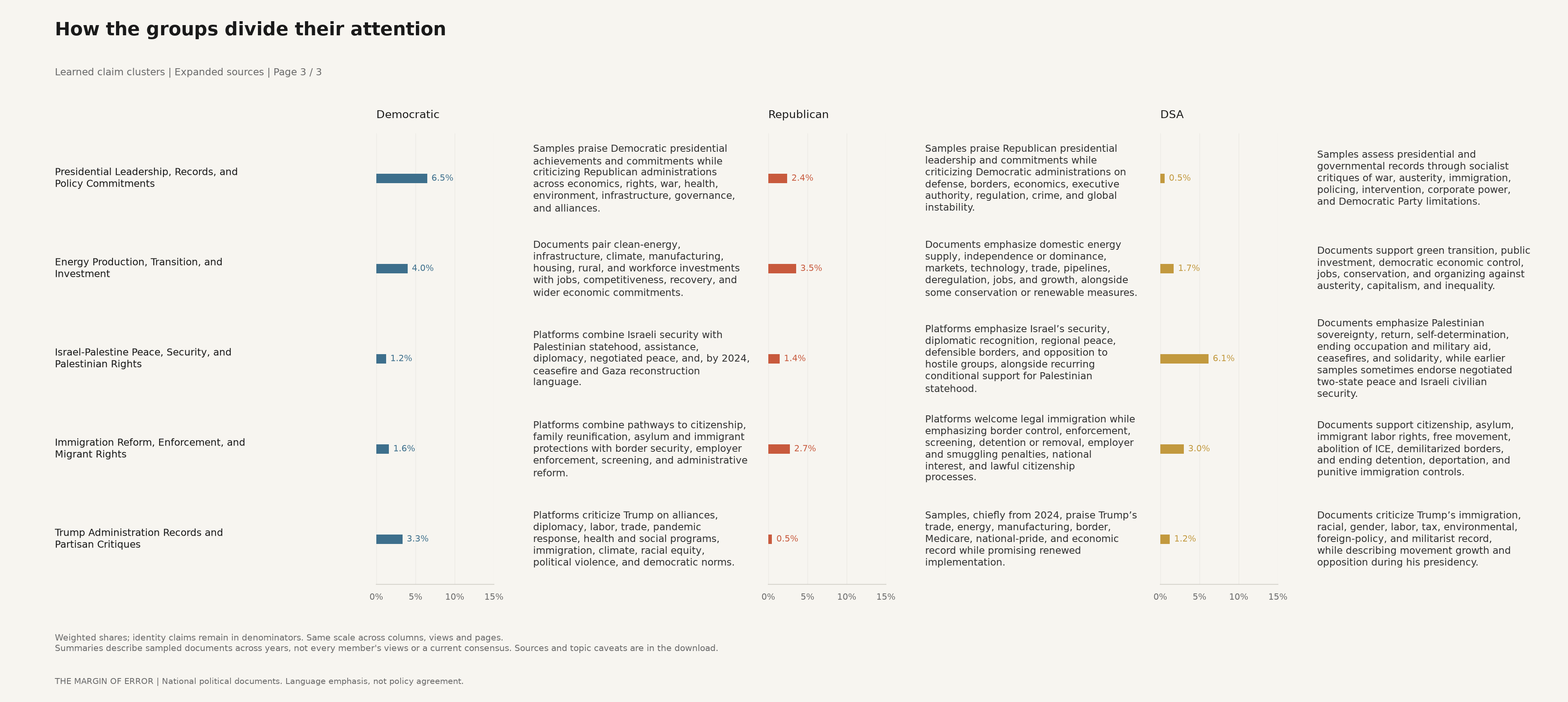
Share of attention, page 3 of 3. All organizations use the same subjects and chart scales.
The Democratic Party commits to American values, opportunity, nondiscrimination, public safety, social insurance, community strength, homeland security, and public investment. The Democratic Party supports housing, education, health, infrastructure, income, and community-development investments directed toward low-income, rural, underserved, minority, and disaster-affected communities. The Democratic Party portrays American strength through collective effort, democratic values, alliances, principled leadership, prosperity, diplomacy, and partners capable of addressing shared challenges.
The Republican Party portrays America as an exceptional leader whose military, economy, ideals, alliances, and resolve should preserve security, freedom, prosperity, and global influence. The Republican Party's sampled documents reject Democratic administrations, federal expansion, spending, judicial or executive actions, international constraints, military cuts, and selected trade, social, or security policies. The Republican Party supports safety-net providers, veterans, foster families, local partnerships, training, transportation, child care, housing, and state or community responses to need.
DSA links oppression and social conflict to capitalism, racism, austerity, anti-labor politics, police, prisons, borders, surveillance, militarism, and elites dividing working people. DSA supports rank-and-file unionism, organizing, collective bargaining, strikes, labor solidarity, universal labor rights, and worker power across workplaces and social movements. DSA supports preserving social programs, expanding housing and infrastructure, meeting material needs, and organizing for working-class, poor, disabled, minority, and neglected communities.
These are summaries of observed documents across 2000–2026, not exhaustive descriptions of current beliefs. DSA coverage includes national resolutions and statements alongside platforms/programs; periods and genres differ.
These maps compare the concentration of each organization's language in a shared semantic space. Explore the issues and source statements behind the points. Similar language does not imply the same policy position.
Hover to explore an issue. Click or tap to pin it.
Weighted policy-claim shares across 2000–2026, not language density or policy agreement. Ratios use unrounded shares; 1× means equal attention. The combined baseline gives Democrats and Republicans equal weight.
Key differences
Democratic and DSA
Both support investment and jobs; DSA more often links transition to public ownership, democratic control, and anti-capitalist restructuring.
Democrats stress transition investment, infrastructure, climate, and jobs; Republicans more often stress supply, markets, deregulation, and energy independence or dominance.
Republican and DSA
Republicans favor market-led production and supply; DSA favors public control, green transition, conservation, and democratic economic restructuring.
Party positions
Democratic Party
The Democratic Party pairs clean-energy, infrastructure, climate, manufacturing, housing, rural, and workforce investments with jobs, competitiveness, recovery, and wider economic commitments.
Supporting source statements
Some sampled commitments concern housing, trade, rural development, or investment generally rather than energy.
In 1997, the U.S. negotiated the Kyoto Protocols, an international treaty to establish a strong, realistic, and effective framework to reduce greenhouse emissions in an environmentally strong and economically sound way.
The disruption of the world's ecological systems - from the rise of global warming and the consequent damage to our climate balance, to the loss of living species and the depletion of ocean fisheries and forest habitats - continues at a frightening rate. We must act now to protect our Earth while preserving and creating jobs for our people. In 1997, we negotiated the historic Kyoto Protocols, an international treaty that will establish a strong, realistic, and effective framework to reduce greenhouse emissions in an environmentally strong and economically sound way. We are working to develop a broad international effort to take action to meet this threat. Al Gore and the Democratic Party believe we must now ratify those Protocols.
Commitment to use natural resources to fuel the economy.
Protecting public lands. We will use our natural resources to fuel our economy, but end Republican giveaways to special interests that exploit public lands without regard for environmental consequences. We will require companies to restore leased lands to their original state after their work is done. And we will make sure our government treats our national parks with the same respect and care that millions of families show each year when they visit.
Commitment to invest in advanced biofuels like cellulosic ethanol which will provide American-grown fuel and help free the United States from reliance on oil.
We'll dramatically increase the fuel efficiency of automobiles, and we'll help auto manufacturers and parts suppliers convert to build the cars and trucks of the future and their key components in the United States. And we will help workers learn the skills they need to compete in the green economy. We are committed to getting at least 25 percent of our electricity from renewable sources by 2025. Building on the innovative efforts of the private sector, states, cities, and tribes across the country, we will create new federal-local partnerships to scale the success and deployment of new energy solutions, install a smarter grid, build more efficient buildings, and use the power of federal and military purchasing programs to jumpstart promising new markets and technologies. We'll invest in advanced biofuels like cellulosic ethanol which will provide American-grown fuel and help free us from the tyranny of oil. We will use innovative measures to dramatically improve the energy efficiency of buildings.
Support for further cutting reliance on oil with increased energy efficiency in buildings, industry, and homes.
We can move towards a sustainable energy-independent future if we harness all of America's great natural resources. That means an all-of-the-above approach to developing America's many energy resources, including wind, solar, biofuels, geothermal, hydropower, nuclear, oil, clean coal, and natural gas. President Obama has encouraged innovation to reach his goal of generating 80 percent of our electricity from clean energy sources by 2035. Democrats support making America the world's leader in building a clean energy economy by extending clean energy incentives that support American businesses and American jobs in communities across the country. It's not enough to invent clean energy technologies here; we want to make them here and sell them around the world. We can further cut our reliance on oil with increased energy efficiency in buildings, industry, and homes, and through the promotion of advanced vehicles, fuel economy standards, and the greater use of natural gas in transportation. Harnessing our natural gas resources needs to be done in a safe and responsible manner, which is why the Obama administration has proposed a number of safeguards to protect against water contamination and air pollution. We will continue to advocate for the use of this clean fossil fuel, while ensuring that public and environmental health and workers' safety are protected. We support more infrastructure investment to speed the transition to cleaner fuels in the transportation sector.
Commitment to incentivize wind, solar, and other renewable energy over the development of new natural gas power plants.
We will work to expand access to cost-saving renewable energy by low-income households, create good-paying jobs in communities that have struggled with energy poverty, and oppose efforts by utilities to limit consumer choice or slow clean energy deployment. We will streamline federal permitting to accelerate the construction of new transmission lines to get low-cost renewable energy to market, and incentivize wind, solar, and other renewable energy over the development of new natural gas power plants.
Commitment to invest significant new resources in clean energy generation and distribution.
Native American tribes have for too long been forced to cope with insufficient access to health care and mental health services, nutrition services, and modern infrastructure. Democrats are committed to pursuing environmental justice and climate justice, including for Indigenous peoples and communities, and will invest significant new resources in clean water and wastewater infrastructure, clean energy generation and distribution, and sustainable and regenerative agriculture. And we will make mandatory and work toward full funding for the Indian Health Service as part of our commitment to pursuing strong nation-to-nation relationships and honoring the United States' trust obligations to Native American communities.
Commitment to eliminate tens of billions of dollars in subsidies for oil and gas companies.
Democrats oppose unfair loopholes and wasteful subsidies that benefit special interests at everyone else's expense. We will fight to get rid of them. That starts by eliminating tens of billions of dollars in subsidies for oil and gas companies. It means ending special tax breaks for corporate jets, and boosting fuel taxes on corporate and private jet travel, saving taxpayers $4 billion over 10 years. And we'll no longer permit companies to deduct the cost of paying executives more than $1 million a year. Corporations shouldn't get a tax break for giving huge pay packages to CEOs.
Republican Party
The Republican Party emphasizes domestic energy supply, independence or dominance, markets, technology, trade, pipelines, deregulation, jobs, and growth, alongside some conservation or renewable measures.
Supporting source statements
The sample also contains broader economic and national-leadership commitments.
Republicans will continue to support renewable energy through extension of the production tax credit for wind and biomass, as well as efforts to expand the use of biodiesel and ethanol, which can reduce America's dependence on foreign oil while increasing revenues to farmers.
Commitment to aggressively support technological advances to reduce petroleum dependence.
Given that fully 97 percent of our current transportation vehicles rely on oil, we will aggressively support technological advances to reduce our petroleum dependence. For example, lightweight composites could halve the weight and double the gas mileage of cars and trucks, and together with flex-fuel and electric vehicles, could usher in a renaissance in the American auto industry.
Support for promoting development of all forms of energy.
Since the current President took office in 2009, consumers pay approximately twice as much for gas at the pump. Our common theme is to promote development of all forms of energy, enable consumer choice to keep energy costs low, and ensure that America remains competitive in the global marketplace. We will respect the States' proven ability to regulate the use of hydraulic fracturing, continue development of oil and gas resources in places like the Bakken formation and Marcellus Shale, and review the environmental laws that often thwart new energy exploration and production. We salute the Republican Members of the House of Representatives for passing the Domestic Energy and Jobs Act, a vital piece of pro-growth legislation now introduced by Republicans in the Senate.
Support for the development of all forms of energy that are marketable in a free economy without subsidies, including coal, oil, natural gas, nuclear power, and hydropower.
We support the development of all forms of energy that are marketable in a free economy without subsidies, including coal, oil, natural gas, nuclear power, and hydropower. A federal judge has struck down the BLM's rule on hydraulic fracturing and we support upholding this decision. We respect the states' proven ability to regulate the use of hydraulic fracturing, methane emissions, and horizontal drilling, and we will end the Administration's disregard of the Nuclear Waste Policy Act with respect to the long-term storage of nuclear waste. We encourage the cost-effective development of renewable energy sources — wind, solar, biomass, biofuel, geothermal, and tidal energy — by private capital. The United States is overwhelmingly dependent on China and other nations for rare earth and other hardrock minerals. These minerals are critical to advanced technology, renewable energy, and defense manufacturing. We support expediting the permitting process for mineral production on public lands. We support lifting restrictions to allow responsible development of nuclear energy, including research into alternative processes like thorium nuclear energy.
Commitment to end market-distorting restrictions on oil, natural gas, and coal.
Republicans will increase Energy Production across the board, streamline permitting, and end market-distorting restrictions on Oil, Natural Gas, and Coal. The Republican Party will once again make America Energy Independent, and then Energy Dominant, lowering Energy prices even below the record lows achieved during President Trump's first term.
Democratic Socialists of America
DSA supports green transition, public investment, democratic economic control, jobs, conservation, and organizing against austerity, capitalism, and inequality.
Supporting source statements
Some samples concern movement strategy, elections, or economic restructuring beyond energy.
The development of the Gulf Coast involved billions of public dollars for the petro-chemical industry.
Progressives must organize and demand a “bottom up” recovery program that is transparent, inclusive, and fully funded—without gut- ting other important programs, particularly those that benefit the poor. Poor people’s organizations and community-based organizations need to be at the center of planning and imple- menting the recovery. Katrina has exposed the Bush regime’s hypocrisy, but we cannot say previous administrations of either party would have done better. The failure to protect New Orleans stems from political leaders taking a pass on the public investments needed to provide true social security for all citizens. The literature on the vulnerability of the Gulf region is large, sci- entifically verified and accessible; it has even been featured on NOVA TV-episodes and in National Geographic. The de- velopment of the Gulf Coast involved billions of public dol- lars for the petro-chemical industry, and later the gaming in- dustry. Flood controls that benefited agri-business and real estate interests undermined the barrier islands and marshes
The United States economy can be restructured in an ecologically sustainable direction and one that provides good jobs at good wages only if the federal government invests significantly in infrastructure development, alternative energy, and mass-transit technologies.
• DSA will join the peace movement in demanding an end to war in Afghanistan as well as Iraq and in calling for massive cuts in wasteful and misguided defense spending and for conversion from imperial war policies and arms manufacturing to those meeting domestic needs and stressing humanitarian foreign aid. • DSA will begin a public dialogue among progressives about how to restructure the United States and global econo- my so that it creates productive jobs that provide living wages for all. The United States economy can be restructured in an ecologically sustainable direction (and one that provides good jobs at good wages) only if the federal government invests significantly in infrastructure development, alternative energy, and mass-transit technologies. Only if the federal government restores an effective right to organize can a stengthened union movement force employers to pay wages and benefits that justly reward workers who labor under safe and humane working conditions. By itself, private capital has shown no willingness to take on the massive investments needed to create such new technologies nor has it been willing to recognize the rights of working people to form democratic unions. • Finally, DSA will work in 2010 to insure that progressive Democrats who support many of the above items are re- elected to Congress or replace right-wing Democratic or Republican incumbents.
A transition to renewable energy and innovation in energy productivity can continue to raise living standards.
The global climate system is in grave peril from the unrestricted use of fossil fuels that powered the industrial revolution. We are moving toward conditions incompatible with those that made human civilization possible. A transition to renewable energy and innovation in energy productivity can continue to raise living standards, but quality of life can improve even more with cultural change, in Bill McKibben’s phrase, toward “fewer belongings and more belonging.”
Investments in renewable energy and efficient technologies would be prioritized to guarantee ecological sustainability and the future existence of life on Earth.
Very large, strategically important the terms ofour national political discourse sectors ofthe economy — such as housing, in the face ofthe often overwhelming logic utilities and heavy industry — would be of “there is no alternative.” History has subject to democratic planning outside the shown time and again that societies fall market, while a market sector consisting of short of their full potential for human worker-owned and -operated firms would emancipation without radical trailblazers be developed for the production and working ceaselessly to pull mainstream distribution of many consumer goods. In political discourse to the Left and thereby this society, large-scale investments in new expandthe“politicsofthepossible.” technologiesandenterpriseswouldbemade onthe basis ofmaximizingthe public good, DemocraticSocialismasRadical Democracy DSAbelievesthatthefightfordemocratic socialismisoneandthesameasthefightfor radical democracy, which we understand as the freedom of all people to determine all aspects of their lives to the greatest extent possible.Ourvisionentailsnothinglessthan the radical democratization of all areas of rather than shareholder value. Crucially, investments in renewable energy and efficient technologies would be prioritized to guarantee ecological sustainability and thefutureexistenceoflifeonEarth. A democratic socialist society would also guarantee a wide range of social rights in ordertoensureequalityofcitizenshipforall.
[PDF page 7] 32-HOUR WORK WEEK A 32-hour work week with no reduction in pay or benefits. UNION POWER Protect all workers’ rights to strike and form a union, make it easier for workers to join unions, and invest in the National Labor Relations Board. TAX THE RICH Raise taxes on the richest earners, for-profit corporations, large inheritances, and private colleges and universities. Establish a wealth tax for the wealthiest in society. WE FIGHT FOR... AN ECONOMY FOR THE WORKING CLASS GREEN NEW DEAL Massive public investment to transition away from fossil fuels toward a green and sustainable economy. Guaranteed support for workers in the fossil fuel industry, massive infrastructure and jobs programs, and public ownership over major transportation and energy infrastructure and natural resources. 12 WORKERS DESERVE MORE! WORKERS DESERVE MORE! 13
Weighted policy-claim shares across 2000–2026, not language density or policy agreement. Ratios use unrounded shares; 1× means equal attention. The combined baseline gives Democrats and Republicans equal weight.
Key differences
Democratic and DSA
Both support housing and social investment; DSA more often frames provision through working-class power, redistribution, and universal material guarantees.
Both discuss community support; Democrats more often foreground federal investment, while Republicans more often include state, charitable, family, or public-private delivery.
Republican and DSA
Republicans include partnerships and decentralized delivery; DSA more often emphasizes expanded public provision, redistribution, and organizing around material needs.
Party positions
Democratic Party
The Democratic Party supports housing, education, health, infrastructure, income, and community-development investments directed toward low-income, rural, underserved, minority, and disaster-affected communities.
Supporting source statements
Programs and beneficiaries vary widely across years, so the sample is not one unified assistance plan.
Support for helping communities reconnect to the land around them.
That is why we support the "Better America Bonds" - tax credits for state and local bonds to build more livable communities. We must help communities reconnect to the land around them, preserve open spaces, build parks, improve water quality, and redevelop rusty old brown fields. We need to help save farms from being turned into strip malls and parks from being paved over. We should acquire new lands for urban and suburban forests and recreation sites and set aside wetlands, coastal and wildlife preserves. And it is time we enhanced our quality of life by unclogging our nation's roads and airports.
Commitment to expand use of voluntary, incentive-based programs that target private landowners.
We will conserve and restore the habitats where wildlife flourish, expanding use of voluntary, incentive-based programs that target private landowners.
Support for strengthening federal commitment to cities.
For the past eight years, the current Administration has ignored urban areas. We look forward to greater partnership with urban America. We will strengthen federal commitment to cities, including by creating a new White House Office on Urban Policy and fully funding the Community Development Block Grant. We support community-based initiatives, such as micro-loans, business assistance centers, community economic development corporations, and community development financial institutions. To help regional business development we will double federal funding for basic research, expand the deployment of broadband technology, increase access to capital for businesses in underserved areas, create a national network of public-private business incubators, and provide grants to support regional innovation clusters. Since businesses can only function when workers can get to their place of employment, we will invest in public transportation including rail, expand transportation options for low-income communities, and strengthen core infrastructure like our roads and bridges. We will provide cities the support they need to perform public safety and national security functions, reinvest in Community Oriented Policing Services, and keep children off the streets by supporting expanded after-school and summer opportunities. Finally, we will work to make cities greener and more livable by training employees to work in skilled clean technologies industries, improving the environmental efficiency of city buildings, and taking smart growth principles into account when designing transportation.
Support for expanding the successful neighborhood stabilization efforts proposed in the President’s American Jobs Act.
President Obama took swift action to stabilize a housing market in crisis, helping five million families restructure their loans to help them stay in their homes, making it easier for families to refinance their mortgages and save hundreds of dollars a month, and giving tax credits to first-time home buyers. He also cracked down on fraudulent mortgage lenders and other abuses that contributed to the housing crisis. Democrats have held the largest financial institutions accountable by requiring them to provide relief for homeowners still struggling to pay their mortgages and to change practices that took advantage of homeowners. Democrats also understand the importance of helping communities fight back against the foreclosures that threaten entire neighborhoods, which is why the President proposed to expand the successful neighborhood stabilization efforts in his American Jobs Act.
Support for directing more federal resources to lifting up communities that have been left out and left behind.
We reaffirm our commitment to eliminate poverty. Democrats will develop a national strategy, coordinated across all levels of government, to combat poverty. We will direct more federal resources to lifting up communities that have been left out and left behind, such as the 10-20-30 model, which directs 10 percent of program funds to communities where at least 20 percent of the population has been living below the poverty line for 30 years or more. We will also focus on communities that suffer from persistent poverty, including empowerment zones and areas that targeted government data indicate are in persistent poverty.
Commitment to drive increased resources to communities with the highest need, including those with the highest concentrations of low-income students, impoverished urban areas impacted by gentrification, and rural areas.
Democrats believe that all children across the United States should have access to high-quality early childhood education programs. We will work with states to offer pre-K for all three- and four-year-olds and expand Head Start and Early Head Start. We will drive increased resources to the communities with the highest need, including those with the highest concentrations of low-income students, impoverished urban areas impacted by gentrification, and rural areas, and will strive to support holistic school readiness. We also will ensure students with disabilities and English language learners have access to and are fully included in early childhood programs.
Commitment to increase funding for programs that support the creation and preservation of affordable housing options for essential workers.
Democrats are dedicated to increasing the supply of an array of housing options like duplexes, triplexes, and townhomes that bridge the gap between single-family homes and large apartment buildings. By reducing barriers to building housing and providing federal tax incentives for the development of housing for people of all incomes, we can foster vibrant, inclusive communities where people from all walks of life can find affordable, diverse living options. Workforce housing must also be prioritized to ensure that our nation's teachers, nurses, firefighters, and other essential workers can afford to live in the communities they serve. We recognize that these workers are the backbone of our society, but they are left to struggle with housing costs that outpace their incomes, leaving them unable to live near their workplaces. Democrats will meet this challenge head-on by increasing funding for programs that support the creation and preservation of affordable housing options for essential workers, as well as collaborating with state and local governments to accelerate the development of workforce housing, ensuring that our communities remain accessible and affordable for all.
Republican Party
The Republican Party supports safety-net providers, veterans, foster families, local partnerships, training, transportation, child care, housing, and state or community responses to need.
Supporting source statements
Approaches range from public programs to partnerships, charities, and state-led delivery.
Commitment to establish stronger public-private partnerships for safety net providers and hospitals in rural and underserved communities.
One area of health care that is sadly ignored is the role of primary and preventive care. This is particularly important in our inner cities and rural communities, where the emergency room may be the only avenue for assistance. People in rural and underserved areas need access to critical primary care. We will boost funding for community health centers and establish stronger public-private partnerships for safety net providers and hospitals in rural and underserved communities.
Support for offering training, transportation, and child care services to help people become self-sufficient.
We endorse President Bush's plan to extend the benefits of welfare reform by strengthening work requirements and promoting healthy marriages, and offering training, transportation, and child care services to help people become self-sufficient. Every American deserves a chance to know the pride of earning a paycheck and providing for his or her family.
Although the Constitution assigns the federal government no role in local education, Washington's authority over the nation's schools has increased dramatically. In less than a decade, annual federal funding has shot up 41 percent to almost $25 billion, while the regulatory burden on state and local governments has risen by about 6.7 million hours — and added $141 million in costs — during that time. We call for a review of Department of Education programs and administration to identify and eliminate ineffective programs, to respect the role of states, and to better meet state needs.
Support for ensuring equitable participation in federal programs by American Indians, including Alaska Natives, and Native Hawaiians.
We support efforts to ensure equitable participation in federal programs by American Indians, including Alaska Natives, and Native Hawaiians and to preserve their culture and languages that we consider to be national treasures. Lastly, we recognize that American Indians have responded to the call for military service in percentage numbers far greater than have other groups of Americans. We honor that commitment, loyalty, and sacrifice of all American Indians serving in the military today and in years past and will ensure that all veterans and their families receive the care and respect they have earned through their loyal service to America.
Support for encouraging efforts to reclaim communities from the culture of poverty.
We call for removal of structural impediments which progressives throw in the path of poor people: Over-regulation of start-up enterprises, excessive licensing requirements, needless restrictions on formation of schools and day-care centers serving neighborhood families, and restrictions on providing public services in fields like transport and sanitation that close the opportunity door to all but a favored few. We will continue our fight for school choice until all parents can find good, safe schools for their children. To protect religious liberty we will ensure that faith-based institutions, especially those that are vital parts of underserved neighborhoods, do not face discrimination by government. We propose new partnerships between those who manage federal programs and those who are on the front lines of fighting poverty on the ground. We must encourage their efforts to reclaim their communities from the culture of poverty. To advance this process, we urge greater state and local responsibility for, and control over, public assistance programs.
Commitment to support increased focus on Benefit flexibility.
Republicans will support increased focus on Chronic Disease prevention and management, Long-Term Care, and Benefit flexibility. We will expand access to Primary Care and support Policies that help Seniors remain in their homes and maintain Financial Security.
Democratic Socialists of America
DSA supports preserving social programs, expanding housing and infrastructure, meeting material needs, and organizing for working-class, poor, disabled, minority, and neglected communities.
Supporting source statements
Some examples are movement priorities or broad redistributive commitments rather than program designs.
Support will be given to measures in the upcoming legislative fight around renewing welfare reform that will aid the poor and not punish them.
Our Priorities For most of history our main focus has been on domestic policies and chc inequalities endemic in our sociery. Thac shall remain our main focus. \X'e shall concencrare mosr of our resource~ on issues and campaigns relat- ed ro injustices faced by low-wage workers in America. \X!e shall support campaigns to raise the minimum wage and to legislate a "living wage." We shall continue our support of union organizing efforts and support meas- ures in the upcoming legislative fight around renewing "welfare reform'' char will aid che poor and noc punish chem. We will concinue our work ro defend Mcdican.: anc..l Social Security. And we will engage in visible, pub- lic activity aimed at educating rhe American public abour the systematic inequalities of our economy. This campaign will be begin with a confer- ence highlighting the 40th Anniversary of che publicacion of The Od1er An1crica and the plighc of the working poor poignanclr depicted in Barbara Ehrenrcich's, Nickel and Dimed. Bue this campaign will be much more rhan a Wasbingcon cvenc. We will rake our message co local com- munities in events and activist campaigns organized over the ncxc cwo years. Recognizing our organizational limitations, we will focus our resources, 10 the near term on enhancing our capacity for political educa- tion and analysis through forums, speaker tours, rctn.~ats. chink-ranks and publications, pa~sing ouc liceracure.
Commitment for DSA's NPC and national office to continue providing resources and information for local living-wage campaigns, immigrant-justice activism and labor support.
Convention Resolution: DSA Priorities 1. The Low-Wage Justice Project Since 2001 the national organization has focused our political work on combating global capitalism’s ‘race-to-the- bottom’ development strategy. This ‘Walmart-ization’ of the global economy has depressed the quality of life of the world’s working people, including those residing in the United States. DSA has “added value” at the national and local levels through efforts to build the community component of a citizen-labor alliance to fight the low-wage economy, which also negates the conservative argument that organized labor’s efforts are ‘self-interested’. DSA has engaged in public political education aimed at illustrating that ‘Walmart-ization’ is not caused by the actions of one particular rapacious corporation but by a systemic and irrational model of global capitalist development. As an al- ternative, DSA has highlighted local, national, and transnational efforts to construct an alternative model of fair trade, global labor and human rights, and equitable develop- ment strategies. Therefore, this convention endorses a continuation and deepening of the organizational focus and coordinated activ- ism that the “Low Wage Justice” campaign (initiated at the 2001 DSA convention) has brought to the organization. In particular, the focus on Wal-Mart, as an exemplar of the cor- porate “race-to-the-bottom” economic strategy, will continue. Thus, this convention commits itself to: a. The DSA NPC and national office continuing to pro- vide resources and information to aid locals in living wage campaigns, immigrant justice activism, and labor support work.
Support for building the capacity of locals, commissions, networks, and activists to take a proactive role in both visible public education and credible political action.
Facilitate the transition of YDS activists into leadership roles in the adult organization when they graduate or leave campus. c. Build the capacity of our locals, commissions, networks, and activists to take a pro-active role in both visible public education and credible political action. d. Modernize the on-line capacity of the organization and its use of new communication technologies in general. Democratic Left • Winter 2009 • page 5
Government should promote alternative forms of housing ownership—co-ops, nonprofit and community development corporations—that would also be committed to revitalizing communities.
A progressive approach to housing affordability, in contrast, would treat housing as a social good rather than as a profit-producing commodity. Government should promote alternative forms of housing owner- ship — co-ops, nonprofit and community development corporations — that would also be committed to revitalizing communities. Despite being much maligned, public housing has served more low income tenants than any single program and should therefore remain a core element of housing policy. In order to meet the housing affordability crisis, all public housing units should be replaced with new units at no less than a one-to-one basis.
Commitment to devote more resources to developing new leaders through individual mentoring, skills training, and educational programming.
[PDF page 12] time. In order to take advantage of this potential, DSA chapters will use a range of tactics to help expand our activist and membership base. First, we will place a greater emphasis on our critique of capitalism andpositive vision ofdemocratic socialism in our coalition, public education and community organizing work. We will also devote more resources to developing new leaders through individual mentoring, skills training and educational programming. Finally, we will engage in regular and intensive assessments of our organizational progress, while always working to recruit as many new members fromadiverseanarrayofbackgrounds. Success across this spectrum ofstruggles should lead to a period when we can talk seriouslyabout the transition to democratic socialism through reforms that fundamentally undermine the power ofthe capitalist system (often referred to as “non- reformist reforms”), such as the nationalization of strategic industries (banking, auto, etc.) and the creation of worker-controlledinvestmentfunds(created bytaxingcorporateprofits) thatwillbuyout capitalist stakes in firms and set up worker- JOINUS! ownedand-operatedfirms onalarge scale. While it may sound premature to begin discussing such long-term objectives before we have achievedourmore modest(though ambitious)short-termgoals,itiscriticalthat we advance a clear vision of our short-, medium- and long-term objectives and a credible account of how we might move from each stage of struggle to the next (moredetailsrelatedto thisquestioncanbe foundinDSA’sstrategydocument).Ifweare not clear about where we are heading, we risk both losing track ofthe importance of our socialist identity and making strategic errors for the sake of short-term tactical gains.
Support for securing adequate compensation and living standards, as well as effective infrastructure, healthcare, and institutions in communities and abroad.
We propose a program of transformative regulation, nationalization, social ownership, and internationalism that builds the solidarity and democratic power necessary for us to succeed. We call for the nationalization of businesses like utilities and critical manufacturing and technology companies, alongside regulation of corporate, communications, data, and financial sectors. We seek to ensure social and worker control over these businesses. We support an expansion of worker cooperatives, mutual aid institutions, cooperative media, physical infrastructure, care work, and collective land ownership. To ensure the well-being of everyone, we also must secure adequate compensation and living standards, as well as effective infrastructure, healthcare, and institutions in our communities and abroad. We can fund much of this through public development and retail banks, socialized government finance, and taxing the rich and corporations. Wealth taxes, increased progressive income tax rates on the highest earners, and increased estate taxes can redistribute wealth from the billionaires who hoard it to the workers who made it.
Support for massive infrastructure and jobs programs.
[PDF page 7] 32-HOUR WORK WEEK A 32-hour work week with no reduction in pay or benefits. UNION POWER Protect all workers’ rights to strike and form a union, make it easier for workers to join unions, and invest in the National Labor Relations Board. TAX THE RICH Raise taxes on the richest earners, for-profit corporations, large inheritances, and private colleges and universities. Establish a wealth tax for the wealthiest in society. WE FIGHT FOR... AN ECONOMY FOR THE WORKING CLASS GREEN NEW DEAL Massive public investment to transition away from fossil fuels toward a green and sustainable economy. Guaranteed support for workers in the fossil fuel industry, massive infrastructure and jobs programs, and public ownership over major transportation and energy infrastructure and natural resources. 12 WORKERS DESERVE MORE! WORKERS DESERVE MORE! 13
Labor Rights, Unionization, and Worker Protections
Weighted policy-claim shares across 2000–2026, not language density or policy agreement. Ratios use unrounded shares; 1× means equal attention. The combined baseline gives Democrats and Republicans equal weight.
Key differences
Democratic and DSA
Both support unions and organizing; DSA more often stresses rank-and-file power, strikes, solidarity, and broader working-class transformation.
Democrats generally favor stronger bargaining and organizing rights; Republicans more often emphasize right-to-work, secret ballots, union accountability, and worker choice.
Republican and DSA
Republicans more often constrain union authority or stress individual choice; DSA emphasizes collective power, strikes, solidarity, and expansive organizing rights.
Party positions
Democratic Party
The Democratic Party supports unions, collective bargaining, organizing rights, higher wages, labor-law enforcement, safer workplaces, and protections for workers excluded from existing rules.
Supporting source statements
Specific mechanisms and covered workers differ across platform years.
Support for fair treatment of temporary, part-time and contract workers, including the wages and benefits appropriate to the work they perform.
We know that even as the economy changes and expands, millions of workers will continue to labor in jobs that pay low wages and may not require significant education or skills. Many of these workers are women, people of color, or recent immigrants. These workers provide invaluable services to American society and their work has great dignity. Democrats are committed to ensuring that these workers - no less than their counterparts in more highly-skilled, better paid positions - are treated with dignity, respect, and fairness on the job. Democrats also believe that workers in temporary, part-time, and contract jobs should be treated fairly and earn the wages and benefits they deserve because of the jobs they do.
Support for reforming labor laws to protect the rights of workers, including public employees, to bargain contracts and organize on a level playing field without interference.
Standing up for workers. We will ensure that the right to organize a union exists in the real world, not just on paper, because that's how we create more jobs that can support families. That means reforming our labor laws to protect the rights of workers (including public employees) to bargain contracts and organize on a level playing field without interference. It also means barring the permanent replacement of legal strikers. And we will of course reverse this Administration's cuts in wages for working people by restoring overtime protections for hard-working Americans. We will strengthen health and safety protections as well.
Commitment to allow unions to organize and lift up workers.
Working together, we can cut poverty in half within ten years. We will provide all our children a world-class education, from early childhood through college. We will develop innovative transitional job programs that place unemployed people into temporary jobs and train them for permanent ones. To help workers share in our country's productivity, we'll expand the Earned Income Tax Credit, and raise the minimum wage and index it to inflation. The majority of adults in poverty are women, and to combat poverty we must work for fair pay, support for mothers, and policies that promote responsible fatherhood. We'll start letting our unions do what they do best again—organize and lift up our workers. We'll make sure that every American has affordable health care that stays with them no matter what happens. We will assist American Indian communities, since 10 of the 20 poorest counties in the United States are on Indian lands. We'll bring businesses back to our inner-cities, increase the supply of affordable housing, and establish "promise neighborhoods" that provide comprehensive services in areas of concentrated poverty. These will be based on proven models, such as the Harlem Children's Zone in New York City, which seeks to engage all residents with tangible goals such as attendance at parenting schools, retention of meaningful employment, college for every participating student, and strong physical and mental health outcomes for children.
Commitment to fight for labor laws that facilitate the collective bargaining process.
Democrats believe that the right to organize and collectively bargain is a fundamental American value; every American should have a voice on the job and a chance to negotiate for a fair day's pay after a hard day's work. We will continue to fight for the right of all workers to organize and join a union. Unions helped build the greatest middle class the world has ever known. Their work resulted in the 40-hour workweek and weekends, paid leave and pensions, the minimum wage and health insurance, and Social Security and Medicare - the cornerstones of middle class security. We will fight for labor laws that provide a fair process for workers to choose union representation, that facilitate the collective bargaining process, and that strengthen remedies for violations of the law. We will fight for collective bargaining rights for police officers, nurses, firefighters, emergency medical technicians, teachers, and other public sector workers - jobs that are a proven path to the middle class for millions of Americans. We will continue to vigorously oppose “Right to Work” and “paycheck protection” efforts, and so-called “Save our Secret Ballot” measures whenever they are proposed.
Commitment to make it easier for public and private workers to exercise their right to organize and join unions.
The Democratic Party believes that when workers are strong, America is strong. Democrats will make it easier for workers, public and private, to exercise their right to organize and join unions. We will fight to pass laws that direct the National Labor Relations Board to certify a union if a simple majority of eligible workers sign valid authorization cards, as well as laws that bring companies to the negotiating table. We support binding arbitration to help workers who have voted to join a union reach a first contract.
Commitment to fight to raise wages for working people and improve job quality and security.
Democrats will fight to raise wages for working people and improve job quality and security, including by raising the federal minimum wage so it reaches $15 an hour by 2026. Raising the federal minimum wage, so fewer workers are forced to hold down multiple jobs to make ends meet, will significantly decrease risks of infection from COVID-19 and in the future. We know that strong American labor unions help increase wages and job standards for workers across the economy, which is why Democrats will prioritize passing the PRO Act and restoring workers' rights, including the right to launch secondary boycotts. We will repeal so-called "right to work" laws that undermine worker power and lead to lower wages and less protection for workers across the economy, and ensure those who have been left without wage and hour protections for decades—including domestic workers and farmworkers—have the same rights as other workers. Democrats will support legislation to strengthen whistleblower and anti-retaliation protections for workers who speak for themselves or their coworkers. And we will take action to rein in anti-competitive corporate power by rewriting the rules that have undermined workers' ability to advocate for themselves, including non-compete clauses, no-poaching agreements, and contracts that force workers into mandatory arbitration to resolve violations of employment laws.
Support for codifying a right to organize for domestic workers, farm workers, and other unprotected laborers.
Democrats will keep fighting to pass the Protecting the Right to Organize (PRO) Act, to give everyone the right to organize for better pay, benefits, and working conditions, and to hold abusive bosses accountable for violating workers' rights. We oppose state right-to-work laws, which drive down wages and leave workers unsafe; and we support penalizing employers who engage in union busting. We'll work to pass the Public Service Freedom to Negotiate Act, guaranteeing public sector bargaining rights; and to codify a right to organize for domestic workers, farm workers, and other unprotected laborers. Democrats will continue to create strong labor standards for jobs created with taxpayer dollars through legislation and with strong Buy American rules. Consistent with the law, we will ensure that federal grants and other assistance to employers are contingent on recipients committing to not interfering with workers' efforts to form a union. By leveraging the benefits of federal grants for infrastructure, manufacturing and services, we will seek to ensure that all Americans have the opportunity to participate in the American Dream.
Republican Party
The Republican Party emphasizes right-to-work, secret-ballot union elections, union financial accountability, worker choice, job creation, and selected workplace or compensation protections.
Supporting source statements
The sample combines limits on union power with some worker-protection measures.
Support for the right of states to enact Right-to-Work laws.
We affirm the right of individuals to voluntarily participate in labor organizations and to bargain collectively. We therefore support the right of states to enact Right-to-Work laws. No one should be forced to contribute to a campaign or a candidate, so we will vigorously implement the Supreme Court's Beck decision to stop the involuntary use of union dues for political purposes. We will revoke the illegal executive order excluding millions of workers from federal contracts, and safeguard the unemployment compensation system against the diversion of its funds for political purposes.
Support for the right of states to enact Right-to-Work laws.
We affirm the time-honored right of individuals to voluntarily participate in labor organizations and to bargain collectively. We also believe that no American should be coerced into an association they do not wish to join. And no one should be kept out of a job for which they are qualified simply because they choose to remain independent of labor unions. We therefore support the right of states to enact Right-to-Work laws.
Advocacy for modernization of the nation's labor laws to make it easier for employers and employees to plan, execute, and profit together.
We affirm both the right of individuals to voluntarily participate in labor organizations and bargain collectively and the right of states to enact Right-to- Work laws. But the nation's labor laws, to a large extent formed out of conflicts several generations ago, should be modernized to make it easier for employers and employees to plan, execute, and profit together. To protect workers from misuse of their funds, we will conscientiously enforce federal law requiring financial reporting and transparency by labor unions. We advocate paycheck protection laws to guard the integrity of the political process and the security of workers' earnings.
Support the enactment of a National Right-to-Work law to promote worker freedom and greater economic liberty.
We will restore the rule of law to labor law by blocking "card check," enacting the Secret Ballot Protection Act, enforcing the Hobbs Act against labor violence, and passing the Raise Act to allow all workers to receive well-earned raises without the approval of their union representative. We demand an end to the Project Labor Agreements; and we call for repeal of the Davis-Bacon Act, which costs the taxpayers billions of dollars annually in artificially high wages on government projects. We support the right of States to enact Right-to-Work laws and encourage them to do so to promote greater economic liberty. Ultimately, we support the enactment of a National Right-to-Work law to promote worker freedom and to promote greater economic liberty. We will aggressively enforce the recent decision by the Supreme Court barring the use of union dues for political purposes without the consent of the worker.
Commitment to encourage trends by bringing labor law into the 21st century.
We intend to encourage those trends by bringing labor law into the 21st century. It should encourage cooperation between management and workers, not conflict. All workers, including union members, must be free to accept raises and rewards without veto power from union officials. All unionized workers should be able to find out what is going on in their union trust funds and in their executive compensation. We support the right of states to enact Right-to-Work laws and call for a national law to protect the economic liberty of the modern workforce.
Republicans will promote a Culture that values the Sanctity of Marriage, the blessings of childhood, the foundational role of families, and supports working parents. We will end policies that punish families.
Democratic Socialists of America
DSA supports rank-and-file unionism, organizing, collective bargaining, strikes, labor solidarity, universal labor rights, and worker power across workplaces and social movements.
Supporting source statements
Several examples are organizing strategies or solidarity resolutions rather than legislative proposals.
Continued support will be given to union organizing efforts.
Our Priorities For most of history our main focus has been on domestic policies and chc inequalities endemic in our sociery. Thac shall remain our main focus. \X'e shall concencrare mosr of our resource~ on issues and campaigns relat- ed ro injustices faced by low-wage workers in America. \X!e shall support campaigns to raise the minimum wage and to legislate a "living wage." We shall continue our support of union organizing efforts and support meas- ures in the upcoming legislative fight around renewing "welfare reform'' char will aid che poor and noc punish chem. We will concinue our work ro defend Mcdican.: anc..l Social Security. And we will engage in visible, pub- lic activity aimed at educating rhe American public abour the systematic inequalities of our economy. This campaign will be begin with a confer- ence highlighting the 40th Anniversary of che publicacion of The Od1er An1crica and the plighc of the working poor poignanclr depicted in Barbara Ehrenrcich's, Nickel and Dimed. Bue this campaign will be much more rhan a Wasbingcon cvenc. We will rake our message co local com- munities in events and activist campaigns organized over the ncxc cwo years. Recognizing our organizational limitations, we will focus our resources, 10 the near term on enhancing our capacity for political educa- tion and analysis through forums, speaker tours, rctn.~ats. chink-ranks and publications, pa~sing ouc liceracure.
Support for workers on both sides of the Green Line, but not their reactionary political leaderships.
[PDF page 3] “blank check.” Despite the horrific Israeli occupation, no mainstream politi- cians have the courage or foresight to call for the end of U.S. military aid to Israel, a cessation that should last until Israel ends all illegal settlement activity and demonstrates a renewed willingness to trade land for peace. The militarization of Israeli society is complemented by right-wing-backed free market “reforms,”austerity measures and other blatant attacks on workers’ living standards.These have made Israel less secure, vulnerable not just from physical assault by external enemies but from a self-induced crisis economy. The recent massive public workers strike, led by the Histadrut Labour Federation – the third nationwide strike in 18 months – is a direct outcome of the government’s iron-wall intransigence, the accumulated financial burden of maintaining Israel as a garrison state, and efforts by the Likud-led government to ruthlessly privatize Israel’s public sector. Similarly, the continued violence buttresses the role of the most regressive elements in Palestinian society, at the expense of the emergence of a secular, progressive leadership. As socialists, DSA supports workers on both sides of the Green Line, and not their reac- tionary political leaderships. The pro-peace and labor forces in both Palestine and Israel are the seg- ments of the region’s societies with which we politically identify and from which we draw strength.They cannot succeed absent the aid of the interna- tional community. Only a U.S.
Support for continuing to work with labor and its allies to pass meaningful labor law reform that would restore a real right to organize and strike and ensure that the NLRB enforces these laws.
Joining progressive forces fighting for a new round of massive federal financial aid to state, county, and municipal governments. Only by such measures can essential public services be maintained and massive deflationary layoffs be avoided. 3. Holding public hearings on an Economic Bill of Rights, to be developed in conjunction with our allies, and using the Economic Justice Agenda as a starting point. 4. Continuing to work with labor and its allies to pass meaningful labor law reform that would restore a real right to organize and strike and ensure that the NLRB enforces these laws. In particular, we will work to pass the Employee Free Choice Act, with an emphasis on encouraging our coalition partners in the non-labor left to understand the impor- tance of rebuilding the labor movement as a vital element in progressing on all our issues. Furthermore: (A section on Immigration Reform will be added later by the NPC) • DSA reasserts its commitment to passing single-payer health care legislation at either the federal or state level. page 4 • Democratic Left • Winter 2003 page 4 • Democratic Left • Winter 2009
The Employee Free Choice Act (EFCA) would restore the original intent of the National Labor Relations Board (NLRB) by permitting workers to choose union representation without fear and intimidation.
The Employee Free Choice Act (EFCA) would restore the original intent of the NLRB by permitting workers to choose union representation without fear and intimidation. If a majority of workers demonstrated their choice to form a union, it would be certified without a delay-ridden and coercive election process. Employer stonewalling on negotiating a first collective agreement could trigger an arbitration process. Penalties for serious abuses of workers’ rights to organize would be stiffened.
Commitment to stand in solidarity with movements around the world fighting to raise global labor, environmental, and human rights standards in opposition to corporate “race to the bottom” policies.
DSA will stand in solidarity with movements around the world fighting to raise global labor, environmental, and human rights standards in opposition to corporate“racetothebottom”policies.Such solidarity often will take the form of opposing our government’s own foreign policy, which supports undemocratic international institutions (including pro- corporate “free trade agreements”), and which backs, often through military intervention, authoritarian regimes that support U.S. government and economic interests. BuildingDSAandtheSocialistLeft DSA’s role in building progressive social movements is essential to our work; regardless of what we gain as an organization from this work, it is an end in itself. Additionally, through our coalition work and community organizing we learn invaluable organizing skills and discover countless ways to improve the workthatwe do. However, in order to be effective in this work, as well as to build broader-based, "Weneedtodramaticallyincreasetheranksof thesocialistmovementintheUnitedStates."independent socialist organizations that we hope will grow over time into a powerful political force, we need to dramatically increasetheranksofthesocialistmovement in the United States. While DSA has expanded significantly since 2010, there is stilltremendousroomforgrowth,especially inthe wake ofSanders’ PoliticalRevolution, which exposed countless young people to theideaofdemocraticsocialismforthefirst
Support for labor rights for all, regardless of immigration status.
Labor rights for all, regardless of immigration status, and inclusion of farm workers, street vendors, day laborers, and domestic workers under National Labor Relations Board legal protections
Support for protecting all workers’ rights to strike and form a union.
[PDF page 7] 32-HOUR WORK WEEK A 32-hour work week with no reduction in pay or benefits. UNION POWER Protect all workers’ rights to strike and form a union, make it easier for workers to join unions, and invest in the National Labor Relations Board. TAX THE RICH Raise taxes on the richest earners, for-profit corporations, large inheritances, and private colleges and universities. Establish a wealth tax for the wealthiest in society. WE FIGHT FOR... AN ECONOMY FOR THE WORKING CLASS GREEN NEW DEAL Massive public investment to transition away from fossil fuels toward a green and sustainable economy. Guaranteed support for workers in the fossil fuel industry, massive infrastructure and jobs programs, and public ownership over major transportation and energy infrastructure and natural resources. 12 WORKERS DESERVE MORE! WORKERS DESERVE MORE! 13
Economic Prosperity Narratives and Development Models
Weighted policy-claim shares across 2000–2026, not language density or policy agreement. Ratios use unrounded shares; 1× means equal attention. The combined baseline gives Democrats and Republicans equal weight.
Key differences
Democratic and DSA
Democrats generally frame inclusive growth within existing institutions; DSA more often critiques capitalism and advances democratic planning, redistribution, and socialist alternatives.
Democrats more often credit investment and inclusion; Republicans more often credit markets, trade, tax reductions, deregulation, and resource development.
Republican and DSA
Republicans foreground market freedom and private enterprise; DSA foregrounds capitalist inequality, public control, democratic planning, and production for human needs.
Party positions
Democratic Party
The Democratic Party connects prosperity to public investment, infrastructure, manufacturing, education, inclusion, innovation, fair growth, and records attributed to Democratic administrations.
Supporting source statements
The sample mixes causal narratives, administration records, and policy commitments.
But ours is a record to build on, not to rest on. That's because eight years later, we face a new challenge: how to keep prosperity alive - and how to deepen it - in a fast-moving, fast-changing economy. We can never take our economic prosperity for granted nor can we afford to go back to either tax-and-spend or cut-and-run - the failed policies of the past. It took innovative, new Democratic policies to create the environment where prosperity could bloom. It will take more such policies to allow prosperity to blossom - to forge a prosperity that does not leave anyone out and does not leave anyone behind.
When the middle class grows in size and security, the country gets stronger.
The heart of the American promise has always been the middle class, the greatest engine of economic growth the world has ever known. When the middle class grows in size and security, our country gets stronger. And when more American families save and invest in their children's future, America grows stronger still.
Belief that the benefits of open markets should be shared more equitably.
We believe that trade should strengthen the American economy and create more American jobs, while also laying a foundation for democratic, equitable, and sustainable growth around the world. Trade has been a cornerstone of our growth and global development, but we will not be able to sustain this growth if it favors the few rather than the many. We must build on the wealth that open markets have created, and share its benefits more equitably.
President Obama and Democrats around the country are fighting back from the deepest economic crisis since the Great Depression by laying the foundations for an economy that out-educates, out-builds, and out-innovates the rest of the world.
The United States continues to move forward towards a future of strong and sustained growth. Thanks to the leadership of President Obama and Democrats around the country, we're fighting back from the deepest economic crisis since the Great Depression by making investments to create jobs, grow the middle class, and lay the foundations for an economy that out-educates, out-builds, and out-innovates the rest of the world. Today, America is both stronger and safer than it was four years ago. Now, we must continue the work we've started so that the United States of America never fails to meet the tests of our time.
When women and girls are healthy, educated, and able to participate economically, their families and communities prosper, poverty decreases, and economies grow.
We believe the United States must continue to be a strong advocate for the rights and opportunities of women and girls around the world. Elevating their status is not just the right thing to do—it is also a strategic imperative that advances American interests in prosperity and stability. When women and girls are healthy, educated, and able to participate economically, their families and communities prosper, poverty decreases, and economies grow. And when women participate in conflict resolution and post-conflict processes, it improves the likelihood of securing sustainable peace. Democrats are committed to advancing the rights and opportunities of women and girls as a central focus of American diplomacy, development, and defense efforts and will continue to support the United States National Action Plan on Women, Peace, and Security. We will work to end the epidemic of gender-based violence around the world. We will urge ratification of the Convention for the Elimination of All Forms of Discrimination Against Women.
Evidence-based investments in jobs, housing, education, and the arts will make the nation freer.
It is past time to end the failed "War on Drugs," which has imprisoned millions of Americans—disproportionately Black people and Latinos—and hasn't been effective in reducing drug use. Democrats support policies that will reorient our public safety approach toward prevention, and away from over-policing—including by making evidence-based investments in jobs, housing, education, and the arts that will make our nation fairer, freer, and more prosperous.
When women and girls are healthy, educated, and able to participate economically, their families and communities prosper, poverty decreases, and economies grow.
President Biden believes the United States must continue to be a strong advocate for the rights and opportunities of women and girls around the world. Under his leadership, the United States issued its first-ever National Strategy on Gender Equity and Equality, which recognizes that elevating the status of women and girls is not just the right thing to do – it is a strategic imperative that advances American interests in prosperity and stability. When women and girls are healthy, educated, and able to participate economically, their families and communities prosper, poverty decreases, and economies grow. And when women participate in conflict resolution and post-conflict processes, it improves the likelihood of securing sustainable peace.
Republican Party
The Republican Party connects growth to markets, trade, lower taxes, deregulation, resource development, entrepreneurship, and economic freedom, often contrasting these with government intervention.
Supporting source statements
Some claims are retrospective or rhetorical rather than specific proposals.
Cutting tax rates, simplifying the tax code, deregulating industries, and opening world markets to American enterprise resulted in tremendous growth in the 1980s.
Twenty years ago, the economy was in shambles. Unemployment was at 7.1 percent, inflation at 13.5 percent, and interest rates at 15.3 percent. The Democratic Party accepted that malaise as the price the nation had to pay for Big Government, and in so doing lost the confidence of the American people. Inspired by Presidents Reagan and Bush, Republicans hammered into place the framework for today's prosperity and surpluses. We cut tax rates, simplified the tax code, deregulated industries, and opened world markets to American enterprise. The result was the tremendous growth in the 1980s that created the venture capital to launch the technology revolution of the 1990s.
Economic growth allows people to lift their lives out of poverty.
Republicans know that a strong world economy enhances our national security by advancing prosperity and freedom in the rest of the world. Economic growth supported by free trade and free markets creates new jobs and higher incomes. It allows people to lift their lives out of poverty, spurs economic and legal reform, enhances the fight against corruption, and reinforces the habits of liberty.
Belief in the free market as the best tool to sustained prosperity and opportunity for all.
Homeownership remains key to creating an opportunity society. We support timely and carefully targeted aid to those hurt by the housing crisis so that affected individuals can have a chance to trade a burdensome mortgage for a manageable loan that reflects their home's market value. At the same time, government action must not implicitly encourage anyone to borrow more than they can afford to repay. We support energetic federal investigation and, where appropriate, prosecution of criminal wrongdoing in the mortgage industry and investment sector. We do not support government bailouts of private institutions. Government interference in the markets exacerbates problems in the marketplace and causes the free market to take longer to correct itself. We believe in the free market as the best tool to sustained prosperity and opportunity for all. We encourage potential buyers to work in concert with the lending community to educate themselves about the responsibilities of purchasing a home, condo, or land.
Prosperity provides the means by which individuals and families can maintain their independence from government.
We are the party of maximum economic freedom and the prosperity freedom makes possible. Prosperity is the product of self-discipline, work, savings, and investment by individual Americans, but it is not an end in itself. Prosperity provides the means by which individuals and families can maintain their independence from government, raise their children by their own values, practice their faith, and build communities of self-reliant neighbors. It is also the means by which the United States is able to assert global leadership. The vigor of our economy makes possible our military strength and is critical to our national security.
A stronger private sector in U.S. territories can reduce dependence on public employment and lead toward self-sufficiency.
We recognize the challenges facing all the U.S. territories in an era of dramatic global economic change. They need venture capital to retain existing industries and develop new ones. A stronger private sector can reduce dependence on public employment and lead toward self-sufficiency. Their development of local energy options will be crucial to reduce dependence on costly imported fuel.
Support for defeating inflation and quickly bringing down all prices.
1. DEFEAT INFLATION, AND QUICKLY BRING DOWN ALL PRICES.
Democratic Socialists of America
DSA critiques capitalist growth and inequality while supporting democratic planning, public investment, redistribution, labor power, and socialist alternatives organized around human needs.
Supporting source statements
The sample spans critique, strategy, and long-term visions rather than one development program.
The economic expansion of the last decade primarily benefited the well-off.
National Priori.ties Resolution Introduction We meer in Philadelphia at a rime of national crisis. The great economic expansion of the lase decade, an expan- sion that primarily benefired the well off. is over. The economic recession will incrc::ase already morally unacceptable levels of inequality by worsening the conditions of low-wage workers and threatening the living standards of the middle class. Americans have been subject co ter- rorist arcacl<s and are deeply concerned about the security of their fumilies and
The critique of individualist marketplace ideology and the defense of social solidarity and public provision are only coherently done by socialists.
3. Public Socialist Education A staple of viable DSA locals and campus chapters has been visible, well-publicized socialist education. Socialists understand that ideological struggle is political work, and that socialist agitation and education must focus on the health and perspectives of movements opposing corporate domination as well as “imagining” socialism and sketching what a better world would look like. Over the past few years, however, particularly on cam- pus and areas where DSA has numerous members but weak (or no-longer existing) locals, the organization has engaged in little public educational work. This work remains impera- tive as, given the weakness of liberalism, the critique of indi- vidualist marketplace ideology and the defense of social soli- darity and public provision is only coherently done by social- ists. There remains a popular audience open to a critique of the stifling center-right consensus that dominates American politics. Such work provides a viable way for even small
Short of affordable re-financing, distressed homeowners should have the right to stay in their homes and pay the holders of their mortgages an affordable, current-market-value rent.
DSA will endeavor to take advantage of the massive “socialist-baiting” campaign of the right to educate the American public as to the major role socialist-inspired reforms have played in building more equitable societies than our own in Northern Europe and elsewhere. II. DSA will engage in both education and action to rebuild a United States economy that serves the needs of working Americans and their families rather than the narrow interests of corporate elites. We will fight to defend people’s basic needs against the continued effects of the global economic meltdown and to restructure the U.S. economy in a demo- cratic direction. We will prepare for a range of struggles so as to be able to join nascent movements where and when we are most needed. Key to this defense are: 1. Building an anti-foreclosure fight-back. The anti-foreclosure movement should use whatever forms of protest that can protect citizens from being evicted ftom their homes and literally put onto the streets. DSA will join movements demand- ing a moratorium on foreclosures and the creation of a Federal Home Mortgage Administration that would refinance “underwater mortgages” at affordable rates and force banks to absorb more of the losses on their speculative mortgages. Short of affordable re-financing, distressed home-owners should have the right to stay in their homes and pay the holders of their mortgages an affordable, current-market-value rent. 2.
In a society that assures income security, loss of a job will open opportunities to new employment without the pressure to accept the first job offer that emerges.
In a society that assures income security, loss of a job will open opportunities to new employment without the pressure to accept the first job offer that emerges. Thus, income security gives all of us the freedom to take a chance on a new job that may more fully develop our potential as workers and as human beings. Income security also provides the economic space for development of independent ideas and thinking. These in turn provide the basis for an independent politics that articulates the needs and wants of the population as a whole rather than the desires and fancies of a wealthy elite.
In the imagined democratic socialist society, more free time, protection from economic exploitation and deeper norms of respect and solidarity would for the first time let individuals on a mass scale freely choose their development, limited by mutual respect and the absence of exploitation and oppression.
With more free time, protection from the vagaries of economic exploitation and deepened norms of respect and solidarity, individuals onamass scale would be able for the first time to freely choose how they wanted to develop as individuals, limited onlybyprinciples ofmutual respect and the absence of exploitation and oppression. Race- and gender-based identities, despite having their origins in systems of oppression, would no longer be imposed upon individuals by society, and would likely play a positive role in shaping individuals’identities. Itshouldalways be remembered, however, that like every other form of society, a democratic socialist societycannot produce total social harmony. Such a society will always have to navigate among the competing claims of different groups and democratic political institutions will always be needed to arbitrate and mediate such conflict. Democratic socialism, that is, will notbetheutopiathatmanysocialistsofold imagined. Yet the achievement of a democratic socialist society would nevertheless mark one of the greatest advances in human history. Instead of war, there would be peace; instead of competition, cooperation; instead of exploitation, equality; instead of pollution, sustainability and instead of domination, freedom. Life would still have sorrows as well as joys, and there would still be failed projects and unrequited love. But with democratic socialismthere wouldno longer be unnecessary suffering imposed on the mass of society by institutions over which wehavenocontrol. III.OurStrategy Withthisvisioninplace,weturnfinallyto anoverviewofDSA’sstrategyformovingthe needleofemancipationclosertodemocratic socialism over the coming years and
Support for social ownership of all major industry and infrastructure.
[PDF page 4] 6 PROGRAM FOR 2024 The US political and economic system is failing the working class. Millions struggle with low wages, dangerous working conditions, and limited control over our own lives, all while the top one percent has gotten richer and richer. Billionaires control access to basic human needs like housing, healthcare, and education and make a profit off of them...This capitalist economic system is the cause of violence, unemployment, and a climate crisis that poses an existential threat to life on earth. Black and brown workers in racially segregated communities bear the brunt of capitalism’s cruelties, suffering especially from poverty wages, discrimination, deportation, and unemployment, often pushing workers into illegal activity to survive. Instead of investing in working-class communities, capitalists prefer to police and incarcerate workers they consider expendable to protect their wealth. Accelerating declines in living standards are exploited by the Christian nationalist right and figures like Donald Trump. Americans rejected the far- right agenda in the 2020 elections and watched a failed coup attempt to overturn the election results.... The far-right threatens Americans’ civil liberties. They attack the right of people to decide whether to have a kid by overturning Roe v. Wade and continue to restrict abortion access. Now they attack the rights of queer and transgender people by banning gender-affirming care. These culture wars are intended to pit workers against each other to empower a right- wing government.
Weighted policy-claim shares across 2000–2026, not language density or policy agreement. Ratios use unrounded shares; 1× means equal attention. The combined baseline gives Democrats and Republicans equal weight.
Key differences
Democratic and DSA
Both emphasize voting access; DSA more often adds proportional representation, noncitizen enfranchisement, economic democracy, and anti-corporate structural change.
Democrats emphasize access and federal protections; Republicans more often emphasize identification, citizenship, paper ballots, state authority, and election-security rules.
Republican and DSA
Republicans emphasize eligibility and ballot safeguards; DSA emphasizes expanded enfranchisement, proportional representation, participation, and restraints on corporate power.
Party positions
Democratic Party
The Democratic Party supports voting-rights enforcement, restored ballot access, opposition to suppression, campaign-finance reform, representative institutions, and broader democratic accountability.
Supporting source statements
Some samples concern constitutional rights or governance beyond elections.
Support for the sovereignty of American Indians and Native Alaskans.
The Democratic Party proudly upholds its tradition of support for the first Americans. The sovereignty of the American Indians and Native Alaskans and a strong affirmation of the government-to-government relationship are basic to our approach to the tribal governments. As we move into the 21st century, we have to renew our trust obligations and work to improve the lives of the many Indians who live in terrible poverty. The Democratic Party pledges to continue our work to make a difference in the lives of those who occupied this land before us. We affirm the legal and political relationship between the United States and Native Hawaiians as an important step in the continuing process of reconciliation. We will work to pass legislation establishing a process for Native Hawaiians to reorganize a governing body, freely chosen, expressing their rights to self-determination. The justice we provide the first Americans is a measure of our nation's character, and Democrats believe we should build on the progress of the last eight years.
Commitment to call for legislative action that will fully protect and enforce the fundamental Constitutional right of every American to vote.
Voting is the foundation of democracy, a central act of civic engagement, and an expression of equal citizenship. Voting rights are important precisely because they are protective of all other rights. We will call for legislative action that will fully protect and enforce the fundamental Constitutional right of every American to vote -- to ensure that the Constitution's promise is fully realized and that, in disputed elections, every vote is counted fully and fairly.
Commitment to vigorously enforce voting rights laws instead of making them tools of partisan political agendas.
Voting rights are fundamental rights because they are protective of all other rights. We will work to fully protect and enforce the fundamental Constitutional right of every American vote—to ensure that the Constitution's promise is fully realized. We will fully fund the Help America Vote Act and work to fulfill the promise of election reform, including fighting to end long lines at voting booths and ensuring that all registration materials, voting materials, polling places, and voting machines are truly accessible to seniors, Americans with disabilities, and citizens with limited English proficiency. We will call for a national standard for voting that includes voter-verified paper ballots. We will ensure that absentee ballots are accessible and accurately counted. We will vigorously enforce our voting rights laws instead of making them tools of partisan political agendas; we oppose laws that require identification in order to vote or register to vote, which create discriminatory barriers to the right to vote and disenfranchise many eligible voters; and we oppose tactics which purge eligible voters from voter rolls. We are committed to passing the Count Every Vote Act. Finally, we will enact legislation that establishes harsh penalties for those who engage in voter intimidation and creates a process for providing accurate information to misinformed voters so they can cast their votes in time.
Support for campaign finance reform, potentially through a constitutional amendment if necessary.
President Obama signed an executive order to establish unprecedented ethics rules so that those who leave the executive branch may not lobby this administration and officials may not accept gifts from lobbyists. We support campaign finance reform, by constitutional amendment if necessary. We support legislation to close loopholes and require greater disclosure of campaign spending. President Obama and the national Democratic Party do not accept contributions from federal lobbyists this cycle. We support requiring groups trying to influence elections to reveal their donors so the public will know who's funding the political ads it sees. President Obama and the Democrats are fighting to reduce the influence of money in politics, and holding Congress to higher conflict-of-interest standards.
Support for restoring the full protections of the Voting Rights Act.
We must restore the full protections of the Voting Rights Act. We will bring our democracy into the 21st century by expanding early voting and vote-by-mail, implementing universal automatic voter registration and same day voter registration, ending partisan and racial gerrymandering, and making Election Day a national holiday. We will restore voting rights for those who have served their sentences. And we will continue to fight against discriminatory voter identification laws, which disproportionately burden young voters, diverse communities, people of color, low-income families, people with disabilities, the elderly, and women.
Commitment to restore the full power of the Voting Rights Act.
We must steel and strengthen our democracy, not distort and debase it. Democrats believe there is nothing to fear from the voices and votes of the American people. We will restore the full power of the Voting Rights Act and stamp out voter suppression in all its forms. We will curb the corrupting influence of money in politics and protect the integrity of our elections from all enemies, foreign and domestic. We will never accept political gridlock as our fate. We will never tire in our fight to deliver results and create opportunity for all Americans. And we will end the war on government that has politicized our institutions, denigrated public service, and left the American people on their own instead of working to make them whole.
Commitment to protect the right to vote for returning citizens.
Democrats will end state-level use of private prisons and detention centers, and we will restrict state and local practices like solitary confinement, chokeholds, and restraints on pregnant inmates. We will guarantee access to medical care in prison and will eliminate profiteering from diversion, bail, electronic monitoring, commissaries, and reentry programs. We will support rehabilitation and education, including college programs, for inmates in prison and after their release. To help returning citizens succeed upon their release, we will boost access to transitional housing, affordable housing, mental health and substance use treatment. We will limit reincarcerating people federally to only serious violations of supervised release. And, we will work to expand "ban the box" so returning citizens can more easily find work, protect their right to vote, and protect their right to public services like Pell Grants and nutrition assistance.
Republican Party
The Republican Party supports voter identification, citizenship checks, paper ballots, state authority, representation rules, secret ballots, and selected constitutional safeguards.
Supporting source statements
The sample mixes election administration with broader constitutional amendments and governmental limits.
Support for a constitutional amendment that will restore to the people, through their elected representatives, their right to safeguard the flag.
Our country's ethnic diversity within a shared national culture is unique in all the world. We benefit from our differences, but we must also strengthen the ties that bind us to one another. Foremost among those is the flag. Its deliberate desecration is not "free speech" but an assault against both our proud history and our greatest hopes. We therefore support a constitutional amendment that will restore to the people, through their elected representatives, their right to safeguard Old Glory.
Support for a Constitutional amendment that fully protects marriage.
We strongly support President Bush's call for a Constitutional amendment that fully protects marriage, and we believe that neither federal nor state judges nor bureaucrats should force states to recognize other living arrangements as equivalent to marriage. We believe, and the social science confirms, that the well-being of children is best accomplished in the environment of the home, nurtured by their mother and father anchored by the bonds of marriage. We further believe that legal recognition and the accompanying benefits afforded couples should be preserved for that unique and special union of one man and one woman which has historically been called marriage.
Support for the right of states to require an official government-issued photo identification for voting.
Preventing voting fraud is a civil rights issue. We support the right of states to require an official government-issued photo identification for voting and call upon the Department of Justice to deploy its resources to prevent ballot tampering in the November elections. We support efforts by state and local election officials to ensure integrity in the voting process and to prevent voter fraud and abuse, particularly as it relates to voter registration and absentee ballots.
Support for enacting the Secret Ballot Protection Act.
We will restore the rule of law to labor law by blocking "card check," enacting the Secret Ballot Protection Act, enforcing the Hobbs Act against labor violence, and passing the Raise Act to allow all workers to receive well-earned raises without the approval of their union representative. We demand an end to the Project Labor Agreements; and we call for repeal of the Davis-Bacon Act, which costs the taxpayers billions of dollars annually in artificially high wages on government projects. We support the right of States to enact Right-to-Work laws and encourage them to do so to promote greater economic liberty. Ultimately, we support the enactment of a National Right-to-Work law to promote worker freedom and to promote greater economic liberty. We will aggressively enforce the recent decision by the Supreme Court barring the use of union dues for political purposes without the consent of the worker.
Pledge to protect the voting rights of every citizen.
Honest elections are the foundation of representative government. We pledge to protect the voting rights of every citizen, as well as their rights of conscience when they are harassed or denied a job because of their contributions to a candidate or a cause. We support state efforts to ensure ballot access for the elderly, the handicapped, military personnel, and all legitimate voters. We urge state and local officials to take all appropriate steps to allow voters to cast their ballots in a timely manner. We are concerned, however, that some voting procedures may be open to abuse. For this reason, we support legislation to require proof of citizenship when registering to vote and secure photo ID when voting. We strongly oppose litigation against states exercising their sovereign authority to enact such laws. In addition, to guarantee that everyone's vote is counted, we urge that electronic voting systems have a voter-verified paper audit trail. We urge every state to join the Interstate Voter Registration Cross Check Program to keep voter rolls accurate and to prevent people from voting in more than one state in the same election. To guard against foreign involvement in our elections, we call for vigilance regarding online credit card contributions to candidates and campaigns.
Support for securing elections, including same day voting, voter identification, paper ballots, and proof of citizenship.
SECURE OUR ELECTIONS, INCLUDING SAME DAY VOTING, VOTER IDENTIFICATION, PAPER BALLOTS, AND PROOF OF CITIZENSHIP
Democratic Socialists of America
DSA supports expanded voting rights, proportional representation, full democratic participation, anti-suppression measures, and limits on corporate influence over democracy.
Supporting source statements
Some samples address economic democracy, public institutions, or governance rather than ballot rules.
Progressives and progressive elected officials must demand that all proposals be based on proven need rather than emotional excess.
Democratic Socialists of America Statement on the September 11th Terrorists Attacks terrorist attacks that Nothing can justify the came from the skies on September 11th. Democratic Socialists of America condemns these brutal crimes. The victims of this tragedy require effective justice, not politically motivat- ed hyperbole. Few have been spared the agony of some per- sonal connection to the pain and anguish caused to those who have lost family or friends. Our hearts are with all who have lost loved ones and col- leagues. All of the perpetrators of these criminal acts must be brought before the bar of jus- tice. In the days and weeks ahead we will begin to learn the identities of those who perished, com- pounding the shock of the terrible images that we all saw time and time again on our television screens. Our television screens have also been filled with the pundits of the right pushing their agenda of increased military spending and diminished civil lib- erties. Progressives and progressive elected officials must demand that all proposals be based on proven need rather than emotional excess. Sadly, such excess has already result- ed in attacks against Americans of the Islamic and Sikh faiths. There can be no doubt that more effective anti-terrorist measures, including more effective intelligence gather- ing, better security measures, and policing of the skies, are necessary.
Support for expanding democracy to control corporations.
DSA will endeavor to take advantage of the massive “socialist-baiting” campaign of the right to educate the American public as to the major role socialist-inspired reforms have played in building more equitable societies than our own in Northern Europe and elsewhere. II. DSA will engage in both education and action to rebuild a United States economy that serves the needs of working Americans and their families rather than the narrow interests of corporate elites. We will fight to defend people’s basic needs against the continued effects of the global economic meltdown and to restructure the U.S. economy in a demo- cratic direction. We will prepare for a range of struggles so as to be able to join nascent movements where and when we are most needed. Key to this defense are: 1. Building an anti-foreclosure fight-back. The anti-foreclosure movement should use whatever forms of protest that can protect citizens from being evicted ftom their homes and literally put onto the streets. DSA will join movements demand- ing a moratorium on foreclosures and the creation of a Federal Home Mortgage Administration that would refinance “underwater mortgages” at affordable rates and force banks to absorb more of the losses on their speculative mortgages. Short of affordable re-financing, distressed home-owners should have the right to stay in their homes and pay the holders of their mortgages an affordable, current-market-value rent. 2.
A democracy’s strength is the thoughtful and full engagement of all of its citizens in the decision-making processes in their communities and at all levels of government.
Eight hours for work, Eight hours for rest, and Eight hours for what we will. A truly participatory democracy requires that every citizen have adequate leisure time, in which to fully develop intellectually, culturally, politically and spiritually in the manner of their own choosing. A democracy’s strength is the thoughtful and full engagement of all of its citizens in the decision-making processes in their communities and at all levels of government. To reach our full potential, we must have adequate leisure time in which to think, learn and play. All the art that a society produces is only possible when people have enough time free from the demands of earning a living to freely express their creativity and ingenuity.
A system of proportional representation would be established for Congress so that Congress actually reflects the political will of the electorate.
[PDF page 6] Vitalservicessuchashealthcare, childcare, education (from pre-K through higher education),shelterandtransportationwould be publicly provided to everyone on demand, free ofcharge. Further, in order to ensurethattheenjoymentoffullcitizenship was not tied to ups and downs in the labor market, everyone would also receive a universal basic income — that is, a base salary for every member of society, regardless of the person’s employment status. Finally, the work week would be gradually reduced and vacation time would be expanded to guarantee that everyone in society benefited from increasingly efficient technologies that decrease the overall amount of labor needed in the economy (andalso to ensurethatallwho wishto find employmentareabletodoso). Economic democracy would be complemented in the political sphere by a new system that combined an overhauled form of representative democracy (our current system) with direct democracy, a system in which individuals participate directly in the making ofpolitical decisions that affect them. In this system, the Senate (an extremely unrepresentative political body in which states with very small populations have the same level of representation as the most populous states) would be abolished, and a system of proportional representation would be establishedsothatCongressactuallyreflects the political will of the electorate. A democratic socialist government would also implement new referenda and recall mechanisms to hold elected officials accountable during their tenure in office, and a vast system of local participatory institutions would be set up to ensure individuals had a direct voice in political decision-making beyond the ballot box.
[PDF page 9] UNIVERSAL SUFFRAGE Extend full voting rights to people with criminal convictions and noncitizens and establish statehood for Washington D.C. A REPRESENTATIVE CONGRESS Replace the two-party system with a multi-party democracy through proportional representation elections. Expand the number of seats in the House of Representatives and end the Senate filibuster. POPULAR VOTE FOR PRESIDENT Replace the Electoral College with a national popular vote for President. WE FIGHT FOR... WORKING-CLASS DEMOCRACY REDUCE THE POWER OF THE SUPREME COURT Limit the Court’s power of judicial review which it uses to effectively create and abolish laws outside the legislative process. 16 WORKERS DESERVE MORE! WORKERS DESERVE MORE! 17
Weighted policy-claim shares across 2000–2026, not language density or policy agreement. Ratios use unrounded shares; 1× means equal attention. The combined baseline gives Democrats and Republicans equal weight.
Key differences
Democratic and DSA
Democrats generally present U.S. leadership as constructive; DSA more often critiques empire, militarism, intervention, and territorial control.
Both affirm American leadership; Democrats more often stress partners and collective action, while Republicans more often stress exceptionalism, military strength, and resolve.
Republican and DSA
Republicans celebrate American power and exceptional leadership; DSA challenges U.S. domination and emphasizes self-determination, solidarity, and independence.
Party positions
Democratic Party
The Democratic Party portrays American strength through collective effort, democratic values, alliances, principled leadership, prosperity, diplomacy, and partners capable of addressing shared challenges.
Supporting source statements
Claims vary between national narratives, administration records, and foreign-policy commitments.
America's current prosperity, progress, and peace is a result of the hard work of the American people.
Today, America finds itself in the midst of prosperity, progress, and peace. We have arrived at this moment because of the hard work of the American people. This election will be about the big choices we have to make to secure prosperity that is broadly shared and progress that reaches all families in this new American century. In the year 2000, the Democratic Party stands ready to meet that challenge and to build on our achievements.
Support for strong economic development for all those who live under the U.S. flag.
No country in the world has benefited more from the worldwide expansion of democracy than the United States. Democracies are our best trading partners, our most valuable allies, and the nations with which we share our deepest values. The United States must join with our democratic partners around the world to meet common security challenges and uphold our shared values whenever they are threatened by autocratic practices, coups, human rights abuses, or genocide.
Through collective effort, Americans can overcome challenges.
As Americans, we are bound together by more than nationality or geography. We are bound by a shared set of ideals and values rooted in the notion that we are greater together; that our collective efforts produce something better than the sum of our individual actions; and that together, rather than divided, we can overcome the greatest challenges that come our way.
Donald Trump believes America is weak and an embarrassment. We believe America is unlike any other nation on earth. Our ingenuity is unparalleled, our military unrivaled, our economy the largest, most dynamic, and innovative, and our values an enduring source of strength and inspiration the world over. We are not a country that cowers behind walls. We lead with purpose. With American leadership, guided by our principles and in concert with our allies and partners, the coming years can be the most stable, secure, and prosperous time we and the world have ever known.
Belief that American security and prosperity are enhanced when the United States leads in shaping the rules, forging the agreements, and steering the institutions that guide international relations.
Democrats believe that American security and prosperity are enhanced when the United States leads in shaping the rules, forging the agreements, and steering the institutions that guide international relations. We believe the system of international institutions we built and led over the past seven decades has generated an enormous return on our investment. And in today's more competitive world, its renovation is a critical diplomatic priority. Unfortunately, President Trump has orchestrated an American retreat from global bodies that weakens our influence, cedes ground to our adversaries, and puts global peace and prosperity in jeopardy.
The United States is strongest when its partners are strong.
For too long, American foreign policy was conducted as if our domestic challenges were disconnected from global ones. President Biden understands that the two go hand-in-hand, and that leading abroad means being strong and resilient at home. He also knows that the United States is strongest when our partners are strong too. That's why he has met the challenges of his first term – including the Russian invasion of Ukraine, the existential threat of climate change, and intense strategic competition with China – by leading coalitions of nations who share our values to stand together.
Republican Party
The Republican Party portrays America as an exceptional leader whose military, economy, ideals, alliances, and resolve should preserve security, freedom, prosperity, and global influence.
Supporting source statements
The sample spans aspirational rhetoric, threat narratives, and policy claims across administrations.
Confidence that America's best is the best in the world.
'The fearful build walls; the confident demolish them. I am confident in American workers, farmers, and producers, and I am confident that America's best is the best in the world."
Affirmation of America's role in leading the world toward greater freedom, opportunity, and prosperity.
We affirm America's role in leading the world toward greater freedom, opportunity, and prosperity. Our efforts to expand the reach of economic and political freedom are complemented by our work in fostering religious liberty. Republicans will continue to make the protection and promotion of religious freedom abroad a cardinal principle of our foreign policy. This reflects our national values and protects our national interests, and renders our actions in the world consistent with our ideals as a people. America is a working example of religious liberty, home to millions of Christians, Jews, Muslims, and people of many other faiths who live in harmony and contribute to our culture. In the President's words, "It is not an accident that freedom of religion is one of the central freedoms in our Bill of Rights. It is the first freedom of the human soul.… We must stand for that freedom in our country. We must speak for that freedom in the world." We applaud President Bush's record of accomplishment in broadening the realm of liberty and promoting prosperity and opportunity in the world, and we endorse his vision for the future.
America represents a set of ideals that speak to the highest aspirations of humanity.
From its founding, America has been an idea as much as a political or geographic entity. It has meant, for untold millions around the world, a set of ideals that speak to the highest aspirations of humanity. From its own beginning, the Republican Party has boldly asserted those ideals, as we now do again, to affirm the rights of the people under the rule of law.
In an American century, America will have the strongest economy and the strongest military in the world.
History proves that the best way to promote peace and prevent costly wars is to ensure that we constantly renew America's economic strength. A healthy American economy is what underwrites and sustains American power. The current Administration is weakening America at home through anemic growth, high unemployment, and record-setting debt. We must therefore rebuild our economy and solve our fiscal crisis. In an American century, America will have the strongest economy and the strongest military in the world.
The United States supports closer cooperation in both military and economic matters with those on the front lines of civilization's battle against the forces of evil.
We stand in solidarity with those African countries now under assault by the forces of radical Islam: Boko Haram, al-Shabaab, and others like them. Their terror falls on both Muslims and Christians, on anyone who will not submit to their savage ideology. We urge governments throughout the continent to recognize this threat to their own people. We support closer cooperation in both military and economic matters with those on the front lines of civilization's battle against the forces of evil.
The American people have repeatedly overcome obstacles and forces pitted against them.
Our Nation's History is filled with the stories of brave men and women who gave everything they had to build America into the Greatest Nation in the History of the World. Generations of American Patriots have summoned the American Spirit of Strength, Determination, and Love of Country to overcome seemingly insurmountable challenges. The American People have proven time and again that we can overcome any obstacle and any force pitted against us.
Democratic Socialists of America
DSA criticizes U.S. empire, military dominance, intervention, and territorial control while supporting international solidarity, self-determination, and independence for peoples under U.S. power.
Supporting source statements
Some examples concern particular wars or territories rather than a complete foreign-policy position.
Americans are deeply concerned about the security of their families.
National Priori.ties Resolution Introduction We meer in Philadelphia at a rime of national crisis. The great economic expansion of the lase decade, an expan- sion that primarily benefired the well off. is over. The economic recession will incrc::ase already morally unacceptable levels of inequality by worsening the conditions of low-wage workers and threatening the living standards of the middle class. Americans have been subject co ter- rorist arcacl<s and are deeply concerned about the security of their fumilies and
The United States today spends more on its armed forces than does the rest of the world combined.
crises that have wiped out much of the middle classes of Latin America and Southeast Asia. And while government expenditures for legitimate national defense needs may be necessary, U.S. military spending is today neither legitimate nor prudent. The United States today spends more on its armed forces than does the rest of the world— combined! And the cost of growing and maintaining an empire is contributing to the demise of social and economic democracy at home.
Americans must be organized to understand that governments and corporations borrow prudently to finance investments that enhance long-term productivity.
[PDF page 6] migrate in search of work. Anti-war work will emphasize not just the undemocratic nature of much of U.S. foreign policy, but especially the domestic impact of such massive economic resources being devoted to the military-industrial complex rather than social programs or job creation. II. Public Educational Initiatives for Economic Justice Unlike many other single-issue or activist progressive groups, DSA takes the struggle against “dominant ideology” (the conventional ways citizens are taught to view the world) as central to progressive political work. Americans must be organized to understand, for example, that not only wise governments and corporations, but also families, borrow prudently to finance investments that enhance long-term productivity. Only then can we break the stranglehold of a perverse neoliberal ideology that contends that the United States must continue to deregulate, privatize and de-unionize in order to grow (despite thirty years of such bankrupt policies being the primary cause of the Great Recession!). DSA already has a worthwhile track record in this area, as, if implemented, our 2007 Economic Justice Agenda and 2010 Social and Economic Bill of Rights would have both staved off the economic crisis and achieved a more just United States and global economy. But beyond developing these policy and educational resources, we need to train ourselves to deliver this analysis in an accessible fashion.
The United States is unique among advanced democratic nations by making caring for one’s loved ones primarily a private burden.
The United States is unique among advanced democratic nations by making caring for one’s loved ones primarily a private burden. Northern and Western European nations use policies that include high-quality public day care and preschool, as well as paid maternity and paternity leave. They have initiated child allowances to enable working families to better afford the costs of raising children, while, their health and social insurance systems enable a high proportion of the dependent elderly to afford dignified, professional, in-home care.
For roughly 30 years after the end of World War II, the United States and non-Communist Europe experienced expanding social services.
[PDF page 1] RESISTANCE RISING SOCIALIST STRATEGY IN THE AGE OF POLITICAL REVOLUTION A Summary of Democratic Socialists of America’s Strategy Document June 201 6 D S A I. Analysis of Current Challenges and Opportunities 2016 was a game changing year for leftists and progressives. We are finally re- emerging as a vital and powerful force after an extended period of stagnation and demoralization, and we face a political landscape more favorable than perhaps at any time since the 1960s. For roughly 30 years after the end of World War II, the United States and non-Communist Europe experienced solid economic growth, declining inequality, expanding social services and increasing working-class power, coupled with landmark advances toward racial, gender and sexual equality. In countries such as France and Sweden, labor and socialist movements even made significant (if fleeting) progress toward a democratic socialist transition. Though these gains were tainted in countries such as the
Support for the independence of all other overseas territories and dependencies controlled, occupied, or otherwise exploited by the USA.
Support self-determination and full sovereignty for Hawai’i; Puerto Rico; Amerika Sāmoa (American Samoa); Guåhån (Guam); Northern Mariana Islands; Virgin Islands; and for all indigenous nations whose ancestral lands are within current US borders; as well as for the independence of all other overseas territories and dependencies controlled, occupied, or otherwise exploited by the USA.
[PDF page 15] END THE U.S. WAR MACHINE Defund the Department of War. End all foreign wars and close overseas military bases. Support and fully employ veterans. End immunity for U.S. war criminals and support the International Criminal Court’s mandate to prosecute war crimes. FREE PALESTINE Recognize the rights of the Palestinian people, including the right of return, the right to resist military occupation, and the right to self determination in a free Palestine with Jerusalem as its capital. End all military and economic aid to Israel. Prosecute U.S. and Israeli leaders responsible for the genocide in Gaza. END BLOCKADES, EMBARGOES, AND SANCTIONS People around the world deserve to live their lives without U.S. interference. End economic warfare against countries whose governments act independently of the United States, such as Cuba, Venezuela, and Iran. ABOLISH ICE End ICE detention and deportations and punish federal agents’ brutality. Legalize migration, grant amnesty for all immigrants regardless of status, provide a path to citizenship for all permanent residents, and end visa caps and quotas. 15 Workers Deserve More!
Weighted policy-claim shares across 2000–2026, not language density or policy agreement. Ratios use unrounded shares; 1× means equal attention. The combined baseline gives Democrats and Republicans equal weight.
Key differences
Democratic and DSA
Both support protections and investment; Democrats frame institutional national commitments, while DSA more often stresses movements, economic democratization, and anti-militarism.
Both make broad protective commitments; Democrats more often emphasize opportunity and public programs, Republicans families, efficient government, and American-first priorities.
Republican and DSA
Republicans emphasize national, family, and American-worker commitments; DSA emphasizes movement organizing, democratic restructuring, expanded rights, and reduced military spending.
Party positions
Democratic Party
The Democratic Party commits to American values, opportunity, nondiscrimination, public safety, social insurance, community strength, homeland security, and public investment.
Supporting source statements
The examples span unrelated protections and national aspirations rather than one program.
Commitment to empower Americans to take charge of their own lives.
We must also continue to decentralize our government, to make it more flexible and responsive towards communities and individuals, and to turn its focus towards empowering Americans to take charge of their own lives.
Commitment to honor the values of a strong American community.
And we will honor the values of a strong American community: widening the circle of equality, protecting the sanctity of freedom, and deepening our commitment to this country.
We will pursue policies to undermine extremism, recognizing that this contest is also between two competing ideas and visions of the future. A crucial debate is occurring within Islam. The vast majority of Muslims believe in a future of peace, tolerance, development, and democratization. A small minority embrace a rigid and violent intolerance of personal liberty and the world at large. To empower forces of moderation, America must live up to our values, respect civil liberties, reject torture, and lead by example. We will make every effort to export hope and opportunity–access to education, that opens minds to tolerance, not extremism; secure food and water supplies; and health care, trade, capital, and investment. We will provide steady support for political reformers, democratic institutions, and civil society that is necessary to uphold human rights and build respect for the rule of law.
Commitment to ensuring Americans do not face employment discrimination.
We know that putting America back to work is Job One, and we are committed to ensuring that Americans do not face employment discrimination. We support the Employment Non-Discrimination Act because people should not be fired based on their sexual orientation or gender identity.
Democrats will protect our country. We will strengthen our homeland security, deal wisely and firmly with those who seek to imperil America or our partners, deter aggression, and promote peace. We will use all the tools of American power, especially diplomacy and development, to confront global threats and ensure war is the last resort.
Commitment to upholding American values at home and abroad.
Democrats believe that torture is immoral and ineffective. President Trump's fondness for torture and other war crimes only gives fodder to America's enemies. Democrats will immediately reaffirm the Obama-Biden Administration's ban on torture and commit to upholding American values at home and abroad. We will condemn the mistreatment of imprisoned individuals wherever it occurs, and we will hold to account those who perpetrate human rights abuses.
Original extracted wording: Commitment to commit to upholding American values at home and abroad.
Commitment to never back down from protecting Social Security, Medicare, and Medicaid.
Democrats won't let that happen. Generations of Americans have paid into these programs, with every paycheck of their lives. We'll never back down from our ironclad commitment to protecting Social Security, Medicare, and Medicaid. We reject any effort to privatize Social Security or to cut any of the benefits that the American people have earned. Middle-class Americans pay 6.2 percent of their income to support Social Security, and the self-employed pay twice that. But people with multi-million dollar incomes pay a fraction of 1 percent. We'll strengthen the program and expand benefits by asking the wealthiest Americans to pay their fair share. We also oppose any actions to cut Medicare benefits. We'll look to expand traditional Medicare coverage to include dental, vision, and hearing services, which are so key to health and quality of life, by making the wealthy and big corporations pay their fair share.
Republican Party
The Republican Party commits to dignity, families, efficient government, American workers, national strength, anti-discrimination enforcement, social insurance, and economic stability.
Supporting source statements
The sample mixes domestic protections, governance, economic nationalism, and broad values.
Commitment to reduce the burden on all Americans, especially those who struggle most.
We commit ourselves to tax reforms that will sustain our nation's prosperity and reflect its decency. We will reduce the burden on all Americans, especially those who struggle most.
Commitment to defend families, schools, and religious congregations.
"We are living in a time of great change – in our world, in our economy, in science and medicine. Yet some things endure – courage and compassion, reverence and integrity, respect for differences of faith and race. The values we try to live by never change. And they are instilled in us by fundamental institutions, such as families and schools and religious congregations. These institutions, these unseen pillars of civilization, must remain strong in America, and we will defend them. We must stand with our families to help them raise healthy, responsible children."
Commitment to end wasteful U.S. spending on ineffective programs.
The other party wants more government control over people's lives and earnings; Republicans do not. The other party wants to continue pork barrel politics; we are disgusted by it, no matter who practices it. The other party wants to ignore fiscal problems while squandering billions on ineffective programs; we are determined to end that waste. The entrenched culture of official Washington — an intrusive tax-and-spend liberalism — remains a formidable foe, but we will confront and ultimately defeat it.
Commitment to treating all Americans with respect and dignity.
The institution of marriage is the foundation of civil society. Its success as an institution will determine our success as a nation. It has been proven by both experience and endless social science studies that traditional marriage is best for children. Children raised in intact married families are more likely to attend college, are physically and emotionally healthier, are less likely to use drugs or alcohol, engage in crime, or get pregnant outside of marriage. The success of marriage directly impacts the economic well-being of individuals. Furthermore, the future of marriage affects freedom. The lack of family formation not only leads to more government costs, but also to more government control over the lives of its citizens in all aspects. We recognize and honor the courageous efforts of those who bear the many burdens of parenting alone, even as we believe that marriage, the union of one man and one woman must be upheld as the national standard, a goal to stand for, encourage, and promote through laws governing marriage. We embrace the principle that all Americans should be treated with respect and dignity.
Commitment to make government work for the people, rather than the other way around.
Founding Father and Constitution Framer James Wilson declared that in America, "the people are the masters of government," but that in other countries, "the government is master of the people." We pledge to make government work for the people, rather than the other way around. Much of what the federal government does can be improved, much should be replaced, and much needs to be done away with or returned to the states. It is long past time for just tinkering around the edges of a bloated and unresponsive bureaucratic state. Its poorly managed programs, some begun generations ago, are ill-suited to meet present needs and future requirements. Its credit card budgets impose massive indebtedness on every American today and on children yet unborn. The more it intrudes into every aspect of American life the more it alienates the citizens who work, pay taxes, and wonder what has happened to the country they love. We agree with Thomas Jefferson that "[t]he multiplication of public offices, increase of expense beyond income, growth and entailment of a public debt, are indications soliciting the employment of the pruning knife."
Commitment to protect Medicare and Social Security and ensure Economic Stability.
President Trump has made absolutely clear that he will not cut one penny from Medicare or Social Security. American Citizens work hard their whole lives, contributing to Social Security and Medicare. These programs are promises to our Seniors, ensuring they can live their golden years with dignity. Republicans will protect these vital programs and ensure Economic Stability. We will work with our Great Seniors, in order to allow them to be active and healthy. We commit to safeguarding the future for our Seniors and all American families.
Democratic Socialists of America
DSA supports economic democratization, public investment, social movements, expanded rights, working-class organization, climate responsibility, and reduced military spending.
Supporting source statements
Several examples are movement priorities or broad organizational commitments, not specific government programs.
Commitment to continue to actively participate in social movements to democratize control of the global economy.
[PDF page 4] Convention Directs Focus on Low-mtge Economy continued from page 3 our government's own covert oper- ations. The peace movement, as the ineffectiveness of the administra- tion's military tactics become appar- ent, can begin ro operate within mainstream American politics. We will participate, with ochers, in broad educational campaigns and protests consistent wich our values on the issues of terrorism and the response to ic. No discussion of inequality in our domestic economy or the wide- spread poverty in che developing world can avoid the globalization debate. DSA will continue to actively participate in social move- ments to democratize control of the global economy. Our tics to transnational movements of oppo- sition to corporate globalizarion and co socialist parties and left trade union confederations central to such struggles provides DSA with the ability to make a unique contri- bution to these campaigns. We wiU continue our opposition co those trade and investment agree- ments that structure che global econ- omy in the interests of global corpo-
Commitment to fight to restructure the U.S. economy in a democratic direction.
DSA will endeavor to take advantage of the massive “socialist-baiting” campaign of the right to educate the American public as to the major role socialist-inspired reforms have played in building more equitable societies than our own in Northern Europe and elsewhere. II. DSA will engage in both education and action to rebuild a United States economy that serves the needs of working Americans and their families rather than the narrow interests of corporate elites. We will fight to defend people’s basic needs against the continued effects of the global economic meltdown and to restructure the U.S. economy in a demo- cratic direction. We will prepare for a range of struggles so as to be able to join nascent movements where and when we are most needed. Key to this defense are: 1. Building an anti-foreclosure fight-back. The anti-foreclosure movement should use whatever forms of protest that can protect citizens from being evicted ftom their homes and literally put onto the streets. DSA will join movements demand- ing a moratorium on foreclosures and the creation of a Federal Home Mortgage Administration that would refinance “underwater mortgages” at affordable rates and force banks to absorb more of the losses on their speculative mortgages. Short of affordable re-financing, distressed home-owners should have the right to stay in their homes and pay the holders of their mortgages an affordable, current-market-value rent. 2.
Commitment to work with coalitions to promote greater investment in public education and healthcare.
DSA welcomes and will work with broad national and local coalitions that are forming to fight cuts in Social Security, Medicare and Medicaid; to preserve programs that benefit the working poor and most vulnerable; to promote greater investment in public education and healthcare and to raise revenues by taxing the rich and corporations. We also support Tavis Smiley’s and DSA National Honorary Chair Cornel West’s call for President Obama to convene a White House conference on poverty.
Commitment to build deeper ties with organizations representing poor and working-class women and people of color.
[PDF page 8] decades. We believe democratic socialismis theonlyhumaneanddemocraticalternative to capitalism, but considering our limited resourcesatpresentwemustthinkcarefully about how to translate our socialist ideals and values into a viable political strategy. Given the magnitude and scope of the challengesweface,aswellasthedemocratic and decentralized nature of our organization, there is no strategic silver bullet, orsingle, all-encompassingcampaign to which we can devote all of our organizational resources. Rather, our strategy — based on the preceding analysis ofcurrentpoliticalandeconomicconditions — consists of fighting on a number of interconnected fronts in the short-term, leveraginggainsmadeinthesestrugglesinto more structural, offensively-oriented changes inthe medium-termandultimately employing the strength of a mass socialist party or coalition of leftist and progressive parties to win political power and begin the processofsocialisttransformation. Inthe short-term, ourstrategyconsists of workingconcurrentlyonarange ofprojects that we detail below (the relative emphasis placed on each will be determined by local conditions). Regardless of the particular struggle(s) in which a given DSA chapter is engaged, however, in all cases we will focus on overcoming the historic bias of our organization toward white (particularly male) activists. We will do this by building deeper ties with organizations representing poor and working-class women and people of color, and by devoting significant organizational resources to educating our members aboutthe importance ofantiracist organizing and of cultivating welcoming, inclusiveDSAchapters.Belowisasummary of the most important struggles in which DSA will participate over the coming years (thislistisbynomeansexhaustiveofallthe activities undertaken by DSA chapters; details of additional lines of work can be foundinDSA’sstrategydocument).
Commitment to share the burden of preparing the world for inevitable climate change effects.
[PDF page 8] FREE PALESTINE An immediate and permanent ceasefire in Gaza, an end to military and economic aid, and weapons sales to Israel, respect of the authority of the International Criminal Court and the International Court of Justice, and national sovereignty for the Palestinian people. END THE U.S. WAR MACHINE Greatly reduce the U.S. military budget, close overseas bases, and bring troops home. WE FIGHT FOR... WORKING-CLASS FOREIGN POLICY NO MORE ECONOMIC WARFARE End economic sanctions that impact the sovereignty of countries whose governments act independently of the United States, such as Cuba, Venezuela, and Iran. FREEDOM OF MOVEMENT Allow workers to freely migrate between countries to seek employment without restrictive immigration controls. Demilitarize the border, end all immigrant detention and deportations, immediate amnesty for all immigrants regardless of current immigration status, and provide access to jobs, labor rights, and social services to all immigrants. 14 WORKERS DESERVE MORE! WORKERS DESERVE MORE! 15
Democratic Party Identity and Partisan Descriptions
Weighted policy-claim shares across 2000–2026, not language density or policy agreement. Ratios use unrounded shares; 1× means equal attention. The combined baseline gives Democrats and Republicans equal weight.
Key differences
Party positions
Democratic Party
Supporting source statements
Democrats are focused on creating good jobs in communities across America.
Democrats support ambitious public and private investments in science, technology, and research. We are focused on creating good jobs in communities across America. Entrepreneurship and innovation are fundamental to our future economic growth—in the information technology (IT) industry as well as energy, manufacturing, transportation, health, retail, services, and countless other sectors. We will nurture the next generation of scientists, engineers, and entrepreneurs, especially women and people of color, to make sure America continues to out-compete and out-innovate the rest of the world with our bold innovation agenda.
The Democratic Party believes that when workers are strong, America is strong.
The Democratic Party believes that when workers are strong, America is strong. Democrats will make it easier for workers, public and private, to exercise their right to organize and join unions. We will fight to pass laws that direct the National Labor Relations Board to certify a union if a simple majority of eligible workers sign valid authorization cards, as well as laws that bring companies to the negotiating table. We support binding arbitration to help workers who have voted to join a union reach a first contract.
Republican Party
Supporting source statements
Many Democrats believe the federal government has a right to claim money earned by working Americans.
Many Democrats, however, believe the government has a right to claim the money earned by working Americans. They fight any attempt to return the balance of power from Washington to individual families and businesses. Furthermore, the slim majority held by Republicans in the Senate and the rules of the Senate make it difficult to pass permanent tax relief. All of the tax relief provided over the last four years will be eliminated in the next six years if Congress does not take action to make the relief permanent. Our Party endorses the President's proposals to make tax relief permanent, so that families and businesses can plan for the future with confidence. Anything less will result in a significant tax increase on Americans. Making the tax cuts permanent is a crucial first step toward expanding ownership and ensuring that America turns economic growth into lasting prosperity. The only way to accomplish this goal is to elect a solid Republican majority to both houses of Congress. We look forward to a new Congress with larger Republican majorities working with President Bush to ensure that taxes do not go back up on American families.
Democratic Socialists of America
Supporting source statements
Currently, the Democratic Party is inching towards alignment around the impeachment of President Donald Trump.
Currently, the Democratic Party is inching towards alignment around the impeachment of President Donald Trump. Democrats holding power only responded to Trump’s actions because they attempted to impact others in the capitalist class, particularly Joe Biden, the presumed Democratic front-runner for 2020. Meanwhile, corporate-owned media outlets attempt to erase democratic socialists like Representative Rashida Tlaib, who has been calling to “impeach the motherf**ker” since the day she was elected. As socialists, it’s imperative that we weave together the complex dynamics between supporting the candidates we’ve elected, while articulating a positive vision for the world we’re building — and welcoming the hatred of the Establishment who would both take credit for our work and try to dilute it beyond recognition.
Diplomacy, Alliances, Trade, and International Cooperation
Weighted policy-claim shares across 2000–2026, not language density or policy agreement. Ratios use unrounded shares; 1× means equal attention. The combined baseline gives Democrats and Republicans equal weight.
Key differences
Democratic and DSA
Both support cooperation, but DSA samples more consistently criticize military, corporate, and coercive forms of U.S.-led international engagement.
Both discuss alliances and trade; Democratic samples stress cooperative institutions, while Republican samples more often pair engagement with sovereignty, enforcement, and strategic leverage.
Republican and DSA
Republican samples more often defend strategic alliances, trade leverage, and national sovereignty; DSA samples emphasize antiwar solidarity and limits on corporate or imperial power.
Party positions
Democratic Party
The Democratic Party's sampled documents favor alliances, diplomacy, development, multilateral institutions, negotiated agreements, and international cooperation on security, trade, climate, health, and human rights.
Supporting source statements
Documents vary on trade enforcement, sanctions, military partnerships, and the balance between cooperation and unilateral action.
Commitment to enhance alliances with countries in Latin America.
We also are committed to enhancing our alliance with the countries of Latin America. We must build on the work that we began when we hosted the first Summit of the Americas, and we must accelerate implementation of the Plan of Action that will promote hemispheric cooperation on a full spectrum of political, economic, security and social issues.
Commitment to strong and steady support for democratic processes and institutions in the Western Hemisphere.
Latin America and the Caribbean. We believe that it is time to create a new Community of the Americas that reflects our close relationship with our regional neighbors. We will return U.S.-Latin American relations to a place marked by dialogue, consensus and concerted action to address common concerns. We understand that our collective security and prosperity are furthered by mutual efforts to promote democracy, generate wealth, reduce income disparities, and provide sound environmental stewardship. We are committed to strong and steady support for democratic processes and institutions in our hemisphere. We believe that democratic governments deserve our support, and that we should exercise our considerable diplomatic and moral force in support of democratically elected leaders. Mexico has made steady progress toward building a mature democracy, and we will make relations with Mexico a priority in order to best address economic, environmental and social issues of concern. We support effective and peaceful strategies to end the Castro regime as soon as possible and enable the Cuban people to take their rightful place in the democratic Community of the Americas. We will work with the international community to increase political and diplomatic pressure on the Castro regime to release all political prisoners, support civil society, promote the important work of Cuban dissidents, and begin a process of genuine political reform.
Transnational Crime. Transnational criminal networks also pose significant national security challenges. These networks continue to expand dramatically in size and scope, harming people worldwide, posing threats to stability, and subverting government institutions through corruption. Transnational criminal organizations have accumulated unprecedented wealth and power through the drug trade, arms smuggling, human trafficking, and other illicit activities, penetrating legitimate financial systems and destabilizing commercial markets. They extend their reach by forming alliances with terrorist organizations, government officials, and some state security services. That's why, in 2011, the Obama administration released a comprehensive Strategy to Combat Transnational Organized Crime. We are committed to a multidimensional approach that safeguards citizens, breaks the financial strength of criminal and terrorist networks, disrupts illicit trafficking networks, fights government corruption, strengthens the rule of law, bolsters judicial systems, and improves transparency. We have responded to this threat through aggressive targeting of the illicit financial infrastructure supporting cross-border criminal activity. And we will continue to coordinate with other nations and build their capacity to combat these threats.
Commitment to use diplomacy and development to confront global threats.
Democrats will protect our country. We will strengthen our homeland security, deal wisely and firmly with those who seek to imperil America or our partners, deter aggression, and promote peace. We will use all the tools of American power, especially diplomacy and development, to confront global threats and ensure war is the last resort.
Commitment to support a comprehensive strategy to strengthen security and prosperity in partnership with the people of Central America and the Caribbean and with the support of the international community.
Finally, Democrats will address the root causes of migration—violence and insecurity, poverty, pervasive corruption, lack of educational and economic opportunity, and the impacts of climate change. Disciplined American leadership and well-designed assistance programs can help prevent and mitigate the effects of migration crises around the world, from Southeast Asia to Sub-Saharan Africa to Central America. We will support a comprehensive strategy to strengthen security and prosperity in partnership with the people of Central America and the Caribbean and with the support of the international community. And we will renew American diplomacy as our tool of first resort, rebuild our partnerships and alliances, and once again lead the global humanitarian response.
Commitment to strengthen laws that regulate lobbying by foreign governments.
Trust in democracy is critical to protecting democracy. Democrats will adopt ethics reforms to ensure every American can feel confident that their government is working for them, not for special interests. Democrats will enact legislation to apply similar standards to Members of Congress. Democrats will create a federal ethics commission to strengthen good governance laws, like those requiring financial and lobbying disclosure. Democrats will require all federal candidates to disclose at least 10 years of tax returns. To ensure tax dollars go to work for the American people, not for special interests, Democrats will reestablish merit-based federal contracting and ban political appointees from interfering in grantmaking. And to ensure that policy decisions are guided by what's best for the American people, not by special interests, Democrats will strengthen laws that regulate lobbying by foreign governments and lower the threshold for registering as a federal lobbyist.
Republican Party
The Republican Party's sampled documents combine alliances and negotiated trade with sovereignty protections, burden-sharing, firm enforcement, strategic competition, sanctions, and reservations about international courts or agreements.
Supporting source statements
Positions vary across years between multilateral market opening, selective withdrawal, and stronger national control.
Commitment to revitalize the World Trade Organization negotiations on agriculture and services.
Free trade must be fair trade that advances America's economic goals and protects American jobs. To achieve this goal, we must act globally, regionally, and bilaterally to negotiate new trade agreements and enforce existing trade commitments. We must be at the table when trade agreements are negotiated, make the interests of American workers and farmers paramount, and ensure that the drive to open new markets is successful. We reject moves toward economic isolationism. America is the best place in the world to do business, and our workers and products are the best in the world. On a level playing field we can outmatch any other nation. We applaud the President's actions to open foreign markets to American manufacturing products, agricultural goods, services, and intellectual property, while ensuring enforcement of trade agreements so that other nations live up to their promises.
Advocacy for continued expansion of trade with African nations.
The great promise of Africa has been dimmed by disease, hunger, and violence. Republicans have faced up to each of those challenges because, in addition to humanitarian concerns, the U.S. has important security interests in the stability and progress of African nations. The devastating toll of HIV/AIDS threatens to destabilize entire societies through large numbers of orphaned youths. In response, the U.S. has become the unrivaled leader in fighting the diseases that are the scourge of much of the continent. Republican-sponsored legislation has brought jobs and investment to sub-Saharan Africa. To continue that progress, we advocate continued expansion of trade with African nations.
Support for closer cooperation in both military and economic matters with those African countries under attack by forces which seek the destruction of the United States.
We stand in solidarity with those African countries now under assault by the forces of radical Islam and urge other governments throughout the continent to recognize this threat to them as well. We support closer cooperation in both military and economic matters with those who are under attack by forces which seek our destruction.
Support for a worldwide multilateral agreement among nations committed to the principles of open markets.
International trade is crucial for all sectors of America's economy. Massive trade deficits are not. We envision a worldwide multilateral agreement among nations committed to the principles of open markets, what has been called a "Reagan Economic Zone," in which free trade will truly be fair trade for all concerned.
Commitment to stand up to countries that cheat and prioritize American producers over foreign outsourcers.
Republicans will continue forging an America First Trade Policy as set forth in Chapter 5, standing up to Countries that cheat and prioritizing American Producers over Foreign Outsourcers. We will bring our critical Supply Chains back home. President Trump turned American Trade Policy around, protecting U.S. Producers, and renegotiating failed agreements.
Democratic Socialists of America
DSA's sampled documents support international cooperation while opposing militarism, coercive intervention, corporate trade rules, sanctions, and institutions viewed as subordinating workers or poorer nations.
Supporting source statements
The sample spans reformist multilateral proposals, antiwar demands, solidarity campaigns, and critiques of U.S. power.
Commitment to continue its opposition to those trade and investment agreements that structure the global economy in the interests of global corporations.
[PDF page 4] Convention Directs Focus on Low-mtge Economy continued from page 3 our government's own covert oper- ations. The peace movement, as the ineffectiveness of the administra- tion's military tactics become appar- ent, can begin ro operate within mainstream American politics. We will participate, with ochers, in broad educational campaigns and protests consistent wich our values on the issues of terrorism and the response to ic. No discussion of inequality in our domestic economy or the wide- spread poverty in che developing world can avoid the globalization debate. DSA will continue to actively participate in social move- ments to democratize control of the global economy. Our tics to transnational movements of oppo- sition to corporate globalizarion and co socialist parties and left trade union confederations central to such struggles provides DSA with the ability to make a unique contri- bution to these campaigns. We wiU continue our opposition co those trade and investment agree- ments that structure che global econ- omy in the interests of global corpo-
The NPC and staff will use the organization’s international ties and other contacts to facilitate a dialogue between progressive elected officials in the United States and in other countries that would focus on policy alternatives to the “Washington consensus”.
[PDF page 5] DSA groups to reach out to others who share our politics and those open to a radical analysis. Thus, this convention commits itself to: a. Increasing the amount of internal and public educa- tion done at all levels of the organization in regard to the relevance of democratic socialist vision, analysis, and pro- gram to contemporary politics and to popular democratic re- sistance movements at home and abroad. b. The NPC and staff working to develop a speakers’ bureau of DSA members who can speak at locals and YDS- sponsored public meetings, thus providing a socialist perspec- tive on key issues of the day. c. The NPC and national staff continuing efforts to im- prove Democratic Left, the website, e-mail announcements, and other forms of public communication. d. The NPC and staff organizing a working retreat of key DSA and YDS activists to address revitalizing a socialist political and intellectual center in the United States e. The NPC and staff using the organization’s interna- tional ties and other contacts to facilitate a dialogue between progressive elected officials in the United States and in other countries that would focus on policy alternatives to the “Wash- ington consensus.” f. The NPC and staff opposing neoliberalism and other forms of pro-corporate ideology and dominance within the Democratic Party and elsewhere.
DSA recognizes that its primary political responsibility is to change a U.S. foreign policy that continues to give a blank check to Israeli government policy by prolonging its policy of massive unconditional military aid to Israel.
DSA Statement on the Middle East continued from previous page As the preponderant military force in the region, Israel can best reinitiate the peace process. Israel could help restore its tarnished international image by taking up the Arab League’s 2002 initiative as a starting point for comprehen- sive peace negotiations. In 2002, the Arab League abandoned its long-stand- ing denial of the right of the state of Israel to exist and offered to recognize the state of Israel in return for the creation of a Palestinian state on the West Bank and Gaza Strip, with its capital in East Jerusalem. DSA recognizes that its primary political responsibility is to change a U.S. for- eign policy that continues to give a blank check to Israeli government policy by prolonging its policy of massive unconditional military aid to Israel. The Bush administration’s unyielding support for Israeli intransigence harmed the people of Gaza, the West Bank, and Israel itself. Thus, DSA will work, along with other pro-peace forces in the American Jewish, Arab, and broader progressive community, to pressure the Obama administration to adopt a bal- anced Middle-East approach. We support the Obama administration’s call for an end to expansion of settlements, and we urge pressure on Israel to freeze any settlement activity as a prelude to abandoning them in an effort to bring peace.
Commitment to partner with other organizations in issue coalitions whenever feasible to build social movements that will constitute the next Left.
3. DSA locals and YDS chapters will be active in the struggles they identify, based upon unique local conditions, to be most helpful to defending democracy and building the popular movements needed to overcome neoliberal capitalist control of our country and world. We will partner with other organizations in issue coalitions whenever feasible to build these social movements that will constitute the next Left. The national office will continue to promote and help coordinate local/chapter involvement in the following issues at whatever capacity possible, given staff and national volunteer resources.
Commitment to oppose the U.S. government’s own foreign policy, which supports undemocratic international institutions, including pro-corporate “free trade agreements”.
DSA will stand in solidarity with movements around the world fighting to raise global labor, environmental, and human rights standards in opposition to corporate“racetothebottom”policies.Such solidarity often will take the form of opposing our government’s own foreign policy, which supports undemocratic international institutions (including pro- corporate “free trade agreements”), and which backs, often through military intervention, authoritarian regimes that support U.S. government and economic interests. BuildingDSAandtheSocialistLeft DSA’s role in building progressive social movements is essential to our work; regardless of what we gain as an organization from this work, it is an end in itself. Additionally, through our coalition work and community organizing we learn invaluable organizing skills and discover countless ways to improve the workthatwe do. However, in order to be effective in this work, as well as to build broader-based, "Weneedtodramaticallyincreasetheranksof thesocialistmovementintheUnitedStates."independent socialist organizations that we hope will grow over time into a powerful political force, we need to dramatically increasetheranksofthesocialistmovement in the United States. While DSA has expanded significantly since 2010, there is stilltremendousroomforgrowth,especially inthe wake ofSanders’ PoliticalRevolution, which exposed countless young people to theideaofdemocraticsocialismforthefirst
Support for working cooperatively with other governments and through the United Nations to solve global problems.
[PDF page 8] FREE PALESTINE An immediate and permanent ceasefire in Gaza, an end to military and economic aid, and weapons sales to Israel, respect of the authority of the International Criminal Court and the International Court of Justice, and national sovereignty for the Palestinian people. END THE U.S. WAR MACHINE Greatly reduce the U.S. military budget, close overseas bases, and bring troops home. WE FIGHT FOR... WORKING-CLASS FOREIGN POLICY NO MORE ECONOMIC WARFARE End economic sanctions that impact the sovereignty of countries whose governments act independently of the United States, such as Cuba, Venezuela, and Iran. FREEDOM OF MOVEMENT Allow workers to freely migrate between countries to seek employment without restrictive immigration controls. Demilitarize the border, end all immigrant detention and deportations, immediate amnesty for all immigrants regardless of current immigration status, and provide access to jobs, labor rights, and social services to all immigrants. 14 WORKERS DESERVE MORE! WORKERS DESERVE MORE! 15
Weighted policy-claim shares across 2000–2026, not language density or policy agreement. Ratios use unrounded shares; 1× means equal attention. The combined baseline gives Democrats and Republicans equal weight.
Key differences
Democratic and DSA
Democratic samples combine reform with policing institutions; DSA samples more often challenge those institutions directly and advocate decarceration or abolitionist alternatives.
Both address safety and justice administration; Democratic samples more often foreground disparity reduction and sentencing reform, while Republican samples more often emphasize enforcement and punishment.
Republican and DSA
Republican samples emphasize police, prosecution, and public order; DSA samples emphasize state violence, racialized punishment, decarceration, and community-based alternatives.
Party positions
Democratic Party
The Democratic Party's sampled documents combine community safety and policing resources with sentencing reform, rehabilitation, reentry, civil-rights enforcement, and efforts to reduce racial disparities and excessive incarceration.
Supporting source statements
Earlier documents include tougher punishment and capital punishment alongside later reform-oriented claims.
Support for a zero-tolerance policy toward racial profiling in all law enforcement agencies in America.
Good policing demands mutual trust and respect between the community and the police. We shouldn't let the acts of a few rogue officers undermine that trust or the reputation of the outstanding work of the vast majority of our dedicated men and women in blue. That is why we need to end the unjust practice of racial profiling in America - because it's not only unfair, it is inconsistent with America's community policing success, it is a violation of the basic American principle of innocent until proven guilty, it views Americans as members of groups instead of as individuals, and it is just plain shoddy policing. We believe that all law enforcement agencies in America should adopt a zero-tolerance policy toward racial profiling.
Support for cracking down on gang violence and drug crime.
Crime and violence. While terrorism poses an especially menacing threat to our nation, a strong America must remain vigilant against the scourge of homegrown crime as well. We are proud that Democrats led the fight to put more than 100,000 cops on the beat through the COPS program, and we will continue our steadfast support for COPS and community policing. To keep our streets safe for our families, we support tough punishment of violent crime and smart efforts to reintegrate former prisoners into our communities as productive citizens. We will crack down on the gang violence and drug crime that devastate so many communities, and we will increase drug treatment, including mandatory drug courts and mandatory drug testing for parolees and probationers, so fewer crimes are committed in the first place. We support the rights of victims to be respected, to be heard, and to be compensated. We will help break the cycle of domestic violence by punishing offenders and standing with victims. We will protect Americans' Second Amendment right to own firearms, and we will keep guns out of the hands of criminals and terrorists by fighting gun crime, reauthorizing the assault weapons ban, and closing the gun show loophole, as President Bush proposed and failed to do.
Commitment to fight inequalities in the criminal justice system.
We will end the dangerous cycle of violence, especially youth violence, with proven community-based law enforcement programs such as the Community Oriented Policing Services. We will reduce recidivism in our neighborhoods by supporting local prison-to-work programs. We will continue to fight inequalities in our criminal justice system. We believe that the death penalty must not be arbitrary. DNA testing should be used in all appropriate circumstances, defendants should have effective assistance of counsel. In all death row cases, and thorough post-conviction reviews should be available.
Commitment to continue fighting inequalities in the criminal justice system.
We will continue to fight inequalities in our criminal justice system. We believe that the death penalty must not be arbitrary. DNA testing should be used in all appropriate circumstances, defendants should have effective assistance of counsel, and the administration of justice should be fair and impartial. That's why we enacted the Fair Sentencing Act, reducing racial disparities in sentencing for drug crimes. That's why President Obama appointed two distinguished jurists to the Supreme Court: Justices Elena Kagan and Sonia Sotomayor. Moving forward, we will continue to nominate and confirm judges who are men and women of unquestionable talent and character and will always demonstrate their faithfulness to our law and our Constitution and bring with them a sense of how American society works and how the American people live.
Commitment to close private prisons and detention centers.
Democrats are committed to reforming our criminal justice system and ending mass incarceration. Something is profoundly wrong when almost a quarter of the world's prison population is in the United States, even though our country has less than five percent of the world's population. We will reform mandatory minimum sentences and close private prisons and detention centers. Research and evidence, rather than slogans and sound bites, must guide criminal justice policies.
Commitment to end racial and religious profiling in law enforcement.
Democrats are committed to ending discrimination on the basis of race, ethnicity, national origin, religion, language, gender, age, sexual orientation, gender identity, or disability status. We will appoint U.S. Supreme Court justices and federal judges who look like America, are committed to the rule of law, will uphold individual civil rights and civil liberties as essential components of a free and democratic society, and will respect and enforce foundational precedents, including Brown v. Board of Education and Roe v. Wade . Democrats are committed to restoring the full power of the Voting Rights Act and ensuring every citizen can access the ballot box. We will enforce and strengthen the Matthew Shepard and James Byrd, Jr. Hate Crimes Prevention Act, and will end racial and religious profiling in law enforcement.
Democrats will take action to expunge federal marijuana-only convictions. We will combat drug trafficking and expand the use of drug courts, interventions, and diversion for people with substance use disorders. We will fund a new Accelerating Justice System Reform grant program to provide jurisdictions with critical resources to foster community trust and safety, reduce inequity and justice system involvement, and alleviate burdens on police. We will expand access to public defenders and step up civil rights enforcement, including by boosting funding for the Justice Department's Civil Rights Division and hiring 50 new Assistant U.S. Attorneys. And, we will remove barriers to legal access, combat hate crimes, and counter cyber threats. To keep children and teens safe and out of the justice system, we will invest in after-school programs, community centers, and summer jobs. And, to ensure young people get a second chance after leaving the justice system, we will automatically seal and expunge juvenile records.
Republican Party
The Republican Party's sampled documents emphasize public order, police support, prosecution, victims, punishment, prison administration, and local enforcement, with some attention to rehabilitation and reentry.
Supporting source statements
The sampled record varies on federal roles, sentencing, drug policy, prison reform, and capital punishment.
Commitment to prosecute dangerous offenders identified as felons in instant background checks.
We defend the constitutional right to keep and bear arms, and we affirm the individual responsibility to safely use and store firearms. Because self-defense is a basic human right, we will promote training in their safe usage, especially in federal programs for women and the elderly. A Republican administration will vigorously enforce current gun laws, neglected by the Democrats, especially by prosecuting dangerous offenders identified as felons in instant background checks. Although we support background checks to ensure that guns do not fall into the hands of criminals, we oppose federal licensing of law-abiding gun owners and national gun registration as a violation of the Second Amendment and an invasion of privacy of honest citizens. Through programs like Project Exile, we will hold criminals individually accountable for their actions by strong enforcement of federal and state firearm laws, especially when guns are used in violent or drug-related crimes. With a special emphasis upon school safety, we propose the crackdown on youth violence explained elsewhere in this platform.
Support for using jail time as an effective deterrent to drug use.
To continue this progress, we must ensure that jail time is used as an effective deterrent to drug use and support the continued funding of grants to assist schools in drug testing. At the same time, we should make drug treatment available to people willing to take the courageous step of admitting they have a problem and working hard to overcome it. The President's Access to Recovery (ATR) program is giving individuals seeking drug treatment expanded access to effective providers through a new voucher program.
Support for mandatory prison time for all assaults involving bodily injury to law enforcement officers.
In solidarity with those who protect us, we call for mandatory prison time for all assaults involving bodily injury to law enforcement officers. Reviews of death sentences imposed for murdering a police officer should be expedited, and a retrial of the penalty phase of the killer's trial should be allowed in the absence of a unanimous verdict. We support the right of off-duty and retired officers to carry firearms. Criminals should be barred from seeking monetary damages for injuries they incur while committing a crime.
Support for mandatory prison sentencing for gang crimes.
Liberals do not understand this simple axiom: criminals behind bars cannot harm the general public. To that end, we support mandatory prison sentencing for gang crimes, violent or sexual offenses against children, repeat drug dealers, rape, robbery and murder. We support a national registry for convicted child murderers. We oppose parole for dangerous or repeat felons. Courts should have the option of imposing the death penalty in capital murder cases.
Support for diversion of first-time, nonviolent offenders to community sentencing.
We applaud the Republican Governors and legislators who have been implementing criminal justice reforms like those proposed by our 2012 platform. Along with diversion of first-time, nonviolent offenders to community sentencing, accountability courts, drug courts, veterans treatment courts, and guidance by faith-based institutions with proven track records of rehabilitation, our platform emphasized restorative justice to make the victim whole and put the offender on the right path. As variants of these reforms are undertaken in many states, we urge the Congress to learn from what works. In the past, judicial discretion about sentences led to serious mistakes concerning dangerous criminals. Mandatory minimum sentencing became an important tool for keeping them off the streets. Modifications to it should be targeted toward particular categories, especially nonviolent offenders and persons with drug, alcohol, or mental health issues, and should require disclosure by the courts of any judicial departure from the state's sentencing requirements.
STOP THE MIGRANT CRIME EPIDEMIC, DEMOLISH THE FOREIGN DRUG CARTELS, CRUSH GANG VIOLENCE, AND LOCK UP VIOLENT OFFENDERS
Democratic Socialists of America
DSA's sampled documents criticize policing, prisons, criminalization, racialized violence, and punitive drug policy while supporting decarceration, abolitionist organizing, community control, and material alternatives.
Supporting source statements
Some claims describe specific abuses or campaigns rather than a complete criminal-justice program.
All perpetrators of the criminal acts of September 11th must be brought before the bar of justice.
Democratic Socialists of America Statement on the September 11th Terrorists Attacks terrorist attacks that Nothing can justify the came from the skies on September 11th. Democratic Socialists of America condemns these brutal crimes. The victims of this tragedy require effective justice, not politically motivat- ed hyperbole. Few have been spared the agony of some per- sonal connection to the pain and anguish caused to those who have lost family or friends. Our hearts are with all who have lost loved ones and col- leagues. All of the perpetrators of these criminal acts must be brought before the bar of jus- tice. In the days and weeks ahead we will begin to learn the identities of those who perished, com- pounding the shock of the terrible images that we all saw time and time again on our television screens. Our television screens have also been filled with the pundits of the right pushing their agenda of increased military spending and diminished civil lib- erties. Progressives and progressive elected officials must demand that all proposals be based on proven need rather than emotional excess. Sadly, such excess has already result- ed in attacks against Americans of the Islamic and Sikh faiths. There can be no doubt that more effective anti-terrorist measures, including more effective intelligence gather- ing, better security measures, and policing of the skies, are necessary.
DSA calls on the Attorney Generals of the relevant states to appoint special prosecutors to investigate those public officials and private institutions that recklessly disregarded the poor and frail.
DSA supports a special, independent commission to in- vestigate the Katrina disaster as well as the long-term neglect of investment in public infrastructure that makes all of us vul- nerable to further “acts of nature.” We demand that poor people’s organizations such as ACORN be involved in plan- ning the rebuild from its earliest stages. We call on the Attor- ney Generals of the relevant states to appoint special pros- ecutors to investigate those public officials and private insti- tutions that recklessly disregarded the poor and frail. We de- mand vast increases in legal service budgets so that low-in- come people can protect themselves from predatory develop- ers. We call on Congress to implement a need-based system for rationing heating oil, and other petroleum products if nec- essary, to counter the rationing created by price-gouging specu- lative “market forces.” Democratic socialists understand that we live in a soci- ety driven by the priorities of large corporations. Such corpo- rations are “retooling” the economy and the wage structure to inflate profits and drive down living standards. At the center of this “race-to-the-bottom” economic strategy is the elimi- nation of unions and other institutions that allow ordinary people to fight back and to contest for a government that will act on their behalf. The forces of reaction also deliberately use racially coded language and symbols to maintain institu- tionalized racism and to divide a potential multi-racial coali- tion against corporate power.
The anti-foreclosure movement should use whatever forms of protest that can protect citizens from being evicted from their homes and literally put onto the streets.
DSA will endeavor to take advantage of the massive “socialist-baiting” campaign of the right to educate the American public as to the major role socialist-inspired reforms have played in building more equitable societies than our own in Northern Europe and elsewhere. II. DSA will engage in both education and action to rebuild a United States economy that serves the needs of working Americans and their families rather than the narrow interests of corporate elites. We will fight to defend people’s basic needs against the continued effects of the global economic meltdown and to restructure the U.S. economy in a demo- cratic direction. We will prepare for a range of struggles so as to be able to join nascent movements where and when we are most needed. Key to this defense are: 1. Building an anti-foreclosure fight-back. The anti-foreclosure movement should use whatever forms of protest that can protect citizens from being evicted ftom their homes and literally put onto the streets. DSA will join movements demand- ing a moratorium on foreclosures and the creation of a Federal Home Mortgage Administration that would refinance “underwater mortgages” at affordable rates and force banks to absorb more of the losses on their speculative mortgages. Short of affordable re-financing, distressed home-owners should have the right to stay in their homes and pay the holders of their mortgages an affordable, current-market-value rent. 2.
Cities enact ordinances criminalizing loitering, sleeping and panhandling behavior to keep the homeless out of public view.
The goal of the 1949 Housing Act was “a decent home and a suitable home environment for every American family.” However,even before the financial meltdown and the resulting tidal wave of foreclosures, FDR’s depiction of a nation one-third ill-housed, remained accurate. According to the National Low Income Housing Coalition, one in three households, split equally between home owners and renters, confront the problem of housing affordability. In addition, as many as 3.5 million people face homeless for varying periods of time in any given year and another 1 million are chronically homeless, some suffering from mental illness or addiction. Ordinances criminalizing loitering, sleeping and panhandling behavior are enacted by cities to keep the homeless out of public view.
The use of prisons to regulate behavior, which disproportionately affects communities of color and the poor, would be replaced with a system that decriminalizes a wide range of offenses, particularly nonviolent drug-related offenses.
[PDF page 7] universal daycare, eldercare and paid family leave. In the legal sphere, all citizens would have equal rights, in contrast to the current reality in which millions of citizens (in the District ofColumbia, Puerto Rico, overseas territories and Native American tribes) do not have the ability to elect their own congressional representatives. In the legal system, the racialized system of unequal justice that currently exists would be replaced by a system that featured citizen reviewboards(vestedwithrealauthority) of both the police and court systems. The disgraceful use of prisons to regulate behavior (which disproportionately affects communities of color and the poor) would be replaced with a system that decriminalized a wide range of offenses (particularly nonviolent drug-related offenses) and combined full services to victims with restorative justice, mental health care and various forms ofcounseling tohelppeoplefindproductivewaystomove forward after committing serious crimes. Finally, racial/ethnic and sex/gender-based oppressions maywell continue in a socialist society. Hence a wide range ofprograms to dismantle the privileges associated with whiteness, maleness and heteronormativity would have to be developed, and anti- discriminationpoliciesintheworkplaceand in social organizations would have to be intensified. Beyondaddressingthelegaciesofgender, racial, sexualandotherformsofoppression, democratic socialism would bring about a cultural renaissance in which a vastarrayof new artistic practices and lifestyles would flourish.
Support for ending mandatory arrest and failure to protect laws that lead to the criminalization of survivors of gendered violence.
End mandatory arrest and failure to protect laws that lead to the criminalization of survivors of gendered violence; grant clemency to criminalized survivors
[PDF page 6] MEDICARE FOR ALL Universal healthcare with no premiums, co-pays, or deductibles. Guarantees for reproductive and gender-affirming care. END THE WAR ON DRUGS Treat drug addiction as a health issue, not a criminal one. FIGHT MASS INCARCERATION AND POLICE BRUTALITY Abolish mandatory minimums and cash bail, and demilitarize police departments. COLLEGE FOR ALL Make all public higher education tuition-free with no out-of-pocket cost for room and board and cancel all student loan debt. WE FIGHT FOR... THRIVING WORKING CLASS COMMUNITIES HOUSING FOR ALL Establish universal rent-control and the guaranteed right to counsel for all tenants. Public investment in building quality multi-income social housing. SUPPORT WORKING FAMILIES Expansive paid family leave for all workers, and free public universal childcare and pre-K. 10 WORKERS DESERVE MORE! WORKERS DESERVE MORE! 11
Tax Relief, Progressive Revenue, and Corporate Taxation
Weighted policy-claim shares across 2000–2026, not language density or policy agreement. Ratios use unrounded shares; 1× means equal attention. The combined baseline gives Democrats and Republicans equal weight.
Key differences
Democratic and DSA
Both support progressive revenue, while DSA samples more strongly frame taxation as redistribution and a challenge to concentrated corporate and wealth power.
Both propose tax relief, but Democratic samples target lower and middle incomes while seeking more corporate or affluent revenue; Republican samples favor broader rate reductions.
Republican and DSA
Republican samples prioritize lower taxes for families, investment, and business; DSA samples prioritize higher taxation of wealth, corporations, and financial activity.
Party positions
Democratic Party
The Democratic Party's sampled documents pair middle- and lower-income tax relief with credits, corporate enforcement, and higher or restored contributions from wealthy households to finance public priorities.
Supporting source statements
Rates, thresholds, credits, and treatment of investment income vary substantially across platforms.
Support for tax cuts that would let families invest in their job skills and lifelong learning.
The Bush tax slash takes a different course. It is bigger than any cut Newt Gingrich ever dreamed of. It would let the richest one percent of Americans afford a new sports car and middle class Americans afford a warm soda. It is so out-of-step with reality that the Republican Congress refused to enact it. It would undermine the American economy and undercut our prosperity. Under the leadership of Al Gore, Democrats want to give middle class families tax cuts they can use - tax cuts that will put their own values into action and that will not injure the economic vitality they rely on. Democrats seek the right kind of tax relief - tax cuts that are specifically targeted to help those who need them the most. These tax cuts would let families live their values by helping them save for college, invest in their job skills and lifelong learning, pay for health insurance, afford child care, eliminate the marriage penalty for working families, care for elderly or disabled loved ones, invest in clean cars and clean homes, and build additional security for their retirement.
Support for cutting taxes for companies that create jobs in America.
We will fight for American jobs and we will fight for American workers. Under John Kerry and John Edwards, we will revive America's manufacturing sector, create new jobs and protect existing ones by ending tax breaks for companies that ship jobs overseas and cutting taxes for companies that create jobs here at home; by fighting for free, fair and balanced trade; by encouraging investment in small businesses and helping companies deal with rising health care costs; by promoting new technologies, like energy, that will lead to the companies and jobs of tomorrow; and by ensuring that people of every age learn the skills to succeed in today's economy.
Commitment to offer additional tax cuts for middle class families.
We must reform our tax code. It's thousands of pages long, a monstrosity that high-priced lobbyists have rigged with page after page of special interest loopholes and tax shelters. We will shut down the corporate loopholes and tax havens and use the money so that we can provide an immediate middle-class tax cut that will offer relief to workers and their families. We'll eliminate federal income taxes for millions of retirees, because all seniors deserve to live out their lives with dignity and respect. We will not increase taxes on any family earning under $250,000 and we will offer additional tax cuts for middle class families. For families making more than $250,000, we'll ask them to give back a portion of the Bush tax cuts to invest in health care and other key priorities. We will end the penalty within the current Social Security system for public service that exists in several states. We will expand the Earned Income Tax Credit, and dramatically simplify tax filings so that millions of Americans can do their taxes in less than five minutes.
Commitment to make the U.S. tax code fairer and simpler.
In order to reduce the deficit while still making the investments we need in education, research, infrastructure, and clean energy, the President has asked for the wealthiest taxpayers to pay their fair share. We have to cut what we don't need in order to make room for the things we do need to grow our economy. We support allowing the Bush tax cuts for the wealthiest to expire and closing loopholes and deductions for the largest corporations and the highest-earning taxpayers. We are committed to reforming our tax code so that it is fairer and simpler, creating a tax code that lives up to the Buffett Rule so no millionaire pays a smaller share of his or her income in taxes than middle class families do. We are also committed to reforming the corporate tax code to lower tax rates for companies in the United States, with additional relief for those locating manufacturing and research and development on our shores, while closing loopholes and reducing incentives for corporations to shift jobs overseas.
Commitment to offer tax relief to hard working, middle-class families for the cost squeeze they have faced for years from rising health care, childcare, education, and other expenses.
We will offer tax relief to hard working, middle-class families for the cost squeeze they have faced for years from rising health care, childcare, education, and other expenses. Donald Trump and the Republican Party would do the opposite and provide trillions in tax cuts for millionaires, billionaires, and corporations at the expense of working families, seniors, and the health of our economy.
Commitment to make sure the wealthy pay their fair share in taxes.
Democrats will take action to reverse the Trump Administration's tax cuts benefiting the wealthiest Americans and rewarding corporations for shipping American jobs overseas. We will crack down on overseas tax havens and close loopholes that are exploited by the wealthiest Americans and biggest corporations. We will make sure the wealthy pay their fair share in taxes. We will make sure investors pay the same tax rates as workers and bring an end to expensive and unproductive tax loopholes, including the carried interest loophole. Corporate tax rates, which were cut sharply by the 2017 Republican tax cut, must be raised, and "trickle-down" tax cuts must be rejected. Estate taxes should also be raised back to the historical norm.
Commitment to protect and expand tax benefits for working people and families with children.
Democrats will protect everyone earning less than $400,000 a year from any tax increase; and we will fight to protect and expand other tax benefits for working people and families with children.
Republican Party
The Republican Party's sampled documents favor lower, simpler, and more predictable taxes, including relief for families, businesses, investment, estates, and savings, alongside selected enforcement measures.
Supporting source statements
The sampled proposals differ on credits, deductions, payroll taxes, corporate rates, and deficit implications.
Support for tax reform that takes 6 million families off the tax rolls, cuts the rate for those who remain on the tax rolls, and doubles the child tax credit to $1,000.
Reward work with tax reform that takes 6 million families off the tax rolls, cuts the rate for those who remain on the rolls, and doubles the child tax credit to $1,000.
Support for preventing taxes on families from going up next year.
We know what brought us this success – the hard work of the American people and the Republican commitment to low taxes. Now we must keep our economy on the right path by preventing taxes on families from going up next year, making the tax relief of the last four years permanent, and reforming the tax code to make it simpler, fairer, and more growth-oriented.
Support for replacing high tax rates that discourage thrift with incentives to save.
We support a tax code that encourages personal savings. High tax rates discourage thrift by penalizing the return on savings and should be replaced with incentives to save. We support a plan to encourage employers to offer automatic enrollment in tax-deferred savings programs. The current limits on tax-free savings accounts should be removed.
Support for eliminating taxes on interest, dividends, and capital gains altogether for lower and middle-income taxpayers.
Our proposal is straightforward. Wherever tax rates penalize thrift or discourage investment, they must be lowered. Wherever current provisions of the code are disincentives for economic growth, they must be changed. We will not divide the American people into winners and losers. We will eliminate as many special interest provisions and loopholes as possible and curb corporate welfare, especially where their erosion of the tax base has created pressure for higher rates. We will be mindful of the burdens on families with children and the impact on an aging population. We will seek simplicity and clarity so that every taxpayer can understand how much of their income is consumed by the federal government.
DSA's sampled documents advocate progressive taxation of corporations, wealth, high incomes, estates, and financial activity to fund social programs and reduce concentrated economic power.
Supporting source statements
Documents vary between immediate revenue measures, structural redistribution, and critiques of particular tax legislation.
Because there is less financial profit in building public levees, restoring marshland, constructing affordable housing, or providing meaningful job training for the unemployed, it takes a democratic government using funds collected via progressive taxation to create such public goods.
[PDF page 13] that protected the region from flooding. Any sane rebuilding of the Gulf region must follow the principles of sustainable development—even when such principles run up against the capitalist values of privatization and profit maximization. Since the election of Ronald Reagan, the work of the g o v e r n i n g Right has been to cut taxes, shrink government services, and starve income support pro- grams. It’s been a bi-par- tisan policy, where Demo- crats offered a version of conservatism- lite promoting neo-liberal policies of “re-inventing government,” making it smaller but less effective. Both sides, though the Right has been more blatant, have used racist stereotyping to demonize the poor and thus erode public support for the social safety net. After a generation of choosing between neo-conservatism and New Democrats, the public is left with a government incapable of responding to a crisis that even Republican voters say requires a governmental response. Because there is less financial profit in building public levees, restoring marshland, constructing affordable housing, or providing meaningful job training for the unemployed, it takes a democratic government using funds collected via progressive taxation to create such public goods.
Support for a fair and progressive income and corporate tax structure.
In the spirit of solidarity, we encourage the movement to demand: • A public jobs program • The nationalization of failed banks • Medicare for all • The forgiveness of student debt • An end to foreclosures • Substantial investment in clean energy • A fair & progressive, income & corporate tax structure • A tax on all speculative financial transactions We can fund these vital public policies if we reverse the Bush and Reagan tax cuts for the top two per cent, restore effective corporate taxation, and end wasteful military spending. And we can only reverse the decline in working people's standard of living if we restore the democratic right of working people to unionize. This is the crossroads of our age. Before us lie two divergent paths. One leads to further domination of capital and the descent of our society into a world of “have-nots” dominated by a handful of “have-lots,” a world where the government values bombs over books, where the poor pay more taxes than the rich, where environmental destruction continues to accelerate, and where racist, patriarchal and homophobic structures grow stronger. The other path leads towards greater freedom and democracy, guided by the vision of a democratic society. We must refuse to continue down the established road of increasing injustice and instead choose the difficult trek towards liberation. As Dr. Martin Luther King, Jr.
Removing the cap on income subject to the Social Security tax could secure benefits for projected recipients into the foreseeable future.
United States budget deficits are the result of public-policy decisions. They were created by three decades of tax cuts for the rich and corporations, an inefficient and expensive health care system and out- of-control military spending. If we restored taxes on corporations and the rich to 1960s levels, eliminated waste, fraud and boondoggle weapons contracts in defense spending and eliminated private profit in health care, we could recreate the economy and society that existed between 1947 and 1973 when marginal tax rates on the wealthy and excess profits taxes on corporations ranged between 50 percent and 90 percent. During this period workers benefited from union density of 35 percent at its peak, an opportunity to enjoy middle-class standards of consumption, and income in- equality reached its lowest point in U.S. history. Progressive personal and corporate income tax rates would fund a robust public education system, childcare, pa- rental leave and universal health care. Moreover, a simple and just reform in the financing of Social Security — removing the cap on income subject to the Social Security tax — would secure benefits for projected recipients into the foreseeable future.
Starting in the 1970s, economic elites in the United States and non-Communist Europe began mobilizing politically to lower taxes for the rich and corporations.
[PDF page 2] UnitedStatesbytheracializedandgendered manner inwhichtheyweredistributed,this period represents the high-water mark of working-class strength and security in the 20thcentury. TheRiseofNeoliberalism Starting in the 1970s, however, in a movement that would become known as neoliberalism, economic elites in these countries began mobilizing politically to lowertaxesfor therichandcorporations,to eviscerate democratic decision-makingboth intheworkplaceaswellasattheballotbox, toslashspendingonessentialsocialservices such as education and social security, to deregulate industries across the economy and to open up flows of capital across national borders. These “reforms” enabled corporations to evade virtually all forms of accountability either to the workers they employed or to the communities in which they operated. In the United States neoliberalism was aided by racialized attacks on social service provision in which African American and Latino recipients of welfare and other anti-poverty programs were portrayed as an “undeserving poor” whose lifestyle was being subsidized by (white) taxpayers (even though whites constituted the largest group of welfare beneficiaries). The success of neoliberalism across the United States and Europe differed based upon the relative strength or weakness of left-wingpoliticalpartiesandtradeunions– leaving working people in traditional bastions of social democracy such as Sweden relatively better off than working people in countries such the United States where trade unions and the Left have been weakhistorically. Butbythe early2000s the historicgainsmadeacrossthesecountriesin the post-World War Two period had been rolled back dramatically.
Support for taxing financial transactions, capital gains, luxury purchases, and domestic and global corporations.
Taxation: Reduce and eliminate regressive sales and excise taxes that punish the working class; increase tax rates on upper income earners, institute wealth taxes, increase estate taxes, and tax financial transactions, capital gains, luxury purchases, and domestic and global corporations
Support for raising taxes on for-profit corporations.
[PDF page 7] 32-HOUR WORK WEEK A 32-hour work week with no reduction in pay or benefits. UNION POWER Protect all workers’ rights to strike and form a union, make it easier for workers to join unions, and invest in the National Labor Relations Board. TAX THE RICH Raise taxes on the richest earners, for-profit corporations, large inheritances, and private colleges and universities. Establish a wealth tax for the wealthiest in society. WE FIGHT FOR... AN ECONOMY FOR THE WORKING CLASS GREEN NEW DEAL Massive public investment to transition away from fossil fuels toward a green and sustainable economy. Guaranteed support for workers in the fossil fuel industry, massive infrastructure and jobs programs, and public ownership over major transportation and energy infrastructure and natural resources. 12 WORKERS DESERVE MORE! WORKERS DESERVE MORE! 13
Public Education Access, Funding, and School Choice
Weighted policy-claim shares across 2000–2026, not language density or policy agreement. Ratios use unrounded shares; 1× means equal attention. The combined baseline gives Democrats and Republicans equal weight.
Key differences
Democratic and DSA
Both favor access and public investment; DSA samples more explicitly oppose privatization and frame education as a universal right under democratic control.
Democratic samples emphasize public investment and equitable access; Republican samples more strongly emphasize parental choice, local control, discipline, and alternative providers.
Republican and DSA
Republican samples emphasize parental choice and decentralized options; DSA samples emphasize universal public provision, labor rights, inclusion, and reduced market control.
Party positions
Democratic Party
The Democratic Party's sampled documents emphasize public investment, broad access, teachers, achievement gaps, accountability, safe schools, early learning, and affordable pathways through college.
Supporting source statements
Documents vary on testing, charters, discipline, federal standards, and the balance between access and accountability.
Support for democracy education, civic education, and service requirements in schools.
We must also remember that our schools are not just training the next generation of workers, they are also educating the next generation of citizens. That's why Democrats support democracy education, civic education, and service requirements in our schools.
Support for an America where every child comes to school ready to learn.
We believe in an America where every child comes to school ready to learn. Where every student is held to high standards, and every school has the resources and responsibility to meet those standards. Where every classroom has a great teacher, and every student gets enough personal attention to foster a talent or overcome a difficulty. We believe in an America where every teenager completes a rigorous high school curriculum. Where every qualified young person who wants to go to college can afford it. And where every adult who needs additional job training can get it.
Commitment to close the achievement gap in education.
But it is no good to be able to ride the bus when you can't afford the bus fare. We will work to provide real opportunities for all Americans suffering from disadvantage; we will pioneer new policies and remedies against poverty and violence that address real human needs and we will close the achievement gap in education and provide every child a world-class education. We support affirmative action, including in federal contracting and higher education, to make sure that those locked out of the doors of opportunity will be able to walk through those doors in the future. As the late Ann Richards said, "We offer a vision where opportunity knows no race, no gender, no color, a glimpse of what can happen in government if we simply open the doors let the people in."
Commitment to continue to fight for access to a world-class education for every child.
But there is still more work to do. Democrats believe that we must raise the minimum wage and index it to inflation. We will continue to fight for equal pay for equal work, a strong labor movement, and access to a world-class education for every child. We will help lift people with disabilities out of poverty. We understand that poverty disproportionately affects communities of color and we are committed to working with those most affected by poverty. We will continue the improvements in refundable tax credits for low-income families to encourage work and education while lifting families out of poverty. To enhance access and equity in employment, education, and business opportunities, we encourage initiatives to remove barriers to equal opportunity that still exist in America. We will expand the Promise Neighborhoods Program to prepare more students for college.
Commitment to raising achievement levels for low-income students.
Democrats believe all students should be taught to high academic standards. Schools should have adequate resources to provide programs and support to help meet the needs of every child. We will hold schools, districts, communities, and states accountable for raising achievement levels for all students—particularly low-income students, students of color, English Language Learners, and students with disabilities.
Support for increasing investments to guarantee all students can access high-quality public schools, no matter where they live.
Democrats believe it is unacceptable that schools are more segregated today than they were in the late 1960s. We believe education is a critical public good, and will increase investments to guarantee all students can access high-quality public schools, no matter where they live, so students of color are well prepared to thrive in college and careers. We will break the school-to-prison pipeline that sees children of color disproportionately punished by the criminal justice system for disciplinary issues that should be handled by school administrators or counselors.
Support for helping schools to lift student achievement, rather than punishing them based on state standardized tests.
The Administration supports a multitude of approaches that have been proven to help students learn: reducing chronic absenteeism by building social and emotional supports at schools, offering literacy programs, and setting high expectations for student attendance; providing intensive tutoring; extending the school day and school year; expanding community schools; and helping schools to lift student achievement, rather than punishing them based on state standardized tests. We support fully funding IDEA to prioritize students with disabilities and the special educator workforce. We support efforts to provide more timely, well-rounded, actionable feedback on student learning and progress to educators and to families that will support instruction and student success, while upholding rigorous academic standards. We oppose the use of private-school vouchers, tuition tax credits, opportunity scholarships, and other schemes that divert taxpayer-funded resources away from public education. Public tax dollars should never be used to discriminate. And we'll continue working to increase accountability at charters, holding them to the same transparency standards as public schools. We'll prioritize education in cutting-edge STEAM fields as well, especially for students from underrepresented communities, preparing every child to compete and thrive. And we're working to provide every student with a pathway to multilingual education, while ensuring equitable access to a high-quality education for English learners, who've historically been underserved.
Republican Party
The Republican Party's sampled documents emphasize parental choice, local control, standards, discipline, charters, vouchers, homeschooling, skills, and alternatives for students in failing schools.
Supporting source statements
The record also includes public-school support, disability access, teacher policy, and federal accountability measures.
Support for assisting states in closing the achievement gap and empowering needy families to escape persistently failing schools by allowing federal dollars to follow their children to the school of their choice.
Assist states in closing the achievement gap and empower needy families to escape persistently failing schools by allowing federal dollars to follow their children to the school of their choice.
Support for school choice initiatives that give parents more control over their children's education.
As stated earlier, we applaud efforts to promote school choice initiatives that give parents more control over their children's education. By the same token, we defend the option for home schooling and call for vigilant enforcement of laws designed to protect family rights and privacy in education. Children should not be compelled to answer offensive or intrusive questionnaires. We will continue to work for the return of voluntary school prayer to our schools and will strongly enforce the Republican legislation that guarantees equal access to school facilities by student religious groups. We strongly support voluntary student-initiated prayer in school without governmental interference. We strongly disagree with the Supreme Court's rulings against student-initiated prayer.
Support for parental options, including home schooling.
We advocate policies and methods that are proven and effective: building on the basics, especially phonics; ending social promotion; merit pay for good teachers; classroom discipline; parental involvement; and strong leadership by principals. We reject a one-size-fits-all approach and support parental options, including home schooling, and local innovations such as schools or classes for boys only or for girls only and alternative and innovative school schedules. We recognize and appreciate the importance of innovative education environments, particularly homeschooling, for stimulating academic achievement. We oppose over-reaching judicial decisions which deny children access to such environments. We support state efforts to build coordination between elementary and secondary education and higher education such as K-16 councils and dual credit programs.
Support for options for learning, including home schooling and local innovations like single-sex classes, full-day school hours, and year-round schools.
The Republican Party is the party of fresh and innovative ideas in education. We support options for learning, including home schooling and local innovations like single-sex classes, full-day school hours, and year-round schools. School choice—whether through charter schools, open enrollment requests, college lab schools, virtual schools, career and technical education programs, vouchers, or tax credits—is important for all children, especially for families with children trapped in failing schools. Getting those youngsters into decent learning environments and helping them to realize their full potential is the greatest civil rights challenge of our time. We support the promotion of local career and technical educational programs and entrepreneurial programs that have been supported by leaders in industry and will retrain and retool the American workforce, which is the best in the world. A young person's ability to achieve in school must be based on his or her God-given talent and motivation, not an address, zip code, or economic status.
Support for U.S. learning options including homeschooling, career and technical education, private or parochial schools, magnet and charter schools, online learning and early-college high schools.
We support options for learning, including home-schooling, career and technical education, private or parochial schools, magnet schools, charter schools, online learning, and early-college high schools. We especially support the innovative financing mechanisms that make options available to all children: education savings accounts (ESAs), vouchers, and tuition tax credits. Empowering families to access the learning environments that will best help their children to realize their full potential is one of the greatest civil rights challenges of our time. A young person's ability to succeed in school must be based on his or her God-given talent and motivation, not an address, ZIP code, or economic status. We propose that the bulk of federal money through Title I for low-income children and through IDEA for children with special needs should follow the child to whatever school the family thinks will work best for them.
Support for overhauling standards on school discipline.
Republicans will support overhauling standards on school discipline, advocate for immediate suspension of violent students, and support hardening schools to help keep violence away from our places of learning.
Democratic Socialists of America
DSA's sampled documents treat education as a public good, supporting universal access, public funding, democratic control, labor rights, inclusion, and reduced market or debt burdens.
Supporting source statements
The sample combines national policy, local campaigns, organizational education, and critiques of privatization.
Public educational work remains imperative given the weakness of liberalism.
3. Public Socialist Education A staple of viable DSA locals and campus chapters has been visible, well-publicized socialist education. Socialists understand that ideological struggle is political work, and that socialist agitation and education must focus on the health and perspectives of movements opposing corporate domination as well as “imagining” socialism and sketching what a better world would look like. Over the past few years, however, particularly on cam- pus and areas where DSA has numerous members but weak (or no-longer existing) locals, the organization has engaged in little public educational work. This work remains impera- tive as, given the weakness of liberalism, the critique of indi- vidualist marketplace ideology and the defense of social soli- darity and public provision is only coherently done by social- ists. There remains a popular audience open to a critique of the stifling center-right consensus that dominates American politics. Such work provides a viable way for even small
Commitment to join forces with those fighting for a radical expansion in public funding of higher education and for a major increase in federal and state grants to university students.
[PDF page 5] We will also support national health care reform that contains a meaningful public option and state single-payer opt-out clause. Short of single payer, only by establishing a public insurer that can compete against wasteful private insurers can health care costs be contained against the pressures of private interests to inflate the cost of health care. DSA locals will actively participate in coalitions fighting for the creation of state-level single-payer health insurance systems. • DSA will work with other progressive organizations to achieve real regulation of banks and the shadow banking system. We favor a financial regulatory system with teeth, one that: restores the Glass-Steagall Act’s separation of invest- ment and commercial banks; and prioritizes investment in productive capital and commercial banks lending at affordable rates to consumers and small business. • DSA will join young people in demanding that higher education, in the long run, be a universal, public good financed through general taxation. In the short run, we will fight for a reversal of cuts in state funding for public higher education. We will join forces with those fighting for a radical expansion in public funding of higher education and for a major increase in federal and state grants to university students.
Everyone has a right to free, high quality public education.
Everyone has a right to free, high quality public education
Free public higher education would take what should be a universal public good out of the marketplace, put it under democratic control, and guarantee it as a right to all citizens — and fund it by a truly progressive tax system that makes the wealthy and corporations pay their fair share of government revenue.
Free public higher education would mean taking what should be a universal public good out of the marketplace, putting it under democratic control and guaranteeing it as a right to all citizens — and funding it by a truly progressive tax system that makes the wealthy and corporations pay their fair share of government revenue. Beyond its inherent benefits, such a campaign would also show people that socialist policies are both desirable and achievable. Gaining free public higher education could serve as a crucial step in making democratic socialist politics more attractive to a wider cross-section of the U.S. public. Electoral Organizing Achieving our goals will require grassroots organizing and “street heat,” but it will also require a critical mass of political office holders to implement them. Although elections in and of themselves will not bring about major political, economic or social reforms — let alone establish a pathway to socialism — it is difficult to imagine how we could achieve any of our objectives in the United States without taking part in the electoral process.
Support for democratizing and funding instruction inclusive of all students while minimizing testing at all levels of education.
Ensure free and democratic public college and, where viable, free private college for all students and democratize and fund instruction inclusive of all students while minimizing testing at all levels of education
Support for making all public higher education tuition-free with no out-of-pocket cost for room and board.
[PDF page 6] MEDICARE FOR ALL Universal healthcare with no premiums, co-pays, or deductibles. Guarantees for reproductive and gender-affirming care. END THE WAR ON DRUGS Treat drug addiction as a health issue, not a criminal one. FIGHT MASS INCARCERATION AND POLICE BRUTALITY Abolish mandatory minimums and cash bail, and demilitarize police departments. COLLEGE FOR ALL Make all public higher education tuition-free with no out-of-pocket cost for room and board and cancel all student loan debt. WE FIGHT FOR... THRIVING WORKING CLASS COMMUNITIES HOUSING FOR ALL Establish universal rent-control and the guaranteed right to counsel for all tenants. Public investment in building quality multi-income social housing. SUPPORT WORKING FAMILIES Expansive paid family leave for all workers, and free public universal childcare and pre-K. 10 WORKERS DESERVE MORE! WORKERS DESERVE MORE! 11
Reproductive Rights, Gender Equality, and Family Policy
Weighted policy-claim shares across 2000–2026, not language density or policy agreement. Ratios use unrounded shares; 1× means equal attention. The combined baseline gives Democrats and Republicans equal weight.
Key differences
Democratic and DSA
Both support reproductive and gender equality, while DSA samples more explicitly connect those rights to socialist, labor, healthcare, and anti-capitalist demands.
Democratic samples defend reproductive and LGBTQ rights; Republican samples emphasize fetal life, conscience, traditional family definitions, and restrictions on abortion funding or access.
Republican and DSA
Republican and DSA samples sharply diverge on abortion, gender, sexuality, and family law, though both sometimes discuss material support for families.
Party positions
Democratic Party
The Democratic Party's sampled documents support reproductive autonomy, abortion and contraception access, gender and LGBTQ equality, family protections, caregiving, and enforcement against discrimination and violence.
Supporting source statements
Specific legal, funding, religious-liberty, and family-policy formulations change across years.
Commitment to support efforts to reduce unintended pregnancies.
Our goal is to make abortion less necessary and more rare, not more difficult and more dangerous. We support contraceptive research, family planning, comprehensive family life education, and policies that support healthy childbearing. The abortion rate is dropping. Now we must continue to support efforts to reduce unintended pregnancies, and we call on all Americans to take personal responsibility to meet this important goal.
Support for a woman's right to choose, consistent with Roe v. Wade, and regardless of her ability to pay.
We will defend the dignity of all Americans against those who would undermine it. Because we believe in the privacy and equality of women, we stand proudly for a woman's right to choose, consistent with Roe v. Wade, and regardless of her ability to pay. We stand firmly against Republican efforts to undermine that right. At the same time, we strongly support family planning and adoption incentives. Abortion should be safe, legal, and rare.
Strong and unequivocal support for Roe v. Wade and a woman's right to choose a safe and legal abortion, regardless of ability to pay.
The Democratic Party strongly and unequivocally supports Roe v. Wade and a woman's right to choose a safe and legal abortion, regardless of ability to pay, and we oppose any and all efforts to weaken or undermine that right.
Commitment to continue to support efforts to protect women against pregnancy discrimination.
Women. President Obama - the son of a single mother and the father of two daughters - understands that women aren't a special interest group. They are more than half of this country, and issues that affect women also affect families. That is why the first bill he signed into law was the Lilly Ledbetter Fair Pay Act, which helps women fight back when they are paid less than men, and why we continue to fight to overcome Republican opposition and pass the Paycheck Fairness Act to help stop gender discrimination in pay before it starts. And that is why the Justice Department and Equal Employment Opportunity Commission, led by President Obama's appointees, have investigated and prosecuted numerous violations of the nation's civil rights laws, and obtained more than $140 million in relief for victims of gender discrimination. We Democrats will continue to support efforts to ensure that workers can combat gender discrimination in the workplace and to protect women against pregnancy discrimination. And that's why we support passing the Healthy Families Act, broadening the Family and Medical Leave Act, and partnering with states to move toward paid leave.
Democrats have been fighting to secure universal health care for the American people for generations, and we are proud to be the party that passed Medicare, Medicaid, and the Affordable Care Act (ACA). Being stronger together means finally achieving that goal. We are going to fight to make sure every American has access to quality, affordable health care. We will tackle the problems that remain in our health care system, including cracking down on runaway prescription drug prices and addressing mental health with the same seriousness that we treat physical health. We will fight Republican efforts to roll back the clock on women's health and reproductive rights, and stand up for Planned Parenthood. And we will tackle the epidemics of substance abuse and gun violence, which each claim tens of thousands of lives every year.
Commitment to fight to protect and codify the right to reproductive freedom.
Like the majority of Americans, Democrats believe every woman should be able to access high-quality reproductive health care services, including safe and legal abortion. We oppose and will fight to overturn federal and state laws that create barriers to women's reproductive health and rights, including by repealing the Hyde Amendment and protecting and codifying the right to reproductive freedom. And Democrats will take action to protect the rights of pregnant women in the workplace, including by requiring employers to make reasonable accommodations for pregnant and breastfeeding workers and those who have recently given birth and at last joining other advanced economies by enacting paid sick days and universal paid family and medical leave.
Commitment to defend all women's right to reproductive health care.
Democrats will also keep fighting to address disparities in health care and make sure every American has access to quality, affordable health care. We've continued to protect and expand the Affordable Care Act, expanding coverage to more Americans ever in history; and we're taking historic steps to lower the cost of prescription drugs — like capping insulin at $35 a month and prescription drug costs at $2,000 a year for seniors — and we'll keep fighting to expand those caps for every American. We will keep pushing to provide Medicaid-like coverage to people in states that have not expanded Medicaid, and to make it easier for parents to keep children enrolled in Medicaid and CHIP. We'll defend all women's right to reproductive health care. As highlighted above, we're tackling the crisis of maternal mortality, expanding Medicaid to cover women for a full year postpartum and investing in a diverse workforce to support pregnant and postpartum women. And, we will address the disproportionate impact of infectious diseases, including HIV and Hepatitis C, and expand access to PrEP to end the HIV epidemic.
Republican Party
The Republican Party's sampled documents emphasize fetal life, abortion restrictions, conscience protections, traditional marriage or sex classifications, adoption, family formation, and opposition to public abortion funding.
Supporting source statements
The packet also contains protections for women and families that do not resolve its internal policy tensions.
Support for a human life amendment to the Constitution.
The Supreme Court's recent decision, prohibiting states from banning partial-birth abortions — a procedure denounced by a committee of the American Medical Association and rightly branded as four-fifths infanticide — shocks the conscience of the nation. As a country, we must keep our pledge to the first guarantee of the Declaration of Independence. That is why we say the unborn child has a fundamental individual right to life which cannot be infringed. We support a human life amendment to the Constitution and we endorse legislation to make clear that the Fourteenth Amendment's protections apply to unborn children. Our purpose is to have legislative and judicial protection of that right against those who perform abortions. We oppose using public revenues for abortion and will not fund organizations which advocate it. We support the appointment of judges who respect traditional family values and the sanctity of innocent human life.
Support for a human life amendment to the Constitution.
As a country, we must keep our pledge to the first guarantee of the Declaration of Independence. That is why we say the unborn child has a fundamental individual right to life which cannot be infringed. We support a human life amendment to the Constitution and we endorse legislation to make it clear that the Fourteenth Amendment's protections apply to unborn children. Our purpose is to have legislative and judicial protection of that right against those who perform abortions. We oppose using public revenues for abortion and will not fund organizations which advocate it. We support the appointment of judges who respect traditional family values and the sanctity of innocent human life.
Support for a human life amendment to the Constitution.
Faithful to the first guarantee of the Declaration of Independence, we assert the inherent dignity and sanctity of all human life and affirm that the unborn child has a fundamental individual right to life which cannot be infringed. We support a human life amendment to the Constitution, and we endorse legislation to make clear that the Fourteenth Amendment's protections apply to unborn children. We oppose using public revenues to promote or perform abortion and will not fund organizations which advocate it. We support the appointment of judges who respect traditional family values and the sanctity and dignity of innocent human life.
Support for legislation to ban sex-selective abortions—gender discrimination in its most lethal form.
Republican leadership has led the effort to prohibit the barbaric practice of partial-birth abortion and permitted States to extend health care coverage to children before birth. We urge Congress to strengthen the Born Alive Infant Protection Act by enacting appropriate civil and criminal penalties on healthcare providers who fail to provide treatment and care to an infant who survives an abortion, including early induction delivery where the death of the infant is intended. We call for legislation to ban sex-selective abortions—gender discrimination in its most lethal form—and to protect from abortion unborn children who are capable of feeling pain; and we applaud U.S. House Republicans for leading the effort to protect the lives of pain-capable unborn children in the District of Columbia. We call for a ban on the use of body parts from aborted fetuses for research. We support and applaud adult stem cell research to develop lifesaving therapies, and we oppose the killing of embryos for their stem cells. We oppose federal funding of embryonic stem cell research.
We call on Congress to ban sex-selection abortions and abortions based on disabilities — discrimination in its most lethal form. We oppose embryonic stem cell research. We oppose federal funding of embryonic stem cell research. We support adult stem cell research and urge the restoration of the national placental stem cell bank created by President George H.W. Bush but abolished by his Democrat successor, President Bill Clinton. We oppose federal funding for harvesting embryos and call for a ban on human cloning.
Support for banning taxpayer funding for sex change surgeries.
We will keep men out of women's sports, ban Taxpayer funding for sex change surgeries, and stop Taxpayer-funded Schools from promoting gender transition, reverse Biden's radical rewrite of Title IX Education Regulations, and restore protections for women and girls.
Democratic Socialists of America
DSA's sampled documents frame reproductive freedom, gender and sexual liberation, healthcare access, childcare, and freedom from violence as connected social and economic rights.
Supporting source statements
The sampled documents mix programmatic demands, historical analysis, solidarity statements, and critiques of both major parties.
The labor, women’s and civil rights movements have all fought to limit the force of unregulated capitalist markets in order to insure equal social rights for all. Thus, the labor movement fought for unemployment, disability and old-age insurance. The feminist movement fought for parental leave and publicly funded child care. Movements of the poor fought for income security, job training and affordable higher education.
Leftists and progressives must defend a woman’s right to abortion and confront a wide range of gender inequities that persist in a male-dominant society, even as neoliberalism increasingly divides working and professional women through the rhetoric of meritocracy and “leaning-in”.
Leftists and progressives also face a staggeringarrayofadditionalchallenges: we mustdefendawoman’srighttoabortionand confront a wide range of gender inequities that persist in our male dominant society, even as neoliberalism increasingly divides working and professional women through therhetoricofmeritocracyand“leaning-in.” We must curtail the United States’ often illegal and generally counterproductive military adventures and “democracy promotion” efforts around the world. We mustfighttowincitizenshipforthemillions of immigrants who contribute massively to our national prosperity but who are forced to live in constant fear ofdeportation, and whodonotenjoythepoliticalandeconomic benefits ofcitizenship. We must find a way to forge deeper cross-national ties among an increasingly global working class with diverse and often conflicting material interests and, perhaps most critically ofall given the grave implications of inaction, we must build a progressive coalition capable of forcing the U.S. government to take dramatic action around theeffectsofhuman-causedclimatechange. Despite these challenges, once in a generation opportunities currently exist for taking the offensive and launching an assertiveanti-capitalistpoliticsintheUnited States. The most difficult — and most important — question that remains, is how, specifically, to make democratic socialist politics a force to be reckoned with in rural communities, towns, citiesandstatesacross the country in the coming years. Before addressing this question, however, we turn first to a no less fundamental issue: what is democratic socialism, and why do we place
Support for repeal of the Hyde Amendment and all legal restrictions on abortion access.
[PDF page 6] MEDICARE FOR ALL Universal healthcare with no premiums, co-pays, or deductibles. Guarantees for reproductive and gender-affirming care. END THE WAR ON DRUGS Treat drug addiction as a health issue, not a criminal one. FIGHT MASS INCARCERATION AND POLICE BRUTALITY Abolish mandatory minimums and cash bail, and demilitarize police departments. COLLEGE FOR ALL Make all public higher education tuition-free with no out-of-pocket cost for room and board and cancel all student loan debt. WE FIGHT FOR... THRIVING WORKING CLASS COMMUNITIES HOUSING FOR ALL Establish universal rent-control and the guaranteed right to counsel for all tenants. Public investment in building quality multi-income social housing. SUPPORT WORKING FAMILIES Expansive paid family leave for all workers, and free public universal childcare and pre-K. 10 WORKERS DESERVE MORE! WORKERS DESERVE MORE! 11
Counterterrorism, Military Readiness, and War Strategy
Weighted policy-claim shares across 2000–2026, not language density or policy agreement. Ratios use unrounded shares; 1× means equal attention. The combined baseline gives Democrats and Republicans equal weight.
Key differences
Democratic and DSA
Democratic samples retain military and intelligence tools; DSA samples more consistently reject intervention, occupation, militarized counterterrorism, and expansive defense spending.
Both support security capacity and troops; Republican samples more consistently stress force readiness, while Democratic samples more often pair security measures with diplomacy and oversight.
Republican and DSA
Republican samples emphasize deterrence, readiness, and force options; DSA samples emphasize demilitarization, antiwar organizing, disarmament, and opposition to intervention.
Party positions
Democratic Party
The Democratic Party's sampled documents combine counterterrorism, intelligence, alliances, military readiness, nonproliferation, veterans' support, and selective force with diplomacy, oversight, and ending particular wars.
Supporting source statements
Approaches vary by conflict and administration, including disagreements over Iraq, Afghanistan, drones, detention, and defense resources.
Commitment to strengthen defense against the proliferation of conventional and unconventional weapons that threaten America.
We must strengthen our defense against the proliferation of conventional and unconventional weapons that threaten America. Our first priority must be to continue the work we have begun in cutting stockpiles of weapons of mass destruction, halting testing, and ensuring that weapons and weapons-grade material do not fall into the wrong hands. Working with the government of the Russian Federation, we have helped safeguard nuclear material against the danger of theft. We have made it possible for thousands of Russia's nuclear scientists and weapons experts to find peaceful pursuits. And we have helped deactivate nearly 5,000 nuclear warheads.
Commitment to train and equip the military to enhance its capabilities to seek out and destroy terrorists.
Improving intelligence to find and stop terrorists. We will train and equip the military to enhance its capabilities to seek out and destroy terrorists. We will strengthen the capacity of intelligence and law enforcement around the world by forging stronger international coalitions to provide better information and communication.
Commitment to defeat Al Qaeda in Afghanistan and Pakistan, where those who attacked the U.S. on 9-11 reside and are resurgent.
The central front in the war on terror is not Iraq, and it never was. We will defeat Al Qaeda in Afghanistan and Pakistan, where those who actually attacked us on 9-11 reside and are resurgent.
Eleven years of continuous military operations and repeated deployments to Iraq and Afghanistan have stretched U.S. forces and strained their families.
Eleven years of continuous military operations and repeated deployments to Iraq and Afghanistan have stretched our forces and strained their families. Going forward, our troops will face fewer deployments, allowing them more time to train and ensuring that they are ready for the full range of missions they may have to face.
Commitment to remain a resilient nation, always coming together to stand up to terror.
We must defeat ISIS, al Qaeda, and their affiliates, and prevent other groups from emerging in their place. Democrats will continue to lead a broad coalition of allies and partners to destroy ISIS' stronghold in Iraq and Syria. We will press those in the region, especially the Gulf countries and local forces on the ground, to carry their weight in prosecuting this fight. We will dismantle the global network of terror, which supplies terrorists with money, arms, and fighters, and stop them from recruiting and inspiring potential radicals. We will improve our intelligence capabilities, with appropriate safeguards here at home, and ensure that the intelligence community and law enforcement is prepared to deal effectively with the threats we face. We will harden our defenses as well as those of our partners against external and homegrown threats. We will secure the homeland, investing more resources to improve mass transit, aviation, infrastructure, and port security. And we will remain a resilient nation, always coming together to stand up to terror.
Commitment to sustain the global effort to defeat ISIS, al-Qaeda, and their affiliates.
Democrats will sustain the global effort to defeat ISIS, al-Qaeda, and their affiliates. We will ensure that the world is equally committed to the difficult task that follows military success: dealing with the underlying conditions that allowed violent extremism to flourish in the first place. We will work with our partners to prioritize diplomatic, law enforcement, and intelligence tools, to reinforce our objectives instead of distorting them.
As the Administration plans against dramatic changes in geopolitics, technology, economics, and the environment, the U.S. military has maintained its ability to address terrorist threats, evidenced by successful strikes against leaders of al-Qa'ida and ISIS.
The United States has the finest fighting force in the history of the world. And while our soldiers, sailors, airmen, Marines, Coast Guardsmen and guardians remain the envy of the globe, President Biden understands that maintaining our military advantages in the future means making strategic investments now. That is why the Administration has invested in cutting-edge capabilities across all services and domains and maintained a commitment to modernize and recapitalize the nuclear triad as the bedrock of deterrence. That is also why President Biden has made historic investments in America's military industrial base, putting billions of dollars to work in America to increase production capacity of critical munitions and other capabilities to support U.S. and allied forces in combat zones such as Ukraine. And as the Administration does the work to plan against dramatic changes in geopolitics, technology, economics, and the environment, our military has maintained its ability to address terrorist threats, evidenced by successful strikes against leaders of al-Qa'ida and ISIS.
Republican Party
The Republican Party's sampled documents emphasize military strength, readiness, missile and nuclear defense, counterterrorism, intelligence, support for troops, and preserving force options against identified threats.
Supporting source statements
The record varies on nation-building, alliances, treaties, war management, and the scale or purpose of deployments.
America faces a new and rapidly evolving threat from terrorism and international crime.
America faces a new and rapidly evolving threat from terrorism and international crime. Meeting this threat requires not just new measures, but also consistent policies and determination from America's leaders.
Terrorists long ago declared war on America, and now America has declared war against terrorists. We are defending the peace by taking the fight to the enemy. We are confronting terrorists overseas so we do not have to confront them here at home. We are destroying the leadership of terrorist networks in sudden raids, disrupting their planning and financing, and keeping them on the run. Month by month, we are shrinking the space in which they can freely operate, by denying them territory and the support of governments.
Americans and Russians share an imperative to end terrorism.
Americans and the Russian people have common imperatives: ending terrorism, combating nuclear proliferation, promoting bilateral trade, and more. But matters of serious concern remain, particularly the Russian government's treatment of the press, opposition parties, and institutions of civil society. It continues its aggressive confrontations with its neighbors, from economic intimidation to outright warfare, and has aligned with dangerous anti-democratic forces in the Middle East. As a condition for its continued acceptance in world organizations, Russia must respect the independence and territorial integrity of all the nations of the former Soviet Union, beginning with the republic of Georgia, and move toward a free and democratic society.
Commitment to deter any adversary who would attack the U.S. or use terror as a tool of government.
We must deter any adversary who would attack us or use terror as a tool of government. Every potential enemy must have no doubt that our capabilities, our commitment, and our will to defeat them are clear, unwavering, and unequivocal. We must immediately employ a new blueprint for a National Military Strategy that is based on an informed and validated assessment of the potential threats we face, one that restores as a principal objective the deterrence using the full spectrum of our military capabilities. As Ronald Reagan proved by the victorious conclusion of the Cold War, only our capability to wield overwhelming military power can truly deter the enemies of the United States from threatening our people and our national interests.
A Republican administration will restore our nation's credibility. We must stand up for our friends, challenge our foes, and destroy ISIS. Hezbollah, controlling over 100,000 missiles in Lebanon, must be isolated and Lebanon's independence restored. We will support the transition to a post-Assad Syrian government that is representative of its people, protects the rights of all minorities and religions, respects the territorial integrity of its neighbors, and contributes to peace and stability in the region. The Iraqi people have been on the front lines in the fight against terror. Hundreds of thousands have been killed, and the attacks against them continue, even in Baghdad. Our partnership with them should continue as long as ISIS and others like it survive in the region. We are deeply concerned that, in the face of genocide against them, Christian communities in cities like Erbil are receiving no financial support from either the U.S. government or the UN to help with displaced persons and urban refugees. Their survival is sustained only by private charities. This must change immediately. Defeating ISIS means more than pushing back its fighters while abandoning its victims. It must mean aiding those who have suffered the most — and doing so before they starve. It means supporting the long-term survival of indigenous religious and ethnic communities, punishing the perpetrators of crimes against humanity, and conditioning humanitarian and military assistance to governments on their observable commitment to human rights.
If the United States does not have a Strong Military, it will not be able to defend its interests and will be at the mercy of Hostile Nations.
Common Sense tells us clearly that if we don't have a Strong Military, we won't be able to defend our interests and we will be at the mercy of Hostile Nations. The Policy of the Republican Party must be to ensure that America's Military is the strongest and best-equipped in the World—and that our Government uses that great strength sparingly, and only in clear instances where our National Interests are threatened.
Democratic Socialists of America
DSA's sampled documents oppose war, occupation, military intervention, nuclear escalation, surveillance, and expansive defense spending while supporting demilitarization, diplomacy, and antiwar organizing.
Supporting source statements
Some documents address specific conflicts or solidarity campaigns rather than a comprehensive security doctrine.
National Priori.ties Resolution Introduction We meer in Philadelphia at a rime of national crisis. The great economic expansion of the lase decade, an expan- sion that primarily benefired the well off. is over. The economic recession will incrc::ase already morally unacceptable levels of inequality by worsening the conditions of low-wage workers and threatening the living standards of the middle class. Americans have been subject co ter- rorist arcacl<s and are deeply concerned about the security of their fumilies and
The United States, the European Union and the United Nations must station a permanent international armed peace-keeping force to separate the parties now.
government willing to take a forthright stand against Israel’s occupation policies by threatening to cut off military aid can move Israeli policy in a pro-peace direction.At the same time, the U.S. and the European Union (the main provider of aid to the Palestinian Authority) should pressure the Palestinian Authority to do all in its power to cease attacks on Israeli civilians. In addition, the United States, the European Union and the United Nations must station a permanent international armed peace-keeping force to separate the parties now. Such a force must be maintained during what will be, by its nature, an initially fragile peace. Only years of peaceful coexistence between a viable Palestinian state and a secure, but non-expansionist Israel can bring a durable, self-sustaining peace to the Middle East. The outline of a just peace settlement has been visible since the nearly suc- cessful secret talks between Israel and the Palestinian Authority in 1995. In return for a just peace, there must be an abandonment of all Israeli settlements on the West Bank and Gaza Strip, except those that a peace treaty might exempt through a mutual exchange of territory. In addition, the capital of the Palestinian state must be sited in the Palestinian parts of Jerusalem, as the Palestine National Council argues.
Commitment to join the peace movement in demanding an end to war in Afghanistan as well as Iraq and in calling for massive cuts in wasteful and misguided defense spending and for conversion from imperial war policies and arms manufacturing to those meeting domestic needs and stressing humanitarian foreign aid.
• DSA will join the peace movement in demanding an end to war in Afghanistan as well as Iraq and in calling for massive cuts in wasteful and misguided defense spending and for conversion from imperial war policies and arms manufacturing to those meeting domestic needs and stressing humanitarian foreign aid. • DSA will begin a public dialogue among progressives about how to restructure the United States and global econo- my so that it creates productive jobs that provide living wages for all. The United States economy can be restructured in an ecologically sustainable direction (and one that provides good jobs at good wages) only if the federal government invests significantly in infrastructure development, alternative energy, and mass-transit technologies. Only if the federal government restores an effective right to organize can a stengthened union movement force employers to pay wages and benefits that justly reward workers who labor under safe and humane working conditions. By itself, private capital has shown no willingness to take on the massive investments needed to create such new technologies nor has it been willing to recognize the rights of working people to form democratic unions. • Finally, DSA will work in 2010 to insure that progressive Democrats who support many of the above items are re- elected to Congress or replace right-wing Democratic or Republican incumbents.
Eliminating weapons programs and reducing more than 200 foreign military bases would yield another $200-300 billion in yearly revenues.
Reversing the Bush tax cuts would yield $125 billion in additional federal revenue per year. Restoring corporate and income tax rates to those of the Eisenhower era would yield another $300 billion in revenue. Eliminating weapons programs we no longer need and reducing our more than 200 foreign military bases would yield another $200-300 billion in yearly revenues. Additional revenues needed to achieve the promise of the social and economic bill of rights should be raised by a modest transaction tax of 0.25 percent on all financial trading. This tax alone could raise over $600 billion in annual revenue, while tamping down destabilizing financial speculation. What Willy Sutton once said about why he robbed banks, because “ That’s where the money is,” remains true today.
Leftists and progressives must curtail the United States’ often illegal and generally counterproductive military adventures and “democracy promotion” efforts around the world.
Leftists and progressives also face a staggeringarrayofadditionalchallenges: we mustdefendawoman’srighttoabortionand confront a wide range of gender inequities that persist in our male dominant society, even as neoliberalism increasingly divides working and professional women through therhetoricofmeritocracyand“leaning-in.” We must curtail the United States’ often illegal and generally counterproductive military adventures and “democracy promotion” efforts around the world. We mustfighttowincitizenshipforthemillions of immigrants who contribute massively to our national prosperity but who are forced to live in constant fear ofdeportation, and whodonotenjoythepoliticalandeconomic benefits ofcitizenship. We must find a way to forge deeper cross-national ties among an increasingly global working class with diverse and often conflicting material interests and, perhaps most critically ofall given the grave implications of inaction, we must build a progressive coalition capable of forcing the U.S. government to take dramatic action around theeffectsofhuman-causedclimatechange. Despite these challenges, once in a generation opportunities currently exist for taking the offensive and launching an assertiveanti-capitalistpoliticsintheUnited States. The most difficult — and most important — question that remains, is how, specifically, to make democratic socialist politics a force to be reckoned with in rural communities, towns, citiesandstatesacross the country in the coming years. Before addressing this question, however, we turn first to a no less fundamental issue: what is democratic socialism, and why do we place
Support for closing all US foreign military bases.
[PDF page 8] FREE PALESTINE An immediate and permanent ceasefire in Gaza, an end to military and economic aid, and weapons sales to Israel, respect of the authority of the International Criminal Court and the International Court of Justice, and national sovereignty for the Palestinian people. END THE U.S. WAR MACHINE Greatly reduce the U.S. military budget, close overseas bases, and bring troops home. WE FIGHT FOR... WORKING-CLASS FOREIGN POLICY NO MORE ECONOMIC WARFARE End economic sanctions that impact the sovereignty of countries whose governments act independently of the United States, such as Cuba, Venezuela, and Iran. FREEDOM OF MOVEMENT Allow workers to freely migrate between countries to seek employment without restrictive immigration controls. Demilitarize the border, end all immigrant detention and deportations, immediate amnesty for all immigrants regardless of current immigration status, and provide access to jobs, labor rights, and social services to all immigrants. 14 WORKERS DESERVE MORE! WORKERS DESERVE MORE! 15
Cross-Policy Opposition and Institutional Critiques
Weighted policy-claim shares across 2000–2026, not language density or policy agreement. Ratios use unrounded shares; 1× means equal attention. The combined baseline gives Democrats and Republicans equal weight.
Key differences
Democratic and DSA
Democratic samples mostly oppose Republican governance; DSA samples also criticize Democratic administrations and connect policy failures to capitalism, militarism, or movement strategy.
Both criticize opposing administrations across many fields; their samples differ mainly in the policies, institutions, and governing choices they identify as failures.
Republican and DSA
Republican samples object to federal expansion and Democratic governance; DSA samples object to capitalism, militarism, coercive institutions, and both major parties.
Party positions
Democratic Party
The Democratic Party's sampled documents criticize Republican administrations and policies across war, economics, rights, environment, governance, and public services while sometimes pairing objections with alternative commitments.
Supporting source statements
Targets and policy fields change across elections; criticism should not be read as one unified governing program.
Effort to ratify the Comprehensive Test Ban Treaty was derailed by Senate Republicans.
We are also equipping our military and continuously preparing our defenses for an unconventional attack. We have been an active player in international efforts to strengthen compliance with the Biological Weapons Convention. We renewed and made permanent the Non-Proliferation Treaty and ratified the Chemical Weapons Convention, but our effort to ratify the Comprehensive Test Ban Treaty was derailed by Senate Republicans. As President, Al Gore will promptly resubmit this treaty to the Senate with a demand from the American people for its ratification.
The Bush Administration bullies rather than persuades.
They rush to force before exhausting diplomacy. They bully rather than persuade. They act alone when they could assemble a team. They hope for the best when they should prepare for the worst. Time and again, this Administration confuses leadership with going it alone and engagement with compromise of principle. They do not understand that real leadership means standing by your principles and rallying others to join you.
Rejection of proposals to continue George Bush's economic policies.
When President Obama first took office, four in five cities had already cut services at a time when American people needed them most, while 48 states faced the prospect of budget deficits in the next fiscal year. We took swift and aggressive action in the first months of this administration to pull cities back from the brink, preventing our local communities from sinking into deeper holes and being forced to lay off tens of thousands of police officers, firefighters, emergency medical technicians, and teachers. This administration is implementing the Neighborhood Revitalization Initiative to combat poverty in American cities and the Sustainable Communities Initiative, supports the proposed Growth Zone Initiatives, and has invested in green jobs training programs, community development, public and affordable housing, and homelessness prevention to cut red tape and help revitalize American cities. The administration knows one size does not fit all, which is why it has listened to city leaders about what they need most and is fostering ground-up, instead of top-down, solutions by assigning federal workers to work side-by-side with local leaders in struggling cities.
The Republican Party refuses to fund important measures that could contain and address the Zika pandemic.
America has made critical investments in global health, including in the areas of maternal and child health, HIV and AIDS, tuberculosis, and malaria. It is vital that we continue this work— which has saved millions of lives around the world and is essential to our nation's health security. While the Republican Party refuses to fund important measures that could contain and address the Zika pandemic, Democrats are ready to limit the reach of Zika—just as we did with Ebola—and support funding for diagnostic tests for the virus, vaccine, and treatment. We will also prepare for potential pandemics, like avian influenza and H1N1, by working with first responders and health officials to reduce the risks associated with unintentional or deliberate outbreaks of infectious diseases.
Opposition to allowing polluters to undermine American competitiveness.
Democrats believe we can build the clean energy infrastructure of the future using American-made materials. We will support measures to build a clean, equitable, and globally competitive manufacturing sector, including national Buy Clean and Buy America standards to incentivize production of low-carbon building and construction materials, like steel, cement, and timber, here in the United States. We will apply a carbon adjustment fee at the border to products from countries that fail to live up to their commitments under the Paris Climate Agreement, because we won't let polluters undermine American competitiveness.
Opposition to all efforts to privatize the U.S. Postal Service.
We also recognize that the U.S. Postal Service is the world's most efficient, and Democrats are wholly committed to supporting a public U.S.P.S. We will fight all efforts to privatize it and will work to ensure that it's financially sustainable. We will protect its universal service obligation and on-time delivery. And we will support a Board of Governors and a Postal Regulatory Commission that champion a strong public Postal Service.
Republican Party
The Republican Party's sampled documents reject Democratic administrations, federal expansion, spending, judicial or executive actions, international constraints, military cuts, and selected trade, social, or security policies.
Supporting source statements
The sampled objections span unrelated domains and include both institutional principles and campaign-era partisan judgments.
The current administration's concept will not protect America.
The current administration at first denied the need for a national missile defense system. Then it endlessly delayed, despite constant concern expressed by the Republican Congress. Now the administration has become hopelessly entangled in its commitment to an obsolete treaty signed in 1972 with a Soviet Union that no longer exists while it is constrained by its failure to explore vigorously the technological possibilities. In order to avoid the need for any significant revisions to the ABM Treaty, the administration supports an inadequate national missile defense design based on a single site, instead of a system based on the most effective means available. Their approach does not defend America's allies, who must be consulted as U.S. plans are developed. Their concept is a symbolic political solution designed on a cynical political timetable. It will not protect America.
Working with other nations, and under the leadership of President Bush and the Republican Congress, the United States has confronted the failure of decades of massive development assistance.
Working with other nations, and under the leadership of President Bush and the Republican Congress, the United States has confronted this failure. President Bush helped to forge a new consensus at the United Nations Conference on Financing for Development in Monterrey that the objectives of assistance – and the strategies to achieve those objectives – must change.
The United States rejects the UN convention on the rights of the child.
Because the UN has no mandate to promote radical social engineering, any effort to address global social problems must respect the fundamental institutions of marriage and family. We assert the rights of families in all international programs and will not fund organizations involved in abortion. We strongly support the long-held policy of the Republican Party known as the "Mexico City policy," which prohibits federal monies from being given to non-governmental organizations that provide abortions or actively promote abortion as a method of family planning in other countries. We reject any treaty or agreement that would violate those values. That includes the UN convention on women's rights, signed in the last months of the Carter Administration, and the UN convention on the rights of the child. For several reasons, particularly our concern for US sovereignty and America's long-term energy needs, we have deep reservations about the regulatory, legal, and tax regimes inherent in the Law of the Sea Treaty.
The current Administration has systematically undermined America's missile defense.
The United States is the only nuclear power not modernizing its nuclear stockpile. It took the current Administration just one year to renege on the President's commitment to modernize the neglected infrastructure of the nuclear weapons complex—a commitment made in exchange for approval of the New START treaty. In tandem with this, the current Administration has systematically undermined America's missile defense, abandoning the missile defense bases in Poland and the Czech Republic, reducing the number of planned interceptors in Alaska, and cutting the budget for missile defense. In an embarrassing open microphone discussion with former Russian President Medvedev, the current President made clear that, if he wins a second term, he intends to exercise "more flexibility" to appease Russia, which means further undermining our missile defense capabilities. A Republican President will be honest and forthright with the American people about his policies and plans and not whisper promises to authoritarian leaders.
Rejection of U.N. Agenda 21 as erosive of U.S. sovereignty.
Precisely because we take our country's treaty obligations seriously, we oppose ratification of international agreements whose long-range implications are ominous or unclear. We do not support the U.N. Convention on Women's Rights, the Convention on the Rights of the Child, the Convention on the Rights of Persons with Disabilities, and the U.N. Arms Trade Treaty, as well as various declarations from the U.N. Conference on Environment and Development. Because of our concern for American sovereignty, domestic management of our fisheries, and our country's long-term energy needs, we have deep reservations about the regulatory, legal, and tax regimes inherent in the Law of the Sea Treaty. We emphatically reject U.N. Agenda 21 as erosive of U.S. sovereignty, and we oppose any form of Global Tax.
Republicans characterize Biden-administration foreign policy as weak, making Americans less safe and damaging U.S. international standing.
Keeping the American People safe requires a strong America. The Biden administration's weak Foreign Policy has made us less safe and a laughingstock all over the World. The Republican Plan is to return Peace through Strength, rebuilding our Military and Alliances, countering China, defeating terrorism, building an Iron Dome Missile Defense Shield, promoting American Values, securing our Homeland and Borders, and reviving our Defense Industrial Base. We will build a Military bigger, better, and stronger than ever before. Our full commitment is to protecting America and ensuring a safe and prosperous future for all.
Democratic Socialists of America
DSA's sampled documents criticize Democratic and Republican administrations, capitalism, militarism, austerity, policing, intervention, and institutional failures while advancing socialist or movement-based alternatives.
Supporting source statements
The evidence mixes U.S. policy critiques, international solidarity, organizational analysis, and statements about particular political actors.
The forces opposed to the manner in which the Bush Administration has carried out the war on terrorism are weak, confined to campuses and existing left organizations, and isolated from even the mainstream left in the trade unions, communities of color, and the progressive wing of Congress.
talking to young people on campuses, and talking co people in other public situations. The forces opposed rn che manner in which the Bush Administration has carried out "rhe war on terrorism" arc weak, confined ro the campus- es and exisring lefr organizadons, and isolarcd from even rhc mainstream lef't in rhe trade unions, communities of color, and the progressive wing of Congress. DSA hopes co build a peace movement Lhat stands for jusuce for tht victims of Seprember I I th and recognizc11 the importance of com- bating terrorism of all stripes, including chat supported by or organized by
That leadership has been negligent – if not criminally implicated – in the failure to bring peace and justice to the region.
DSA has forthrightly condemned suicide bombings and calls on the Palestinian Authority to do all within its power to stop them.But as long as Palestinian desires for self-deter- mination are violently denied by the Israeli occupation, ter- rorist acts of desperation will continue.This analysis is in no way a justification for attacks on Israeli civilians or a vindi- cation of the wisdom of Palestinian leadership, including its often-invoked rejectionism.That leadership has been negli- gent – if not criminally implicated – in the failure to bring peace and justice to the region. It is to say that the Israeli government, an American ally that talks in the name of the Enlightenment and of democratic values,has pursued for 37 years a ruinous policy of occupation, and one that must end. Peace will also not be possible until the United States government stops framing the Israeli-Palestinian conflict as part of the “war on terrorism,” as its roots lie not in some nihilistic global conspiracy but in denying self-determina- tion to the Palestinians. Nor should the legitimate cause of Palestinian self-rule be left in the hands of Islamist religious extremists who use the cause to whip up anti-Jewish hatred or allowed to be exploited by authoritarian Arab regimes to deflect their own people’s attention away from their unde- mocratic domestic practices. The Sharon government can pursue its destructive poli- cies only because the Bush administration (and both parties in the U.S.
Democratic Socialists of America deplores the wall that brings neither long-term security to Israelis nor solidarity with its neighbors.
Israeli-Palestinian Conflict and Winning Peace with Justice in the Middle East A statement from the DSA National Poltical Committee, June 2009 Peace in the Middle East and justice for both the Palestinian and Israeli people can only be achieved through mutual recogni- tion by each side of the right of each people to viable and secure states of their own, in which the rights of minorities are also guaranteed. Thus, the rejectionist politics of both the Netanyahu administration and of Hamas are a barrier to peace. United States foreign policy should be mobilized in favor of peace forces in both camps and, in particular, against rejectionist Israeli government policies, which historically were and remain buttressed by unconditional U.S. economic and military aid. Democratic Socialists of America deplores the continuing Israeli occupation of the West Bank and Gaza strip, its multi-party refusal to uproot settlements in the West Bank that block a peaceful resolution of the conflict, and its wall that brings neither long-term security to Israelis nor solidarity with its neighbors. Further, DSA believes that the recent Israeli bombardment and ground invasion of Gaza did not advance the peace process. In seven years of intermittent rocket launchings from Gaza, 22 Israelis have been killed and scores wounded.
Out-of-control military spending contributed to United States budget deficits.
United States budget deficits are the result of public-policy decisions. They were created by three decades of tax cuts for the rich and corporations, an inefficient and expensive health care system and out- of-control military spending. If we restored taxes on corporations and the rich to 1960s levels, eliminated waste, fraud and boondoggle weapons contracts in defense spending and eliminated private profit in health care, we could recreate the economy and society that existed between 1947 and 1973 when marginal tax rates on the wealthy and excess profits taxes on corporations ranged between 50 percent and 90 percent. During this period workers benefited from union density of 35 percent at its peak, an opportunity to enjoy middle-class standards of consumption, and income in- equality reached its lowest point in U.S. history. Progressive personal and corporate income tax rates would fund a robust public education system, childcare, pa- rental leave and universal health care. Moreover, a simple and just reform in the financing of Social Security — removing the cap on income subject to the Social Security tax — would secure benefits for projected recipients into the foreseeable future.
Structural barriers placed by the U.S. political system hinder the Left and progressive movements.
While a new wave of social movement organizing appears to be underway, and while younger people especially are increasingly open to radicalalternatives, theLeftandprogressive movements remain weak. Today we celebrate more the possibility of political openingsthantheachievementofsignificant concrete gains. Beyond our relative lack of resources, the structural barriers placed in our path by the nature ofthe U.S. political "Todaywecelebratemorethepossibilityof politicalopeningsthantheachievementof significantconcretegains." system and the extraordinary power of individualist ideology to undermine collective action, Leftists and progressives face a groundswell of racist and anti- immigrant political organization — represented most dramatically by Donald Trump’s presidential campaign. As the life prospects ofmany white people in the 99% continue to decline, and as demographic tidesshiftsteadilytowardaUnitedStatesin which people ofcolor constitute a majority, this reactionary organizing is likely to grow evermoreserious. Racist and anti-immigrant politics not only represent adirectassaultonthe civilrights of millions (in the form of voter disenfranchisement, harassment and deportation ofundocumented workers, and hate crimes, to name a few), but also serve as an effective tool that economic elites can employ to divide sections of the working class (who, byfocusingon racial/ethnic fear and hatred, are unable to forge ties of solidarityaroundsharedeconomicstruggles againstthecapitalistclass).Intheabsenceof powerful multiracial coalitions capable of connecting the struggles ofworking people across race and ethnicity, appeals to racism
Undemocratic institutions like the Senate and the Electoral College combine with the force of money in politics to make it impossible for the will of the majority to be expressed.
The American political system was not made to serve the working class. Undemocratic institutions like the Senate and the Electoral College combine with the force of money in politics to make it impossible for the will of the majority to be expressed. The minoritarian right wing Republican Party uses Jim Crow-style racist restrictions on voting to desperately cling to power through reactionary white populism and their political domination of the South and the rural high plains, while mainstream Democrats are hopelessly compromised by their donor class of capitalists. The little democracy we have is currently under siege by the Republican assault on voting rights in the states and the apparent willingness of Republican officials to wholesale overturn results of elections. True change — abolishing the Senate and Electoral College, overturning the Supreme Court cases that hold that money is speech — would require constitutional amendment, made nearly impossible by our ossified Constitution. The nation that holds itself out as the world’s premier democracy is no democracy at all.
Americans witnessed a failed coup attempt to overturn the 2020 election results.
[PDF page 4] 6 PROGRAM FOR 2024 The US political and economic system is failing the working class. Millions struggle with low wages, dangerous working conditions, and limited control over our own lives, all while the top one percent has gotten richer and richer. Billionaires control access to basic human needs like housing, healthcare, and education and make a profit off of them...This capitalist economic system is the cause of violence, unemployment, and a climate crisis that poses an existential threat to life on earth. Black and brown workers in racially segregated communities bear the brunt of capitalism’s cruelties, suffering especially from poverty wages, discrimination, deportation, and unemployment, often pushing workers into illegal activity to survive. Instead of investing in working-class communities, capitalists prefer to police and incarcerate workers they consider expendable to protect their wealth. Accelerating declines in living standards are exploited by the Christian nationalist right and figures like Donald Trump. Americans rejected the far- right agenda in the 2020 elections and watched a failed coup attempt to overturn the election results.... The far-right threatens Americans’ civil liberties. They attack the right of people to decide whether to have a kid by overturning Roe v. Wade and continue to restrict abortion access. Now they attack the rights of queer and transgender people by banning gender-affirming care. These culture wars are intended to pit workers against each other to empower a right- wing government.
Presidential Leadership, Records, and Policy Commitments
Weighted policy-claim shares across 2000–2026, not language density or policy agreement. Ratios use unrounded shares; 1× means equal attention. The combined baseline gives Democrats and Republicans equal weight.
Key differences
Democratic and DSA
Democratic samples defend Democratic presidential records; DSA samples more often criticize those administrations from antiwar, labor, immigrant-rights, or anti-capitalist perspectives.
Each party credits its presidents and faults the other's administrations across many policy domains, producing contrasting leadership records rather than one substantive disagreement.
Republican and DSA
Republican samples praise conservative presidential leadership; DSA samples criticize U.S. administrations, including Trump, through antiwar, socialist, and international-solidarity frames.
Party positions
Democratic Party
The Democratic Party's sampled documents praise Democratic presidential achievements and commitments while criticizing Republican administrations across economics, rights, war, health, environment, infrastructure, governance, and alliances.
Supporting source statements
Claims span prospective promises and retrospective assessments across multiple administrations and policy fields.
With Al Gore as President, the U.S. will make schools safe havens for students to learn and teachers to teach.
With Al Gore as President, America won't go back. We will move forward. We will fight to increase the number of community police on our streets. We will fight to give police the high-tech tools and the training they need to keep our streets safe and our families secure. We will toughen the laws against serious and violent crime to restore the sense of order that says to children as well as to criminals: don't even think about committing a crime here. We will reform a justice system that spills half a million prisoners back onto our streets each year - many of them addicted to drugs, unrehabilitated, and just waiting to commit another crime. We will make schools safe havens for students to learn and teachers to teach. We believe that in death penalty cases, DNA testing should be used in all appropriate circumstances, and defendants should have effective assistance of counsel. In all death row cases, we encourage thorough post-conviction reviews. We will put the rights of victims and families first again. And we will push for more crime prevention, to stop the next generation of crime before it's too late.
In President George Bush's America, opportunity is often dependent on special privileges.
In President George Bush's America, unfortunately, too often you need special privileges if you want opportunity. This White House values wealth over hard work, lavishes special treatment upon a fortunate few at the expense of most businesses and working people, and defends policies that weaken America's competitive position and destroy American jobs. Instead of meeting the challenge of globalization by strengthening our workers' ability to compete and win, this Administration uses globalization as an excuse not to fight for American jobs.
Under Barack Obama, the U.S. will rebuild ties to allies in Europe and Asia.
Too often, in recent years, we have sent the opposite signal to our international partners. In the case of Europe, we dismissed European reservations about the wisdom and necessity of the Iraq war and their concerns about climate change. In Asia, we belittled South Korean efforts to improve relations with the North. In Latin America, from Mexico to Argentina, we failed to address concerns about immigration and equity and economic growth. In Africa, we have allowed genocide to persist for over five years in Darfur and have not done nearly enough to answer the United Nation's call for more support to stop the killing. Under Barack Obama, we will rebuild our ties to our allies in Europe and Asia and strengthen our partnerships throughout the Americas and Africa.
President Obama pledged to double the number of work-study jobs available to students.
To help keep college within reach for every student, Democrats took on banks to reform our student loan program, saving more than $60 billion by removing the banks acting as middlemen so we can better and more directly invest in students. To make college affordable for students of all backgrounds and confront the loan burden our students shoulder, we doubled our investment in Pell Grant scholarships and created the American Opportunity Tax Credit worth up to $10,000 over four years of college, and we're creating avenues for students to manage their federal student loans so that their payments can be only 10 percent of what they make each month. President Obama has pledged to encourage colleges to keep their costs down by reducing federal aid for those that do not, investing in colleges that keep tuition affordable and provide good value, doubling the number of work-study jobs available to students, and continuing to ensure that students have access to federal loans with reasonable interest rates. We invested more than $2.5 billion in savings from reforming our student loan system to strengthen our nation's Historically Black Colleges and Universities, Hispanic-Serving Institutions, Tribal Colleges and Universities, Alaska, Hawaiian Native Institutions, Asian American and Pacific Islander Institutions, and other Minority Serving Institutions. These schools play an important role in creating a diverse workforce, educating new teachers, and producing the next generation of STEM workers.
Twenty million people gained health insurance coverage under President Obama's leadership.
Under President Obama's leadership, and thanks to the hard work and determination of the American people, we have come a long way from the Great Recession and the Republican policies that triggered it. American businesses have now added 14.8 million jobs since private-sector job growth turned positive in early 2010. Twenty million people have gained health insurance coverage. The American auto industry just had its best year ever. And we are getting more of our energy from the sun and wind, and importing less oil from overseas.
The character of the President is on the ballot in this election.
When the American people go to the polls this fall, we will be choosing more than a candidate. Character is on the ballot in this election. The character of our President, yes, but more than that: the character of our democracy, our society, and our leadership in the world.
Under President Biden, the United States is rebuilding roads, bridges, ports, airports, water systems, electric grids, and broadband.
We can't have the best economy in the world if we don't have the best infrastructure. And for generations, American infrastructure was the envy of the world. But over the years, we stopped investing in it, and we fell to thirteenth in infrastructure rankings. The Trump Administration declared it "Infrastructure Week" every week for four years, and never built a thing. But under President Biden, we're finally rebuilding our roads, bridges, ports, airports, water systems, electric grids, broadband, and more, paving the way for a great American "Infrastructure Decade" that will create hundreds of thousands of good-paying union jobs.
Republican Party
The Republican Party's sampled documents praise Republican presidential leadership and commitments while criticizing Democratic administrations on defense, borders, economics, executive authority, regulation, crime, and global instability.
Supporting source statements
The record combines campaign promises, institutional claims, and retrospective assessments from several presidencies.
The next Republican president will direct joint action with the United States in military conflict when necessary.
Standing alongside our allies, we seek a NATO that is strong, cohesive, and active. The next Republican president will give consistent direction on the alliance's purpose, on Europe's need to invest more in defense capabilities, and, when necessary, on acting jointly with the United States in military conflict. The United States needs its European allies to help with key regional security problems as they arise, since America also has global responsibilities. Our goal for NATO is a strong political and security fellowship of independent nations in which consultations are mutually respected and defense burdens mutually shared.
President Bush fulfilled a promise to begin transforming how the nation organizes and equips itself to fight 21st Century adversaries.
President Bush also fulfilled his promise to begin transforming how our nation organizes and equips itself to fight 21st Century adversaries. Leveraging rapidly changing technology with flexible organizations and adaptable doctrine, the President and the Republican Congress have led the transformation of the U.S. military to become lighter, faster, and more lethal. To support the President's transformational goals, the Administration has worked with the Republican Congress to:
The next president must preserve all options in dealing with present conflicts and future crises.
The waging of war — and the achieving of peace — should never be micromanaged in a party platform, or on the floor of the Senate and House of Representatives for that matter. In dealing with present conflicts and future crises, our next president must preserve all options. It would be presumptuous to specify them in advance and foolhardy to rule out any action deemed necessary for our security.
President Obama has reduced the defense budget by over $487 billion over the next decade.
We face a similar challenge today. The current Administration has responded with weakness to some of the gravest threats to our national security this country has faced, including the proliferation of transnational terrorism, continued belligerence by a nuclear-armed North Korea, an Iran in pursuit of nuclear weapons, rising Chinese hegemony in the Asia Pacific region, Russian activism, and threats from cyber espionage and terrorism. In response to these growing threats, President Obama has reduced the defense budget by over $487 billion over the next decade and fought Republican efforts to avoid another $500 billion in automatic budget cuts through a sequestration in early 2013 that will take a meat ax to all major defense programs.
President George W. Bush's health initiatives—AIDS relief under PEPFAR and the Global Fund to Fight AIDS, Tuberculosis, and Malaria—continue to save millions of lives.
We recognize Africa's extraordinary potential. Both the United States and our many African allies will become stronger through investment, trade, and promotion of the democratic and free market principles that have brought prosperity around the world. We pledge to be the best partner of all African nations in their pursuit of economic freedom and human rights. The Republican Congress has extended to 2025 the African Growth and Opportunity Act, and President George W. Bush's health initiatives — AIDS relief under PEPFAR and the Global Fund to Fight AIDS, Tuberculosis, and Malaria — continue to save millions of lives. Peace Corps volunteers and U.S. Seabees teach and build in villages that know firsthand our country's idealism.
After nearly four years of the Biden administration, America is rocked by Open Borders.
Yet after nearly four years of the Biden administration, America is now rocked by Raging Inflation, Open Borders, Rampant Crime, Attacks on our Children, and Global Conflict, Chaos, and Instability.
Democratic Socialists of America
DSA's sampled documents assess presidential and governmental records through socialist critiques of war, austerity, immigration, policing, intervention, corporate power, and Democratic Party limitations.
Supporting source statements
Several samples concern foreign leaders or movements, illustrating the cluster's broad actor-centered attribution.
Some neoliberal pundits applauded former President Clinton’s tough-on-crime policies.
Finally, Democratic Party leaders were so traumatized by charges of being “weak on defense,” “tax-and-spend profligates” and of “coddling the undeserving” that they long ago abandoned any critique of irrational and wasteful military spending. Nor do they clearly defend the centrality of social rights to a democratic society out of fear that standing up for public goods will be attacked by the Right. Some neoliberal pundits applauded former President Clinton’s tough-on-crime policies and “welfare reform” for taking the race card away from the Republicans. But they fail to note that race wasn’t the only card Republicans had to play and, more importantly, that race remains central to most political debates. The price of Clinton’s tough-love politics meant the abandonment by the entire political establishment of any responsibility for redressing the plight of our inner cities as well as that of our rural poor. Nor could this allegedly smart politics win back Congress or cinch victory for Al Gore in 2000.
The George W. Bush administration bailed out the banks that caused the financial crisis with trillions of dollars of taxpayers' money.
Bush administration when the government further cut taxes on the rich, engineered unnecessary foreign war while ignoring domestic need, and bailed out the very banks that caused the financial crisis with trillions of dollars of taxpayers' money. It was class war under the Obama administration when the government extended the Bush tax cuts, bailed out the banks without any strings attached, failed to end foreclosures, and drastically slashed funding for essential federal programs. It was class warfare when the Supreme Court decided to lift all restrictions on corporate involvement in political campaigns. We must draw on the great traditions of resistance in our history - the Patriots, the Abolitionists, the Suffragists, Industrial Unionism, the Civil Rights Movement, and the feminist and LGBTQ movements - and engage our creative imagination in forming a movement for the 2010s. We must bear witness, but we must moreover build power that can challenge the commanding heights of capitalism and can succeed in changing laws in the people's favor. We must make demands on the state, and we must win.
President Obama avoided commitments to substantive change in economic policy or worker rights.
While we note the tactical brilliance of the Democratic campaign in holding the line in crucial swing states, President Obama avoided any commitments to substantive change in the realm of economic policy or worker rights. The myriad and growing problems facing the working poor and the most vulnerable segments of the population were studiously ignored. The labor unions, feminist groups, communities of color and progressive organizations that provided the ground forces will have to mobilize strongly now to reap any real benefit for the people they represent.
Bernie Sanders had a phenomenal success with his “political revolution” during the 2016 United States’ presidential election.
This, combined with the fall of Soviet and East European Communism and the marketization of the Chinese economy by the early 1990s, led mostpunditsandpoliticianstoproclaimthe ultimate triumph ofneoliberalism: “there is no alternative” to the free market became the mantra of policy makers around the world. InsurgentResponsestoNeoliberalism Given the profound and sustained defeats suffered by the Left and progressive movements during this period, by the mid- 2000s socialists and progressives in the United States and Europe could boast of virtually no examples of successful resistance to neoliberalism. Many turned their eyes to South America, which during thistimewaspracticallytheonlydemocratic leftistpoliticalstrongholdintheworld.Only a few short years later, however, the situation in Europe and the United States looked completely different: the Left had finally galvanized significant support in the electoral arena, and had pulled the terms of political debate significantly leftward through creative social movement organizing. To name but a few electoral examples, in Greece the left-wing Syriza party came to power in 2014, in Spain the left-wingPodemospartyemergedfromanti- austerityprotestsin2014andonlytwoyears later it was the third largest party in the country. Even more surprisingwere the rise of Jeremy Corbyn to the leadership of the British Labor Party in 2015 and the phenomenal success of Bernie Sanders’ “politicalrevolution”duringthe2016United States’presidentialelection.
President Nayib Bukele delivered the order via Twitter.
Bukele delivered the order via Twitter alongside threats that legislators who did not attend would “face consequences” for “breaking constitutional order” and incited the public to exercise their constitutional right to popular insurrection if the legislators did not comply. Meanwhile, the Salvadoran Armed Forces tweeted official statements reminding the population that “all our troops have sworn loyalty to the President.”
Under Joe Biden, the United States has prioritized funding a massive military budget and expanding oil drilling.
These attacks are all the more disturbing because we’re missing a real and powerful opposition to it in the U.S. The center-right Democratic Party is controlled by its elite donor class, and cannot act as an effective political counter to the nationalist far right. Only a party that fights for working people can win the battle against fascism. Under Joe Biden, the United States has prioritized funding a massive military budget and expanding oil drilling. Democratic elites are embracing Trump’s racist immigration policies and — most abhorrently — are supporting Israel’s genocide in Gaza, all while brutally cracking down on student protests. This undermines the trust that many placed in Biden and the Democrats. Without a working-class alternative to the Democratic Party, capitalists, Democrats, and the far right will continue to perpetuate violence and injustice at home and abroad. Workers are realizing WORKERS DESERVE MORE! WORKERS DESERVE MORE! 7
Republican Party Identity and Partisan Descriptions
Weighted policy-claim shares across 2000–2026, not language density or policy agreement. Ratios use unrounded shares; 1× means equal attention. The combined baseline gives Democrats and Republicans equal weight.
Key differences
Party positions
Democratic Party
Supporting source statements
The Republican Party supports slashing taxes for corporations and the wealthiest Americans.
The Republican Party has a different vision—instead of asking everyone to do their fair share and making investments we need for an economy built to last, they would slash taxes for corporations and the wealthiest Americans, let Wall Street once again write its own rules, and balance the budget on the backs of the middle class. Romney and Congressional Republicans share the same, distorted view of the economy and support the same, lopsided budget. Romney would roll back the tax relief Democrats provided to working families and college students, and would require massive new taxes on the middle class to pay for his $5 trillion tax plan that primarily benefits the wealthy.
Republican Party
Supporting source statements
The Republican Party believes in American exceptionalism.
We are proud of the record we offer to the American people. We have helped America overcome extraordinary challenges. We are re-shaping our government to meet the demands of the modern world and better serve our citizens.
Democratic Socialists of America
Supporting source statements
The Republican Party favors cuts in social spending.
Living standards have eroded, and union density is at its thinnest in more than 100 years. Public services are underfunded, and government agencies whose job it is to temper or limit the inequalities of a capitalist society have been hamstrung. This corporate offensive has as its ideological counterpart a “free-market” orthodoxy preached and shared not only by the Republican Party but also by neoliberal Democrats—those “centrists” who favor cuts in social spending, advocate deregulation and privatization, and reject accommodations with the unions.
Healthcare Coverage, Affordability, and System Design
Weighted policy-claim shares across 2000–2026, not language density or policy agreement. Ratios use unrounded shares; 1× means equal attention. The combined baseline gives Democrats and Republicans equal weight.
Key differences
Democratic and DSA
Democratic samples expand mixed-system coverage; DSA samples more consistently demand universal single-payer or publicly guaranteed care without financial barriers.
Both seek affordable access; Democratic samples emphasize coverage expansion and public guarantees, while Republican samples more often emphasize choice, competition, and consumer control.
Republican and DSA
Republican samples emphasize private options, competition, and targeted programs; DSA samples emphasize universal public financing, single-payer design, and healthcare as a right.
Party positions
Democratic Party
The Democratic Party's sampled platforms seek broad affordable coverage, stronger Medicare and Medicaid, lower costs, prescription access, public-program equity, and reduced disparities across communities and territories.
Supporting source statements
Proposals vary by year across universal coverage, insurance expansion, public programs, providers, and cost controls.
Support for guaranteed coverage of emergency room care.
Medical decisions should be made by patients and their doctors and nurses, not accountants and bureaucrats at the end of a phone line a thousand miles away. It is time we meaningfully addressed concerns about the quality of care and about the decline of patient, access, trust, and satisfaction. People need to get the health care they need, when they need it, without having to leap endless hurdles. Americans need a real, enforceable Patients' Bill of Rights with the right to see a specialist, the right to appeal decisions to an outside board, guaranteed coverage of emergency room care, and the right to sue when they are unfairly denied coverage.
Belief that health care should be available and affordable in America.
We believe in an America where health care is available and affordable. Where every family looks to the future with hope and excitement, without worry that the cost of health care is becoming too great to bear. Where strong, healthy families build a stronger America.
Commitment to provide access to affordable health insurance.
Just as important, we will invest in a world-class infrastructure, skilled workforce, and cutting-edge technology so that we can compete successfully on high-value-added products, not sweatshop wages and conditions. We will end tax breaks for companies that ship American jobs overseas, and provide incentives for companies that keep and maintain good jobs here in the United States. We will also provide access to affordable health insurance and enhance retirement security, and we will update and expand Trade Adjustment Assistance to help workers in industries vulnerable to international competition, as well as service sector and public sector workers impacted by trade, and we will improve TAA's health care benefits. The United States should renew its own commitment to respect for workers' fundamental human rights, and at the same time strengthen the ILO's ability to promote workers' rights abroad through technical assistance and capacity building.
Accessible, affordable, high quality health care is part of the American promise.
Health Care. We believe accessible, affordable, high quality health care is part of the American promise, that Americans should have the security that comes with good health care, and that no one should go broke because they get sick. Over the determined opposition of Republicans, we enacted landmark reforms that are already helping millions of Americans, and more benefits will come soon.
Commitment to fight for a comprehensive system of primary health care, including dental, mental health care, and low-cost prescription drugs.
We must renew and expand our commitment to Community Health Centers, as well as community mental health centers and family planning centers. These health centers provide critically important, community-based prevention and treatment in underserved communities, prevent unnecessary and expensive trips to emergency rooms, and are essential to the successful implementation of the ACA. We will fight for a comprehensive system of primary health care, including dental, mental health care, and low-cost prescription drugs by doubling of funding for federally qualified community health centers over the next decade, which currently serve 25 million people.
Commitment to build a health care system that provides universal health care coverage.
We are going to at last build the health care system the American people have always deserved: one that finally provides universal health care coverage; reduces prescription drug prices, premiums, and out-of-pocket costs; reins in overall health care expenses; and tackles the deep-seated inequities in our health care system. We will build a health care system that is driven by the needs of patients and the people who care for them, instead of the profit motives of corporations. We will tackle entrenched racial disparities in health care, reduce prescription drug prices by standing up to big pharmaceutical companies, and make it easier to access mental health and substance use disorder treatment and long-term services and supports in metropolitan and rural areas alike.
Commitment to strengthen coverage across all health plans.
At the same time, we must make it easier for all Americans to access high-quality mental health and substance use treatment by recruiting and training more professionals to deliver culturally and linguistically competent, high-quality behavioral health care; and by strengthening coverage across all health plans. And we must extend workforce development and incentive programs. The Administration is delivering $1 billion to hire or train 14,000 school-based mental health counselors – the largest investment in school-based mental health in history – thanks to the Bipartisan Safer Communities Act. And, it is delivering additional resources to support students who need mental health care.
Republican Party
The Republican Party's sampled platforms support affordable access through choice, competition, consumer control, targeted credits, Medicare and Medicaid changes, community care, prevention, and private provision.
Supporting source statements
The samples include both program protection and restructuring, with varied approaches to coverage and regulation.
All Americans should have access to high-quality and affordable health care.
We intend to save this beleaguered system with a vision of health care adapted to the changing demands of a new century. It is as simple, and yet as profound, as this: All Americans should have access to high-quality and affordable health care. They should have a range of options and be able to select what is the best care for their individual and family needs. The integration of access, affordability, quality, and choice into the nation's health care system is the goal that brings together all of the following proposals. In achieving that goal, we will promote a health care system that supports, not supplants, the private sector; that promotes personal responsibility in health care decision-making; and that ensures the least intrusive role for the federal government.
Support for continued efforts to make health care more affordable, more accessible, and more consumer-driven.
Republicans recognize that health care is intrinsic to every family's economic comfort. Americans must have the security to know that the next illness will not wipe out their savings or drive them into debt. We appreciate the fact that market-based health care has given America the most advanced medical system in the world. Proposals discussed earlier, such as Health Savings Accounts and Association Health Plans, provide economic benefits while also making health care more consumer-driven and increasing access to high-quality, affordable health care. We reject any notion of government-run universal health care because we have seen evidence from around the world that government-run health care leads to inefficiencies, long waiting periods, and often substandard health care. And we applaud efforts by President Bush and the Republican Congress to reform the broken medical liability system that is raising health care costs and limiting patients' access to doctors – doctors who are being driven out of their practices by excessive medical liability costs. We support continued efforts to make health care more affordable, more accessible, and more consumer-driven.
Commitment to not put government between patients and their health care providers.
Our goal is to encourage the development of a healthcare system that provides higher quality care at a lower cost to all Americans while protecting the patientphysician relationship based on mutual trust, informed consent, and privileged patient confidentiality. We seek to increase healthcare choice and options, contain costs and reduce mandates, simplify the system for patients and providers, restore cuts made to Medicare, and equalize the tax treatment of group and individual health insurance plans. For most Americans, those who are insured now or who seek insurance in the future, our practical, non-intrusive reforms will promote flexibility in State leadership in healthcare reform, promote a free-market based system, and empower consumer choice. All of which will return direction of the nation's healthcare to the people and away from the federal government.
More than 100 million Americans depend on Medicare or Medicaid for their healthcare.
More than 100 million Americans depend on Medicare or Medicaid for their healthcare; with our population aging, that number will increase. To preserve Medicare and Medicaid, the financing of these important programs must be brought under control before they consume most of the federal budget, including national defense. The good news is that it can be done, and it can be done without endangering the elderly and the needy who depend on those programs. We intend to save Medicare by modernizing it, empowering its participants, and putting it on a secure financial footing. We will preserve the promise of Medicaid as well by making that program, designed for 1965 medicine, a vehicle for good health in an entirely new era.
Healthcare and prescription drug costs are out of control. Republicans will increase Transparency, promote Choice and Competition, and expand access to new Affordable Healthcare and prescription drug options. We will protect Medicare, and ensure Seniors receive the care they need without being burdened by excessive costs.
Democratic Socialists of America
DSA's sampled documents treat healthcare as a right and favor Medicare for All, single-payer coverage, public investment, universal eligibility, comprehensive benefits, and care without point-of-use charges.
Supporting source statements
Some examples address adjacent reproductive care, addiction, institutions, immigration status, or specific reform campaigns.
A single-payer system is equivalent to “Medicare for all,” and not just for the poor or the currently uninsured.
expenditure. With “single payer,” we could maintain private and non-profit provision of health care and consumer choice of primary-care physicians. The government would not take over the administration and provision of health care, but it would eliminate the wasteful and redundant private insurance industry and replace it with one insurer—a system equivalent to “Medicare for all,” and not just for the poor or the currently uninsured. The cost savings in such a program could extend coverage to all citizens; it would also make our labor markets more efficient, as workers would no longer worry that a change in employment might adversely affect their medical coverage. In addition, the huge savings in administrative costs (and elimination of wasteful insurance advertising) could be used to improve the quality of health care.
Reassertion of commitment to passing single-payer health care legislation at either the federal or state level.
Joining progressive forces fighting for a new round of massive federal financial aid to state, county, and municipal governments. Only by such measures can essential public services be maintained and massive deflationary layoffs be avoided. 3. Holding public hearings on an Economic Bill of Rights, to be developed in conjunction with our allies, and using the Economic Justice Agenda as a starting point. 4. Continuing to work with labor and its allies to pass meaningful labor law reform that would restore a real right to organize and strike and ensure that the NLRB enforces these laws. In particular, we will work to pass the Employee Free Choice Act, with an emphasis on encouraging our coalition partners in the non-labor left to understand the impor- tance of rebuilding the labor movement as a vital element in progressing on all our issues. Furthermore: (A section on Immigration Reform will be added later by the NPC) • DSA reasserts its commitment to passing single-payer health care legislation at either the federal or state level. page 4 • Democratic Left • Winter 2003 page 4 • Democratic Left • Winter 2009
Prior to the passage of health reform in 2010, 47 million United States citizens had no health insurance.
In 1948, the United States ratified the United Nations Universal Declaration of Human Rights. Among the rights explicitly mentioned in this document is the right to health care. However, prior to the passage of health reform in 2010, 47 million of our citizens had no health insurance. Another 50 to 70 million had inadequate insurance — insurance that would leave them bankrupt in the event of a major illness. It is not yet clear the extent to which the health care legislation passed in 2010 will address these problems because the problems with the United States health care system are deep rooted and long lasting.
Universal daycare, eldercare and paid family leave would be provided.
[PDF page 7] universal daycare, eldercare and paid family leave. In the legal sphere, all citizens would have equal rights, in contrast to the current reality in which millions of citizens (in the District ofColumbia, Puerto Rico, overseas territories and Native American tribes) do not have the ability to elect their own congressional representatives. In the legal system, the racialized system of unequal justice that currently exists would be replaced by a system that featured citizen reviewboards(vestedwithrealauthority) of both the police and court systems. The disgraceful use of prisons to regulate behavior (which disproportionately affects communities of color and the poor) would be replaced with a system that decriminalized a wide range of offenses (particularly nonviolent drug-related offenses) and combined full services to victims with restorative justice, mental health care and various forms ofcounseling tohelppeoplefindproductivewaystomove forward after committing serious crimes. Finally, racial/ethnic and sex/gender-based oppressions maywell continue in a socialist society. Hence a wide range ofprograms to dismantle the privileges associated with whiteness, maleness and heteronormativity would have to be developed, and anti- discriminationpoliciesintheworkplaceand in social organizations would have to be intensified. Beyondaddressingthelegaciesofgender, racial, sexualandotherformsofoppression, democratic socialism would bring about a cultural renaissance in which a vastarrayof new artistic practices and lifestyles would flourish.
Support for guaranteeing home health care for all who need it to decrease institutionalization.
[PDF page 6] MEDICARE FOR ALL Universal healthcare with no premiums, co-pays, or deductibles. Guarantees for reproductive and gender-affirming care. END THE WAR ON DRUGS Treat drug addiction as a health issue, not a criminal one. FIGHT MASS INCARCERATION AND POLICE BRUTALITY Abolish mandatory minimums and cash bail, and demilitarize police departments. COLLEGE FOR ALL Make all public higher education tuition-free with no out-of-pocket cost for room and board and cancel all student loan debt. WE FIGHT FOR... THRIVING WORKING CLASS COMMUNITIES HOUSING FOR ALL Establish universal rent-control and the guaranteed right to counsel for all tenants. Public investment in building quality multi-income social housing. SUPPORT WORKING FAMILIES Expansive paid family leave for all workers, and free public universal childcare and pre-K. 10 WORKERS DESERVE MORE! WORKERS DESERVE MORE! 11
Economic Hardship, Poverty, and Housing Insecurity
Weighted policy-claim shares across 2000–2026, not language density or policy agreement. Ratios use unrounded shares; 1× means equal attention. The combined baseline gives Democrats and Republicans equal weight.
Key differences
Democratic and DSA
Both describe hardship and unequal burdens; DSA more consistently attributes them to capitalism, austerity, weakened labor standards, privatization, and incarceration.
Both document poverty, housing, employment, and cost pressures; Republican samples more often attach partisan or fiscal blame, while Democratic samples emphasize inequality and disparate burdens.
Republican and DSA
Republicans mix household hardship with trade and fiscal critiques; DSA emphasizes low wages, austerity, capitalist development, and diminished public services.
Party positions
Democratic Party
The Democratic Party describes poverty, job loss, housing unaffordability, racial wealth gaps, health costs, disaster burdens, and pandemic-era fiscal strain across successive election periods.
Supporting source statements
These are mainly problem descriptions; sampled remedies and causal explanations vary by document and year.
More than 1 billion of the Earth's inhabitants live on less than $1 a day, inviting social dislocation, violence, and war.
Mired in the past, the Republican Party fails to realize that ensuring peace and security for Americans today does not just mean guarding against armies on the march. It means investing in building the global peace. It means addressing the fact that more than 1 billion of the Earth's inhabitants live on less than $1 a day - inviting social dislocation, violence, and war. It means meeting new challenges such as international crime and terrorism, environmental degradation, and pandemic diseases head-on. And it means that Forward Engagement must be the new pole-star of our global strategy.
Millions of Americans are struggling under the mounting burden of life's everyday costs.
Our great middle class is hard-pressed. Millions of Americans have lost their jobs, and millions more are struggling under the mounting burden of life's everyday costs.
Poverty. Too many Americans live without hope for a better future or access to good, family-supporting jobs. Fifteen percent of our fellow citizens live in poverty, and one in five families struggles with food insecurity. Many of these families work but are unable to pay the bills. The economic crisis has hit low-income American families particularly hard, but merely restoring our country to where it was before the economic crisis is not enough. We must make ending poverty a national priority.
African Americans and Latinos lost more than half of their net worth as a result of the housing crisis and the Great Recession.
The racial wealth and income gaps are the result of policies that discriminate against people of color and constrain their ability to earn income and build assets to the same extent as other Americans. It has accumulated over time and is made worse by ongoing policies and practices. For example, African Americans and Latinos lost more than half of their net worth as a result of the housing crisis and the Great Recession, because they lost jobs at a much faster rate than white workers and because they were disproportionately targeted for subprime, predatory, and fraudulent mortgages during the run-up to the housing crisis.
State and local governments are suffering severe budget shortfalls due to declines in tax revenues while being asked to shoulder the burden of COVID-related services and rising unemployment.
To prevent President Trump's recession from becoming a depression, Democrats believe we must act immediately to make ambitious investments that will support and create jobs. We urgently need to support state and local governments, which are suffering severe budget shortfalls due to declines in tax revenues while being asked to shoulder the burden of COVID-related services and rising unemployment. State and local budget cuts translate quickly into lost jobs in education, health care, and social services—all fields where we need to be adding jobs to meet the needs of the American people. Democrats will extend significant aid to state and local governments, school districts, and public and nonprofit colleges and universities, including HBCUs and MSIs, to address these budget shortfalls and secure jobs. We will condition state and federal aid on maintaining and expanding public-sector employment, including provisions to protect workers' rights.
The nation's teachers, nurses, firefighters, and other essential workers are struggling with housing costs that outpace their incomes, leaving them unable to live near their workplaces.
Democrats are dedicated to increasing the supply of an array of housing options like duplexes, triplexes, and townhomes that bridge the gap between single-family homes and large apartment buildings. By reducing barriers to building housing and providing federal tax incentives for the development of housing for people of all incomes, we can foster vibrant, inclusive communities where people from all walks of life can find affordable, diverse living options. Workforce housing must also be prioritized to ensure that our nation's teachers, nurses, firefighters, and other essential workers can afford to live in the communities they serve. We recognize that these workers are the backbone of our society, but they are left to struggle with housing costs that outpace their incomes, leaving them unable to live near their workplaces. Democrats will meet this challenge head-on by increasing funding for programs that support the creation and preservation of affordable housing options for essential workers, as well as collaborating with state and local governments to accelerate the development of workforce housing, ensuring that our communities remain accessible and affordable for all.
Republican Party
The Republican Party describes poverty, uninsured families, housing collapse, inflation, trade deficits, unemployment, health disparities, and fiscal distress, sometimes assigning partisan or public-cost blame.
Supporting source statements
Samples combine household hardship, macroeconomic indicators, and international poverty without one consistent causal theory.
America's trade deficit with the rest of the world has surged to record highs.
But free trade must be fair trade, within an open, rules-based international trading system. That will depend on American leadership, which has been lacking for the last eight years. The administration's failure to renew fast track (expedited legislative procedures to approve free trade legislation) has undermined its ability to open new markets abroad for American goods and services. As a result, America's trade deficit with the rest of the world has surged to record highs. We must be at the table when trade agreements are negotiated, make the interests of American workers and farmers paramount, and ensure that the drive to open new markets is successful.
Rising health insurance costs cause families to go without insurance.
The cost of providing health care for employees is a major burden for American businesses. Health insurance costs for employers have been rising every year since 1996, causing businesses to hire fewer new employees and too many families to go without insurance. Studies show that 60 percent of uninsured Americans either work for a small business or are dependent upon someone who does. The way to alleviate that burden is to bring down the cost of health care in America. Shifting the cost-burden onto the federal or state governments – costs that will ultimately be borne by the taxpayers – is not an effective solution to the problem. We must attack the root causes of high health care costs by: aiding small businesses in offering health care to their employees; empowering the self-employed through access to affordable coverage; putting patients and doctors in charge of medical decisions; reducing junk lawsuits and limiting punitive damage awards that raise the cost of health care; and seizing the cost-saving and quality-enhancing potential of emerging health technologies. It is also important that we reaffirm our Party's firm rejection of any measure aimed at making health care a government-run enterprise.
A world where half of the human race lives on a few dollars a day is neither just nor stable.
Americans are the most generous people in the world. No nation spends more in combined public and private efforts to combat disease and poverty around the world, and no nation works harder to ensure the continued vitality of the global economy. Our reasons for doing so are both moral and practical, for a world where half of the human race lives on a few dollars a day is neither just nor stable.
U.S. territories face serious economic challenges as they struggle to retain existing industries and develop new ones.
U.S. territories face serious economic challenges as they struggle to retain existing industries and develop new ones. Development of local energy options is crucial to reduce their dependence on imported fuel and promote economic stability. The Pacific territories should have flexibility to determine the minimum wage, which has seriously restricted progress in the private sector. A stronger private sector can raise wages, reduce dependence on public sector employment, and lead toward local self-sufficiency. All unreasonable economic impediments must be removed, including unreasonable U.S. customs practices.
The number of Americans living in poverty has increased by 7 million under President Obama and the Democratic Party.
Pundits and Democrats tell us that we should accept the new normal of a slow-growing economy. The consequences are too dire to ever accept that: President Obama and his party will set a record of being the first modern president ever to leave office without a single calendar year of three percent economic growth. As a result, the number of Americans living in poverty has increased by 7 million, our nation's economy has lost nearly $8 trillion of cumulative output compared with an average recovery, and the economic growth shortfall has left a cumulative real after-tax per person personal income shortfall of nearly $17,000 compared with an average recovery.
Healthcare and prescription drug costs are out of control.
Healthcare and prescription drug costs are out of control. Republicans will increase Transparency, promote Choice and Competition, and expand access to new Affordable Healthcare and prescription drug options. We will protect Medicare, and ensure Seniors receive the care they need without being burdened by excessive costs.
Democratic Socialists of America
DSA connects hardship to low wages, austerity, weak labor standards, privatization, capitalism, housing costs, incarceration, and crises, emphasizing burdens on workers and marginalized communities.
Supporting source statements
Some examples concern foreign humanitarian crises or broad systemic diagnoses rather than U.S. household insecurity alone.
The economic recession will increase already morally unacceptable levels of inequality by worsening the conditions of low-wage workers and threatening the living standards of the middle class.
National Priori.ties Resolution Introduction We meer in Philadelphia at a rime of national crisis. The great economic expansion of the lase decade, an expan- sion that primarily benefired the well off. is over. The economic recession will incrc::ase already morally unacceptable levels of inequality by worsening the conditions of low-wage workers and threatening the living standards of the middle class. Americans have been subject co ter- rorist arcacl<s and are deeply concerned about the security of their fumilies and
The Israeli government’s policy of administering collective punishment contributes to mass unemployment, economic destitution and homelessness.
Thus we have consistently supported the Palestinian right to a sovereign state on the West Bank and Gaza Strip,as well as Israel’s right to retain its character as a majority Jewish state, with full political and civil rights accorded to Palestinians and Jews, whether secular or religious, as well as to other national and religious minorities, without quali- fication.We reaffirm that commitment today. DSA believes that the greatest barrier to peace is the Sharon government’s efforts to de facto annex most of the occupied territo- ries.The “wall” being built by the Israeli gov- ernment is said to be a defense against terror attacks and protection for isolated, illegal and – in DSA’s view – undesirable Israeli set- tlements, but its creation – whether pur- poseful or not – will divide Palestinian com- munities in a manner that precludes the cre- ation of an independent Palestinian state. The occupation also contributes to a pro- found sense of humiliation and resentment as Palestinians continue to live under the most dire conditions. The Israeli govern- ment’s policy of administering collective punishment, including road blocks, military incursions, the demolition of homes and the wholesale closure of the territories, is self–defeating. By contributing to mass unemployment, economic destitution and homelessness, the policy only increases the pool of extremist recruits and threatens the viability of Palestinian communities.
Only by such measures as massive federal financial aid to state, county, and municipal governments can essential public services be maintained and massive deflationary layoffs be avoided.
Joining progressive forces fighting for a new round of massive federal financial aid to state, county, and municipal governments. Only by such measures can essential public services be maintained and massive deflationary layoffs be avoided. 3. Holding public hearings on an Economic Bill of Rights, to be developed in conjunction with our allies, and using the Economic Justice Agenda as a starting point. 4. Continuing to work with labor and its allies to pass meaningful labor law reform that would restore a real right to organize and strike and ensure that the NLRB enforces these laws. In particular, we will work to pass the Employee Free Choice Act, with an emphasis on encouraging our coalition partners in the non-labor left to understand the impor- tance of rebuilding the labor movement as a vital element in progressing on all our issues. Furthermore: (A section on Immigration Reform will be added later by the NPC) • DSA reasserts its commitment to passing single-payer health care legislation at either the federal or state level. page 4 • Democratic Left • Winter 2003 page 4 • Democratic Left • Winter 2009
The failure of the Fair Labor Standards Act (FLSA) to establish limits on the working day or week has left Americans working more hours than in other advanced industrialized countries.
The failure of FLSA to establish limits on the working day or week has left Americans working more hours than in other advanced industrialized countries. Productivity increases while pay stagnates, forcing people to work additional hours, take second jobs or max-out their credit cards in order to keep up with the rising cost of living. This erosion of leisure time undermines the founding principles of democracy and exposes the contradictions of a capitalist system that exploits workers instead of benefiting them.
Starting in the 1970s, economic elites in the United States and non-Communist Europe began mobilizing politically to slash spending on essential social services such as education and social security.
[PDF page 2] UnitedStatesbytheracializedandgendered manner inwhichtheyweredistributed,this period represents the high-water mark of working-class strength and security in the 20thcentury. TheRiseofNeoliberalism Starting in the 1970s, however, in a movement that would become known as neoliberalism, economic elites in these countries began mobilizing politically to lowertaxesfor therichandcorporations,to eviscerate democratic decision-makingboth intheworkplaceaswellasattheballotbox, toslashspendingonessentialsocialservices such as education and social security, to deregulate industries across the economy and to open up flows of capital across national borders. These “reforms” enabled corporations to evade virtually all forms of accountability either to the workers they employed or to the communities in which they operated. In the United States neoliberalism was aided by racialized attacks on social service provision in which African American and Latino recipients of welfare and other anti-poverty programs were portrayed as an “undeserving poor” whose lifestyle was being subsidized by (white) taxpayers (even though whites constituted the largest group of welfare beneficiaries). The success of neoliberalism across the United States and Europe differed based upon the relative strength or weakness of left-wingpoliticalpartiesandtradeunions– leaving working people in traditional bastions of social democracy such as Sweden relatively better off than working people in countries such the United States where trade unions and the Left have been weakhistorically. Butbythe early2000s the historicgainsmadeacrossthesecountriesin the post-World War Two period had been rolled back dramatically.
Public austerity and incarceration endanger communities and make it difficult for many people to pay for rent, food, childcare, or housing.
Over the past half century, wealth, and therefore economic and political power, have consolidated in fewer and fewer hands even as the conditions of most people’s lives deteriorate. These changes resulted from governments’ and corporations’ response to a crisis of profitability that culminated in attacks on labor and social and economic protections. Private debt is growing; wages have declined in real terms or failed to increase with productivity; and public austerity and incarceration endanger communities and make it difficult for many of us to pay for rent, food, childcare, or housing. As class and regional disparities in health, education, and infrastructure have widened, the fundamental divides of racial capitalism have also deepened.
Millions struggle with low wages, dangerous working conditions, and limited control over their own lives.
[PDF page 4] 6 PROGRAM FOR 2024 The US political and economic system is failing the working class. Millions struggle with low wages, dangerous working conditions, and limited control over our own lives, all while the top one percent has gotten richer and richer. Billionaires control access to basic human needs like housing, healthcare, and education and make a profit off of them...This capitalist economic system is the cause of violence, unemployment, and a climate crisis that poses an existential threat to life on earth. Black and brown workers in racially segregated communities bear the brunt of capitalism’s cruelties, suffering especially from poverty wages, discrimination, deportation, and unemployment, often pushing workers into illegal activity to survive. Instead of investing in working-class communities, capitalists prefer to police and incarcerate workers they consider expendable to protect their wealth. Accelerating declines in living standards are exploited by the Christian nationalist right and figures like Donald Trump. Americans rejected the far- right agenda in the 2020 elections and watched a failed coup attempt to overturn the election results.... The far-right threatens Americans’ civil liberties. They attack the right of people to decide whether to have a kid by overturning Roe v. Wade and continue to restrict abortion access. Now they attack the rights of queer and transgender people by banning gender-affirming care. These culture wars are intended to pit workers against each other to empower a right- wing government.
Institutional Power, Oppression, and Social Conflict
Weighted policy-claim shares across 2000–2026, not language density or policy agreement. Ratios use unrounded shares; 1× means equal attention. The combined baseline gives Democrats and Republicans equal weight.
Key differences
Democratic and DSA
Both criticize discrimination, violence, and attacks on workers; DSA more consistently roots them in capitalism, class power, borders, policing, and prisons.
Both identify threats to rights and democracy; Democratic samples emphasize discrimination and authoritarianism, while Republican samples more often emphasize government overreach and institutional corruption.
Republican and DSA
Republican samples often portray government and ideological institutions as coercive; DSA samples portray capitalist, carceral, border, and right-wing institutions as oppressive.
Party positions
Democratic Party
The Democratic Party describes threats from criminal networks, authoritarian regimes, discrimination, anti-worker conduct, political violence, technology abuse, and institutions that undermine rights or democracy.
Supporting source statements
Examples span domestic and foreign actors, historical injustices, security threats, labor, technology, and civil rights.
Drug producing nations like Colombia have seen their societies torn apart by the intersection of criminal activity, political discord, and terrorism.
Drug producing nations like Colombia have seen their societies torn apart by the intersection of criminal activity, political discord, and terrorism. And our nation is also afflicted with the violence and hopelessness of drugs. We must continue to combat narco-traffickers, increasing our budget to do so. We must continue to have a strong Drug Czar who can bring together the considerable resources of the U.S. Government in this effort. We must continue to fight those who make the financing of this effort possible such as the money launderers who facilitate the drug trade. We must continue to work with our friends and allies and international organizations to fight the blood money of the drug trade by getting a handle on those nations who turn a blind eye to the financial end of this problem.
Cutting taxes for middle class Americans. First, we must restore our values to our tax code. We want a tax code that rewards work and creates wealth for more people, not a tax code that hoards wealth for those who already have it. With the middle class under assault like never before, we simply cannot afford the massive Bush tax cuts for the very wealthiest. We should set taxes for families making more than $200,000 a year at the same level as in the late 1990s, a period of great prosperity when the wealthiest Americans thrived without special treatment. We will cut taxes for 98 percent of Americans and help families meet the economic challenges of their everyday lives. And we will oppose tax increases on middle class families, including those living abroad.
The American Dream is at risk. Incomes are down and foreclosures are up. Millions of our fellow citizens have no health insurance while families working longer hours are pressed for time to care for their children and aging parents. Gas and home heating costs are squeezing seniors and working families alike. We are less secure and less respected in the world. After September 11, we could have built the foundation for a new American century, but instead we instigated an unnecessary war in Iraq before finishing a necessary war in Afghanistan. Careless policies, inept stewardship and the broken politics of this Administration have taken their toll on our economy, our security and our reputation.
The political system is under assault by those who believe that special interests should be able to buy whatever they want in society, including the government.
Our political system is under assault by those who believe that special interests should be able to buy whatever they want in our society, including our government. Our opponents have applauded the Supreme Court's decision in Citizens United and welcomed the new flow of special interest money with open arms. In stark contrast, we believe we must take immediate action to curb the influence of lobbyists and special interests on our political institutions.
Republican governors, legislatures, and their corporate allies have launched attacks on workers' fundamental rights to organize and bargain collectively.
Democrats believe we must break down all the barriers holding Americans back and restore the basic bargain that built America's mighty middle class: If you work hard and play by the rules, you can get ahead and stay ahead. The system is not working when we have a rigged economy in which ordinary Americans work longer hours for lower wages, while most new income and wealth goes to the top one percent. Republican governors, legislatures, and their corporate allies have launched attack after attack on workers' fundamental rights to organize and bargain collectively. Too many Americans are living paycheck to paycheck, and hallmarks of a middle class life—owning a home, having access to affordable and quality childcare, retiring with dignity—feel out of reach. It is no wonder so many Americans feel like the deck is stacked against them. The Democratic Party believes that supporting workers through higher wages, workplace protections, policies to balance work and family, and other investments will help rebuild the middle class for the 21st century.
Around the world, democracy and human rights are under greater assault than they have been in a generation.
Around the world, democracy and human rights are under greater assault than they have been in a generation. Under President Trump, the United States has too often been part of the assault and too rarely engaged in the defense and promotion of universal values. Democrats believe that the fight for universal values should start at home, but it can't end there. Global democratic backsliding and the erosion of human rights put our interests and values at risk. That's why the reinvention of American leadership demands we put democratic values at the core of our foreign policy, with renewed strategies and tools for a new era.
Tech platforms and companies deepen extremism and polarization.
Tech platforms and companies help keep us connected, inspire ideas and innovation, and create a global marketplace. At the same time, they collect, share, and exploit data; risk our children's mental health; and deepen extremism and polarization. There is growing scientific evidence for what so many Americans already know: Social media and other online platforms can affect our mental health and well-being – particularly for our kids. In addition, a handful of dominant tech platforms and companies increasingly control much of the market, allowing them to exercise enormous power over Americans' daily lives – and, too often, use that power to exclude competitors and undermine consumers and innovation.
Republican Party
The Republican Party describes threats from foreign repression, criminal trafficking, government overreach, corruption, judges, ideological institutions, and policies portrayed as weakening freedom, markets, or order.
Supporting source statements
The sample combines international human rights, domestic institutions, regulation, taxation, education, and partisan rhetoric.
Democracy and free markets are under siege from narcotics traffickers, guerrillas, economic uncertainty, and demographic upheaval.
Secure in its strength and its principles, the United States wants strong, healthy neighbors. The next American century should include all of the Americas. Democracy and free markets are again under siege from narcotics traffickers, guerrillas, economic uncertainty, and demographic upheaval. Poverty, inadequate education, rampant crime and corruption all tear at the fabric of several of these societies. In Peru, Ecuador, Colombia, Venezuela, and other countries, democracy is faltering or under serious attack.
Democratic institutions and democratic values are threatened in some parts of Africa by terrorism, chaos, and civil war.
Many of Africa's leaders are committed to the spread of democratic institutions and democratic values throughout their continent. Yet those institutions and values are threatened in some parts of Africa by terrorism, chaos, and civil war. To extend liberty in Africa, we must help African leaders who seek to achieve security and peace on the continent.
Opposition to treating government as a substitute for family or community.
Republicans will uphold and defend our party's core principles: Constrain the federal government to its legitimate constitutional functions. Let it empower people, while limiting its reach into their lives. Spend only what is necessary, and tax only to raise revenue for essential government functions. Unleash the power of enterprise, innovation, civic energy, and the American spirit — and never pretend that government is a substitute for family or community.
For much of the last century, an opposing view has dominated public policy, resulting in the expansion, centralization, and bureaucracy of an entitlement society.
For much of the last century, an opposing view has dominated public policy where we have witnessed the expansion, centralization, and bureaucracy in an entitlement society. Government has lumbered on, stifling innovation, with no incentive for fundamental change, through antiquated programs begun generations ago and now ill-suited to present needs and future requirements. As a result, today's taxpayers—and future generations—face massive indebtedness, while Congressional Democrats and the current Administration block every attempt to turn things around. This man-made log-jam—the so-called stalemate in Washington—particularly affects the government's three largest programs, which have become central to the lives of untold millions of Americans: Medicare, Medicaid, and Social Security.
Tyranny and injustice thrive when America is weakened.
Tyranny and injustice thrive when America is weakened. The oppressed have no greater ally than a confident and determined United States, backed by the strongest military on the planet.
Commitment to slash regulations that stifle jobs, freedom, innovation, and make everything more expensive.
Republicans will slash Regulations that stifle Jobs, Freedom, Innovation and make everything more expensive. We will implement Transparency and Common Sense in rulemaking.
Democratic Socialists of America
DSA links oppression and social conflict to capitalism, racism, austerity, anti-labor politics, police, prisons, borders, surveillance, militarism, and elites dividing working people.
Supporting source statements
Examples range across international conflict, migration, labor struggles, political violence, and broad systemic critique.
Military action that leaves in place an international economy that promotes poverty and inequality throughout the world cannot prevent the growth of extremist groups.
[PDF page 3] Convention Directs Focus on Low-'Wage Economy loved ones. A war on rerrorism has been launched with the promise of effective acrion co currail international terrorism. An aerial campaign against the Taliban ha~ been iniciaccd and ground troops have been imro- duccd in Afghanistan. The administration has promised a Jong campaign with many cheaters of operation. We must acknowledge char our capacity ro respond co chis crisis is lim- ited by the organi1.ational conscraincs within which we operate. AJI our actions must be taken with the aim of ending the marginal position of the lefr in American political life and co rescoring a socialist presence wirhin mainstream policies. Acknowledging the circumstances we face is the fim seep to\'tards changing them. This process began ar our last convcnrion and was con- cinucd ar the Future Search Retreat held chis summer that fairly scared an organization consensus on building DSA and irs capacity. The crisis that began with the September 11 ch atcacks changes the political ground, but not our goals. Whac all DSAers agree upon is that military action char leaves in place an international economy that promotes poverry and inequality through our rhe world cannot prevent chc growth of excremisr groups.
The recent massive public workers strike, led by the Histadrut Labour Federation, is a direct outcome of the government’s iron-wall intransigence, the accumulated financial burden of maintaining Israel as a garrison state, and efforts by the Likud-led government to privatize Israel’s public sector.
[PDF page 3] “blank check.” Despite the horrific Israeli occupation, no mainstream politi- cians have the courage or foresight to call for the end of U.S. military aid to Israel, a cessation that should last until Israel ends all illegal settlement activity and demonstrates a renewed willingness to trade land for peace. The militarization of Israeli society is complemented by right-wing-backed free market “reforms,”austerity measures and other blatant attacks on workers’ living standards.These have made Israel less secure, vulnerable not just from physical assault by external enemies but from a self-induced crisis economy. The recent massive public workers strike, led by the Histadrut Labour Federation – the third nationwide strike in 18 months – is a direct outcome of the government’s iron-wall intransigence, the accumulated financial burden of maintaining Israel as a garrison state, and efforts by the Likud-led government to ruthlessly privatize Israel’s public sector. Similarly, the continued violence buttresses the role of the most regressive elements in Palestinian society, at the expense of the emergence of a secular, progressive leadership. As socialists, DSA supports workers on both sides of the Green Line, and not their reac- tionary political leaderships. The pro-peace and labor forces in both Palestine and Israel are the seg- ments of the region’s societies with which we politically identify and from which we draw strength.They cannot succeed absent the aid of the interna- tional community. Only a U.S.
The worst elements of both Israeli and Palestinian society are now the political leaderships of their respective nations.
The Israeli state has a right to defend its people, but after more than 60 years of self-defense and 40 years of an unjust occupation of the West Bank and Gaza, it should be self-evident that peace and security for Israel cannot be achieved by injustice towards another people. The common Israeli/U.S. effort to isolate, both diplomatically and economically, the Hamas regime in Gaza only served to increase Gazan support for Hamas. There can be no military solution, imposed by either side, to what is a political problem. The withdrawal of the Israeli Defense Forces from the West Bank and the creation of an economically viable and politically independent Palestinian state would provide the Palestinian people a reason to push aside rejectionist forces within their community. DSA also recognizes that leaving it at telling combatants to lay down their arms and embrace a two-state solution is like asking the sea to part itself. With hostilities enduring since before the time of Israel’s founding and with its holding and colonizing East Jerusalem and the occupied territories for longer than the 30 years war lasted, a political solution is both necessary and elusive. In many ways, the worst elements of both Israeli and Palestinian society are now the political leaderships of their respective nations. On the Israeli side, opportunism mixes with chauvinism as Netanyahu’s Likud-coalition government pan- ders to the settler vote.
A capitalist system exploits workers instead of benefiting them.
The failure of FLSA to establish limits on the working day or week has left Americans working more hours than in other advanced industrialized countries. Productivity increases while pay stagnates, forcing people to work additional hours, take second jobs or max-out their credit cards in order to keep up with the rising cost of living. This erosion of leisure time undermines the founding principles of democracy and exposes the contradictions of a capitalist system that exploits workers instead of benefiting them.
Starting in the 1970s, economic elites in the United States and non-Communist Europe began mobilizing politically to deregulate industries across the economy.
[PDF page 2] UnitedStatesbytheracializedandgendered manner inwhichtheyweredistributed,this period represents the high-water mark of working-class strength and security in the 20thcentury. TheRiseofNeoliberalism Starting in the 1970s, however, in a movement that would become known as neoliberalism, economic elites in these countries began mobilizing politically to lowertaxesfor therichandcorporations,to eviscerate democratic decision-makingboth intheworkplaceaswellasattheballotbox, toslashspendingonessentialsocialservices such as education and social security, to deregulate industries across the economy and to open up flows of capital across national borders. These “reforms” enabled corporations to evade virtually all forms of accountability either to the workers they employed or to the communities in which they operated. In the United States neoliberalism was aided by racialized attacks on social service provision in which African American and Latino recipients of welfare and other anti-poverty programs were portrayed as an “undeserving poor” whose lifestyle was being subsidized by (white) taxpayers (even though whites constituted the largest group of welfare beneficiaries). The success of neoliberalism across the United States and Europe differed based upon the relative strength or weakness of left-wingpoliticalpartiesandtradeunions– leaving working people in traditional bastions of social democracy such as Sweden relatively better off than working people in countries such the United States where trade unions and the Left have been weakhistorically. Butbythe early2000s the historicgainsmadeacrossthesecountriesin the post-World War Two period had been rolled back dramatically.
Militarized borders, xenophobic/racist immigration laws, and an abusive prison industrial complex suppress wages and divide the working class.
As democratic socialists, we recognize that migrants experience the most damning and direct crimes of the neoliberal capitalist system. Militarized borders, xenophobic/racist immigration laws, and an abusive prison industrial complex aim to dehumanize and marginalize immigrants, functioning to both suppress wages and divide the working class. We seek to abolish these and any barrier to the social, labor, and political power of migrants through an organized decolonial movement. Our response to this aggression is not reform, but full abolition of anti-immigrant policies, structures, and laws. Immigrants in the United States are living under apartheid conditions. Under the current legal framework, migrants in the US are disenfranchised from basic legal protections.
Black and brown workers in racially segregated communities bear the brunt of capitalism’s cruelties.
[PDF page 4] 6 PROGRAM FOR 2024 The US political and economic system is failing the working class. Millions struggle with low wages, dangerous working conditions, and limited control over our own lives, all while the top one percent has gotten richer and richer. Billionaires control access to basic human needs like housing, healthcare, and education and make a profit off of them...This capitalist economic system is the cause of violence, unemployment, and a climate crisis that poses an existential threat to life on earth. Black and brown workers in racially segregated communities bear the brunt of capitalism’s cruelties, suffering especially from poverty wages, discrimination, deportation, and unemployment, often pushing workers into illegal activity to survive. Instead of investing in working-class communities, capitalists prefer to police and incarcerate workers they consider expendable to protect their wealth. Accelerating declines in living standards are exploited by the Christian nationalist right and figures like Donald Trump. Americans rejected the far- right agenda in the 2020 elections and watched a failed coup attempt to overturn the election results.... The far-right threatens Americans’ civil liberties. They attack the right of people to decide whether to have a kid by overturning Roe v. Wade and continue to restrict abortion access. Now they attack the rights of queer and transgender people by banning gender-affirming care. These culture wars are intended to pit workers against each other to empower a right- wing government.
Immigration Reform, Enforcement, and Migrant Rights
Weighted policy-claim shares across 2000–2026, not language density or policy agreement. Ratios use unrounded shares; 1× means equal attention. The combined baseline gives Democrats and Republicans equal weight.
Key differences
Democratic and DSA
Both support legalization and immigrant protections; DSA samples more consistently reject detention, deportation, ICE, militarized borders, and restrictive controls.
Both include legal pathways and enforcement; Democratic samples emphasize citizenship and humanitarian protections, while Republican samples increasingly prioritize border control, detention, and removal.
Republican and DSA
Republican samples emphasize enforcement, screening, borders, and removal; DSA samples emphasize free movement, amnesty, asylum, abolition of ICE, and ending detention and deportation.
Party positions
Democratic Party
The Democratic Party's platforms combine pathways to citizenship, family reunification, asylum and immigrant protections with border security, employer enforcement, screening, and administrative reform.
Supporting source statements
The balance between legalization, humanitarian protections, and enforcement changes substantially across election years.
Support for restoration of basic due process protections and essential benefits for legal immigrants.
We must punish employers who engage in a pattern and practice of recruiting undocumented workers in order to intimidate and exploit them, and provide strengthened protections for immigrant workers, including whistleblower protections. Doing so enhances conditions for everyone in the workplace. We believe that any increases in H1-B visas must be temporary, must address only genuine shortages of highly skilled workers, and mist include worker protections. They must also be accompanied by other immigration fairness measures and by increased fees to train American workers for high skill jobs. The Democratic Party is committed to assuring an adequate, predictable supply of agricultural labor while protecting American farm workers who are among the poorest and more vulnerable in our society. We reject calls for guest worker programs that lead to exploitation, and instead call for adjusting the status of immigrants with deep roots in the country. We should have equitable asylum policies that treat people the same whether they have fled violence from the Right and Left. And we support restoration of basic due process protections and essential benefits for legal immigrants, so that immigrants are no longer subject to deportation for minor offenses, often committed decades ago without opportunity for any judicial review, and are eligible to receive safety net services supported by their tax dollars.
Undocumented immigrants within U.S. borders who clear a background check, work hard and pay taxes should have a path to earn full participation in America.
We will extend the promise of citizenship to those still struggling for freedom. Today's immigration laws do not reflect our values or serve our security, and we will work for real reform. The solution is not to establish a massive new status of second-class workers; that betrays our values and hurts all working people. Undocumented immigrants within our borders who clear a background check, work hard and pay taxes should have a path to earn full participation in America. We will hasten family reunification for parents and children, husbands and wives, and offer more English-language and civic education classes so immigrants can assume all the rights and responsibilities of citizenship. As we undertake these steps, we will work with our neighbors to strengthen our security so we are safer from those who would come here to harm us. We are a nation of immigrants, and from Arab-Americans in California to Latinos in Florida, we share the dream of a better life in the country we love.
Commitment to pursue tough, practical, and humane immigration reform in the first year of the next administration.
Nonetheless, our current immigration system has been broken for far too long. We need comprehensive immigration reform, not just piecemeal efforts. We must work together to pass immigration reform in a way that unites this country, not in a way that divides us by playing on our worst instincts and fears. We are committed to pursuing tough, practical, and humane immigration reform in the first year of the next administration.
President Obama and the Democratic Party support comprehensive immigration reform that intelligently prioritizes the country's security and economic needs.
These are not permanent fixes. Only Congress can provide a permanent, comprehensive solution. But these are steps in the right direction. President Obama and the Democratic Party stand for comprehensive immigration reform that intelligently prioritizes our country's security and economic needs, while Mitt Romney and the Republicans have opposed commonsense reforms and pandered to the far right.
Commitment to enact comprehensive immigration reform.
We will promote best practices among local law enforcement, in terms of how they collaborate with federal authorities, to ensure that they maintain and build trust between local law enforcement and the communities they serve. We will also vigorously oversee any programs put in place, to make sure that there are no abuses and no arbitrary deportation programs. We will establish an affirmative process for workers to report labor violations and to request deferred action. We will work to ensure that all Americans—regardless of immigration status—have access to quality health care. That means expanding community health centers, allowing all families to buy into the Affordable Care Act exchanges, supporting states that open up their public health insurance programs to all persons, and finally enacting comprehensive immigration reform. And we will expand opportunities for DREAMers to serve in the military and to then receive expedited pathways to citizenship.
Commitment to create a humane, 21st century immigration system that benefits all Americans.
We must heal our nation's deepest wounds, not fan the flames of hate. Democrats will root out structural and systemic racism in our economy and our society, and reform our criminal justice system from top to bottom, because we believe Black lives matter. We will ensure that our nation continues to prize diversity and compassion, and welcomes those who yearn to participate in our great democratic experiment by creating a humane, 21st century immigration system that benefits all Americans.
Support for Congress to pass legislation to provide a pathway to citizenship for Dreamers, farmworkers, careworkers, and other long-term undocumented individuals.
Congress must pass legislation to provide a pathway to citizenship for Dreamers, farmworkers, careworkers, and other long-term undocumented individuals who contribute to this country, by paying taxes and contributing to their local economies, and in his second term, President Biden will continue pressing them to do so.
Republican Party
The Republican Party's platforms welcome legal immigration while emphasizing border control, enforcement, screening, detention or removal, employer and smuggling penalties, national interest, and lawful citizenship processes.
Supporting source statements
Earlier reform and service proposals coexist with increasingly expansive detention, deportation, and border-enforcement commitments.
Support for the recommendations of the U.S. Commission on Immigration Reform.
Because free trade is the most powerful force for the kind of development that creates a middle class and offers opportunity at home, the long-term solution for illegal immigration is economic growth in Mexico, Central America, and the Caribbean. In the short run, however, decisive action is needed. We therefore endorse the recommendations of the U.S. Commission on Immigration Reform:
Support for enforcing the law while welcoming immigrants who enter America through legal avenues.
To better ensure that immigrants enter the United States only through legal means that allow for verification of their identity, reconnaissance cameras, border patrol agents, and unmanned aerial flights have all been increased at the border. In addition, Border Patrol agents now have sweeping new powers to deport illegal aliens without having first to go through the cumbersome process of allowing the illegal alien to have a hearing before an immigration judge. We support these efforts to enforce the law while welcoming immigrants who enter America through legal avenues.
Aliens convicted of crimes that render them removable from the United States must be removed as soon as possible after the completion of their sentences through the immediate transfer of their custody to Immigration and Customs Enforcement.
Gang violence is a growing problem, not only in urban areas but in many suburbs and rural communities. It has escalated with the rise of gangs composed largely of illegal aliens, most of whose victims are law-abiding members of immigrant communities. We call for stronger enforcement and determined prosecution of gang conspiracies. Illegal alien gang members must be removed from the United States immediately upon arrest or after the completion of any sentence imposed. Aliens convicted of crimes that render them removable from the United States must be removed as soon as possible after the completion of their sentences through the immediate transfer of their custody to Immigration and Customs Enforcement.
Support for assisting the journey of legally present newcomers to full citizenship.
We are grateful to the thousands of new immigrants, many of them not yet citizens, who are serving in the Armed Forces. Their patriotism should encourage us all to embrace the newcomers legally among us, assist their journey to full citizenship, and help their communities avoid isolation from the mainstream of society. To that end, while we encourage the retention and transmission of heritage tongues, we support English as the nation's official language, a unifying force essential for the educational and economic advancement of—not only immigrant communities—but also our nation as a whole.
While immigration is addressed in more detail elsewhere, we cannot ignore the reality that border security is a national security issue, and that our nation's immigration and refugee policies are placing Americans at risk. To keep our people safe, we must secure our borders, enforce our immigration laws, and properly screen refugees and other immigrants entering from any country. In particular we must apply special scrutiny to those foreign nationals seeking to enter the United States from terror-sponsoring countries or from regions associated with Islamic terrorism. This was done successfully after September 11, 2001, under the National Security Entry-Exit Registration System, which should be renewed now.
Commitment to increase penalties for illegal entry and overstaying Visas.
Republicans will strengthen ICE, increase penalties for illegal entry and overstaying Visas, and reinstate "Remain in Mexico" and other Policies that helped reduce Illegal Immigration by historic lows in President Trump's first term. We will also invoke the Alien Enemies Act to remove all known or suspected gang members, drug dealers, or cartel members from the United States, ending the scourge of Illegal Alien gang violence once and for all. We will bring back the Travel Ban, and use Title 42 to end the child trafficking crisis by returning all trafficked children to their families in their Home Countries immediately.
Democratic Socialists of America
DSA supports citizenship, asylum, immigrant labor rights, free movement, abolition of ICE, demilitarized borders, and ending detention, deportation, and punitive immigration controls.
Supporting source statements
Some samples discuss particular bills, foreign asylum disputes, trafficking, healthcare, or organizing campaigns rather than comprehensive policy.
Opposition to restrictions on civil liberties and immigration in the name of fighting terrorism.
Resoltttion on 'W/{r and Terrorism Democratic Socialists of America unequivocally opposes Lhe mass murders of September 11, and supporrs bringing those responsible for chose crimes co justice. DSA recognizes the right and responsibility of the U.S. government, in defense of it:. people, co take appropriate steps ro ensun.· char future September 11 chs do noc occur. Those seeps would include: • Diplomatic initiatives; • Technical improvemenrs in domestic security; • Measures designed ro eliminate the international arms trade. • The regulation of international and domesric financial transacuons. • The limited and directed use of multilateral armed force. DSA calls for a hale m the bombing and immediate delivery of sufficiem food and ocher supplies to prevenr a famine in Afghanisran. DSA opposes restrictions on civil liberties and immigration in the name of fighting rerrorism and opposes racist scapegoating of Arab-Americans and American Muslims and all ocher racist scapegoating. DSA opposes "war profireering" in which working pt:ople bear the brum of the sacrifices in the campaign against the Taliban and Al Qaeda, while cor- porations make super-profits and receive governmcnl subsi<lie~. Adopted by DSA National Convention No11ember 11, 2001
Support for passing comprehensive immigration reform legislation that grants immediate permanent resident status to undocumented workers currently in the United States and establishes an expeditious and non-punitive road to citizenship for these workers and their families.
But reducing or even eliminating the economic forces driving mass immigration is not enough. In the meantime, we must develop humane policies to respond to the migration of more than 12 million people already living in the United States. The presence of a vast number of highly exploitable workers—workers without legal status in this country—leads to the proliferation of low-wage, unsafe, and insecure jobs for all. Employers can more easily discriminate against young African Americans, particularly unskilled young men without high school diplomas, when there is vulnerable immigrant labor to exploit, and the availability of a reserve army of the barely employed endangers union wages and union contracts in many areas— notably among lower-skilled construction and factory workers. We need an immediate end to the deportations that keep immigrant workers living in fear and prevent them from exercising the few rights they do possess. We need to pass comprehensive immigration reform legislation that grants immediate permanent resident status to undocumented workers currently in the United States and establishes an expeditious and non- punitive road to citizenship for these workers and their families. Such an immigration bill must not include guest worker programs that further exploit these workers and undercut all workers’ rights to organize and to secure humane wages and working conditions.
DSA advocates for changes in the immigration system to recognize same-sex relationships including marriages, domestic partnerships and long-standing relationships on the same basis as heterosexual relationships in approving visas, residency and citizenship.
6. DSA advocates for changes in the immigration system to recognize same-sex relationships including marriages, domestic partnerships and long-standing relationships on the same basis as heterosexual relationships in approving visas, residency and citizenship.
The Senate bill would allow millions of immigrants and their dependents to work and travel without fear of deportation.
The Senate bill provides an arduous 13-year path to citizenship for the large majority — but not all — of the approximately 11 million undocumented workers. It would grant legal status to millions of immigrants and their dependents, and allow them to work and travel without fear of deportation. But as those embarking on the lengthy road to citizenship cannot go more than 60 days without employment, the Senate bill would severely hamper immigrants from defending their rights in the workplace. In addition, the minimum of $3,750 in fees during the path to citizenship will put full citizenship out of the reach of many.
Leftists and progressives must fight to win citizenship for the millions of immigrants who contribute massively to national prosperity but who are forced to live in constant fear of deportation and who do not enjoy the political and economic benefits of citizenship.
Leftists and progressives also face a staggeringarrayofadditionalchallenges: we mustdefendawoman’srighttoabortionand confront a wide range of gender inequities that persist in our male dominant society, even as neoliberalism increasingly divides working and professional women through therhetoricofmeritocracyand“leaning-in.” We must curtail the United States’ often illegal and generally counterproductive military adventures and “democracy promotion” efforts around the world. We mustfighttowincitizenshipforthemillions of immigrants who contribute massively to our national prosperity but who are forced to live in constant fear ofdeportation, and whodonotenjoythepoliticalandeconomic benefits ofcitizenship. We must find a way to forge deeper cross-national ties among an increasingly global working class with diverse and often conflicting material interests and, perhaps most critically ofall given the grave implications of inaction, we must build a progressive coalition capable of forcing the U.S. government to take dramatic action around theeffectsofhuman-causedclimatechange. Despite these challenges, once in a generation opportunities currently exist for taking the offensive and launching an assertiveanti-capitalistpoliticsintheUnited States. The most difficult — and most important — question that remains, is how, specifically, to make democratic socialist politics a force to be reckoned with in rural communities, towns, citiesandstatesacross the country in the coming years. Before addressing this question, however, we turn first to a no less fundamental issue: what is democratic socialism, and why do we place
[PDF page 8] FREE PALESTINE An immediate and permanent ceasefire in Gaza, an end to military and economic aid, and weapons sales to Israel, respect of the authority of the International Criminal Court and the International Court of Justice, and national sovereignty for the Palestinian people. END THE U.S. WAR MACHINE Greatly reduce the U.S. military budget, close overseas bases, and bring troops home. WE FIGHT FOR... WORKING-CLASS FOREIGN POLICY NO MORE ECONOMIC WARFARE End economic sanctions that impact the sovereignty of countries whose governments act independently of the United States, such as Cuba, Venezuela, and Iran. FREEDOM OF MOVEMENT Allow workers to freely migrate between countries to seek employment without restrictive immigration controls. Demilitarize the border, end all immigrant detention and deportations, immediate amnesty for all immigrants regardless of current immigration status, and provide access to jobs, labor rights, and social services to all immigrants. 14 WORKERS DESERVE MORE! WORKERS DESERVE MORE! 15
Israel-Palestine Peace, Security, and Palestinian Rights
Weighted policy-claim shares across 2000–2026, not language density or policy agreement. Ratios use unrounded shares; 1× means equal attention. The combined baseline gives Democrats and Republicans equal weight.
Key differences
Democratic and DSA
Democratic samples combine Israeli security with Palestinian statehood and assistance; DSA samples more fundamentally challenge occupation, military aid, and restrictions on Palestinian sovereignty.
Both support Israeli security and negotiated peace; Democratic samples more consistently include Palestinian assistance and self-determination, while Republican samples foreground Israel and conditional statehood.
Republican and DSA
Republican samples foreground Israel’s security and hostile groups; DSA samples foreground Palestinian rights, ending occupation and aid, return, ceasefire, and antiwar politics.
Party positions
Democratic Party
The Democratic Party's platforms combine Israeli security with Palestinian statehood, assistance, diplomacy, negotiated peace, and, by 2024, ceasefire and Gaza reconstruction language.
Supporting source statements
Emphasis shifts by conflict and administration; security support coexists with humanitarian aid and Palestinian self-determination.
The United States helped broker the Israel-Jordan Peace Treaty.
In areas where conflict has raged, comprehensive peace agreements are the foundation for lasting security. Bill Clinton and Al Gore have actively pursued peaceful resolutions to conflicts across the world and have been prepared to go the extra mile on behalf of negotiators seeking peace. Al Gore and the Democratic Party are fundamentally committed to the security of our ally, Israel, and the creation of a comprehensive, just, and lasting peace between Israel and its neighbors. We helped broker the Israel-Jordan Peace Treaty, the Wye River accords, and the Sharm el-Sheik Memorandum, and will continue to work with all parties to make progress towards peace. Our special relationship with Israel is based on the unshakable foundation of shared values and a mutual commitment to democracy, and we will ensure that under all circumstances, Israel retains the qualitative military edge for its national security. Jerusalem is the capital of Israel and should remain an undivided city accessible to people of all faiths. In view of the government of Israel's courageous decision to withdraw from Lebanon, we believe special responsibility now resides with Syria to make a contribution toward peace. The recently-held Camp David summit, while failing to bridge all the gaps between Israel and the Palestinians, demonstrated President Clinton's resolve to do all the United States could do to bring an end to that long conflict. Al Gore, as president, will demonstrate the same resolve.
Commitment to the creation of a comprehensive, just and lasting peace between Israel and its neighbors.
The Middle East. The Democratic Party is fundamentally committed to the security of our ally Israel and the creation of a comprehensive, just and lasting peace between Israel and her neighbors. Our special relationship with Israel is based on the unshakable foundation of shared values and a mutual commitment to democracy, and we will ensure that under all circumstances, Israel retains the qualitative edge for its national security and its right to self-defense. Jerusalem is the capital of Israel and should remain an undivided city accessible to people of all faiths.
The United States should stand with Israel against those who seek its destruction.
It is in the best interests of all parties, including the United States, that we take an active role to help secure a lasting settlement of the Israeli-Palestinian conflict with a democratic, viable Palestinian state dedicated to living in peace and security side by side with the Jewish State of Israel. To do so, we must help Israel identify and strengthen those partners who are truly committed to peace, while isolating those who seek conflict and instability, and stand with Israel against those who seek its destruction. The United States and its Quartet partners should continue to isolate Hamas until it renounces terrorism, recognizes Israel's right to exist, and abides by past agreements. Sustained American leadership for peace and security will require patient efforts and the personal commitment of the President of the United States. The creation of a Palestinian state through final status negotiations, together with an international compensation mechanism, should resolve the issue of Palestinian refugees by allowing them to settle there, rather than in Israel. All understand that it is unrealistic to expect the outcome of final status negotiations to be a full and complete return to the armistice lines of 1949. Jerusalem is and will remain the capital of Israel. The parties have agreed that Jerusalem is a matter for final status negotiations. It should remain an undivided city accessible to people of all faiths.
President Obama and the Democratic Party seek Israeli-Palestinian peace precisely because of their commitment to Israel's security.
It is precisely because of this commitment that President Obama and the Democratic Party seek peace between Israelis and Palestinians. A just and lasting Israeli-Palestinian accord, producing two states for two peoples, would contribute to regional stability and help sustain Israel's identity as a Jewish and democratic state. At the same time, the President has made clear that there will be no lasting peace unless Israel's security concerns are met. President Obama will continue to press Arab states to reach out to Israel. We will continue to support Israel's peace treaties with Egypt and Jordan, which have been pillars of peace and stability in the region for many years. And even as the President and the Democratic Party continue to encourage all parties to be resolute in the pursuit of peace, we will insist that any Palestinian partner must recognize Israel's right to exist, reject violence, and adhere to existing agreements.
Commitment to ensure that Israel always has the ability to defend itself.
Democrats will also address the detrimental role Iran plays in the region and will robustly enforce and, if necessary, strengthen non-nuclear sanctions. Iran is the leading state sponsor of terrorism. It violates the human rights of its population, denies the Holocaust, vows to eliminate Israel, and has its fingerprints on almost every conflict in the Middle East. Democrats will push back against Iran's destabilizing activities including its support for terrorist groups like Hamas and Hezbollah, counter Iran's ballistic missile program, bolster the capabilities of our Gulf partners, and ensure that Israel always has the ability to defend itself. Finally, Democrats recognize that the Iranian people seek a brighter future for their country and greater engagement with the international community. We will embrace opportunities for cultural, academic and other exchanges with the Iranian people.
Commitment to restore critical assistance to the Palestinian people in the West Bank and Gaza, consistent with U.S. law.
Democrats oppose any unilateral steps by either side—including annexation—that undermine prospects for two states. Democrats will continue to stand against incitement and terror. We oppose settlement expansion. We believe that while Jerusalem is a matter for final status negotiations, it should remain the capital of Israel, an undivided city accessible to people of all faiths. Democrats will restore U.S.-Palestinian diplomatic ties and critical assistance to the Palestinian people in the West Bank and Gaza, consistent with U.S. law. We oppose any effort to unfairly single out and delegitimize Israel, including at the United Nations or through the Boycott, Divestment, and Sanctions Movement, while protecting the Constitutional right of our citizens to free speech.
The United States strongly supports Israel in the fight against Hamas.
President Biden is working to build a durable peace in the Middle East bolstered by regional integration, a strong coalition to counter and deter Iran and prevent it and its terrorist proxies from threatening the security of the region, and a negotiated two-state solution that ensures Israel's future as a Jewish and democratic state with recognized borders and upholds the right of Palestinians to live in freedom and security in a viable state of their own. The terrorist group Hamas sought to destroy the promise of that vision on October 7, 2023, but they will not succeed. The United States strongly supports Israel in the fight against Hamas. And the hard work of diplomacy under the President's leadership has made real progress on a way forward that will free the hostages, establish a durable ceasefire, ease humanitarian suffering in Gaza, and make possible normalization between Israel and key Arab states, together with meaningful progress and a political horizon for the Palestinian people.
Republican Party
The Republican Party's platforms emphasize Israel’s security, diplomatic recognition, regional peace, defensible borders, and opposition to hostile groups, alongside recurring conditional support for Palestinian statehood.
Supporting source statements
The lone 2024 sample is broad; most detailed Israel-Palestine positions come from 2000–2016 platforms.
Support for Israel and honoring Israel as the only true democracy in the Middle East.
It is important for the United States to support and honor Israel, the only true democracy in the Middle East. We will ensure that Israel maintains a qualitative edge in defensive technology over any potential adversaries. We will not pick sides in Israeli elections. The United States has a moral and legal obligation to maintain its Embassy and Ambassador in Jerusalem. Immediately upon taking office, the next Republican president will begin the process of moving the U.S. Embassy from Tel Aviv to Israel's capital, Jerusalem.
Support for President Bush's vision of two states, Israel and Palestine, living side by side in peace and security.
We support President Bush's vision of two states, Israel and Palestine, living side by side in peace and security. However, as he observed in his remarks of June 24, 2002, for such a vision to become a reality, Palestinians need a new leadership, not compromised by terror. Like all other people, Palestinians deserve a government that serves their interests and listens to their voices. If Palestinians embrace democracy and the rule of law, confront corruption, and firmly reject terror, they can count on American support for the creation of a Palestinian state. The Bush Administration has been clear about the obligations of Arab nations in achieving peace in the Middle East.
America supports the vision of two democratic states living in peace and security: Israel, with Jerusalem as its capital, and Palestine.
Israel is a vigorous democracy, unique in the Middle East. We reaffirm America's commitment to Israel's security and will ensure that Israel maintains a qualitative edge in military technology over any potential adversaries. Israel must have secure, defensible borders and we support its right to exist as a Jewish state able to defend itself against homicide bombings, rocket and mortar fire, and other attacks against its people. We support the vision of two democratic states living in peace and security: Israel, with Jerusalem as its capital, and Palestine. For that to become a reality, the Palestinian people must support leaders who reject terror, embrace the institutions and ethos of democracy, and respect the rule of law. We call on Arab governments throughout the region to help advance that goal. We support Jerusalem as the undivided capital of Israel and moving the American embassy to that undivided capital of Israel.
Like the United States of America, the modern state of Israel is a country born from the aspiration for freedom and stands out among the nations as a beacon of democracy and humanity. Beyond our mutual strategic interests, Israel is likewise an exceptional country that shares our most essential values. It is the only country in the Middle East where freedom of speech and freedom of religion are found. Therefore, support for Israel is an expression of Americanism, and it is the responsibility of our government to advance policies that reflect Americans' strong desire for a relationship with no daylight between America and Israel. We recognize Jerusalem as the eternal and indivisible capital of the Jewish state and call for the American embassy to be moved there in fulfillment of U.S. law.
PREVENT WORLD WAR THREE, RESTORE PEACE IN EUROPE AND IN THE MIDDLE EAST, AND BUILD A GREAT IRON DOME MISSILE DEFENSE SHIELD OVER OUR ENTIRE COUNTRY -- ALL MADE IN AMERICA
Democratic Socialists of America
DSA emphasizes Palestinian sovereignty, return, self-determination, ending occupation and military aid, ceasefires, and solidarity, while earlier samples sometimes endorse negotiated two-state peace and Israeli civilian security.
Supporting source statements
Samples also include Iraq, Syria, Yemen, antisemitism, and other regional or antiwar claims outside Israel-Palestine.
Opposition to racist scapegoating of Arab-Americans and American Muslims and all other racist scapegoating.
Resoltttion on 'W/{r and Terrorism Democratic Socialists of America unequivocally opposes Lhe mass murders of September 11, and supporrs bringing those responsible for chose crimes co justice. DSA recognizes the right and responsibility of the U.S. government, in defense of it:. people, co take appropriate steps ro ensun.· char future September 11 chs do noc occur. Those seeps would include: • Diplomatic initiatives; • Technical improvemenrs in domestic security; • Measures designed ro eliminate the international arms trade. • The regulation of international and domesric financial transacuons. • The limited and directed use of multilateral armed force. DSA calls for a hale m the bombing and immediate delivery of sufficiem food and ocher supplies to prevenr a famine in Afghanisran. DSA opposes restrictions on civil liberties and immigration in the name of fighting rerrorism and opposes racist scapegoating of Arab-Americans and American Muslims and all ocher racist scapegoating. DSA opposes "war profireering" in which working pt:ople bear the brum of the sacrifices in the campaign against the Taliban and Al Qaeda, while cor- porations make super-profits and receive governmcnl subsi<lie~. Adopted by DSA National Convention No11ember 11, 2001
The U.S. and the European Union should pressure the Palestinian Authority to do all in its power to cease attacks on Israeli civilians.
government willing to take a forthright stand against Israel’s occupation policies by threatening to cut off military aid can move Israeli policy in a pro-peace direction.At the same time, the U.S. and the European Union (the main provider of aid to the Palestinian Authority) should pressure the Palestinian Authority to do all in its power to cease attacks on Israeli civilians. In addition, the United States, the European Union and the United Nations must station a permanent international armed peace-keeping force to separate the parties now. Such a force must be maintained during what will be, by its nature, an initially fragile peace. Only years of peaceful coexistence between a viable Palestinian state and a secure, but non-expansionist Israel can bring a durable, self-sustaining peace to the Middle East. The outline of a just peace settlement has been visible since the nearly suc- cessful secret talks between Israel and the Palestinian Authority in 1995. In return for a just peace, there must be an abandonment of all Israeli settlements on the West Bank and Gaza Strip, except those that a peace treaty might exempt through a mutual exchange of territory. In addition, the capital of the Palestinian state must be sited in the Palestinian parts of Jerusalem, as the Palestine National Council argues.
The Israeli state has a right to defend its people, but after more than 60 years of self-defense and 40 years of an unjust occupation of the West Bank and Gaza, it should be self-evident that peace and security for Israel cannot be achieved by injustice towards another people.
The Israeli state has a right to defend its people, but after more than 60 years of self-defense and 40 years of an unjust occupation of the West Bank and Gaza, it should be self-evident that peace and security for Israel cannot be achieved by injustice towards another people. The common Israeli/U.S. effort to isolate, both diplomatically and economically, the Hamas regime in Gaza only served to increase Gazan support for Hamas. There can be no military solution, imposed by either side, to what is a political problem. The withdrawal of the Israeli Defense Forces from the West Bank and the creation of an economically viable and politically independent Palestinian state would provide the Palestinian people a reason to push aside rejectionist forces within their community. DSA also recognizes that leaving it at telling combatants to lay down their arms and embrace a two-state solution is like asking the sea to part itself. With hostilities enduring since before the time of Israel’s founding and with its holding and colonizing East Jerusalem and the occupied territories for longer than the 30 years war lasted, a political solution is both necessary and elusive. In many ways, the worst elements of both Israeli and Palestinian society are now the political leaderships of their respective nations. On the Israeli side, opportunism mixes with chauvinism as Netanyahu’s Likud-coalition government pan- ders to the settler vote.
Such a coalition must put an end to the frontal assault on Muslims, immigrants, people of color, and women.
This nativist, racist and misogynist terrorism and the tragedies it creates can only be ended by a mass coalition of progressive social movements fighting together to put an end to this frontal assault on Muslims, immigrants, people of color and women. Such a coalition must also advance a coherent political analysis and program that directs white working-class anger at the billionaire class and their politics of austerity and violent repression.
There is solidarity and support for those targeted by anti-Semitism.
The mass shooting in Pittsburgh was carried out by a white nationalist motivated by both anti-Semitism and anti-immigrant ideology. We respond in solidarity and support for those targeted by anti-Semitism, all religious intolerance, and anti-immigrant hatred. We recognize that this is one fight, whether it takes place in a synagogue in Pittsburgh, at a march in Charlottesville, or at the border in Texas.
Stand in solidarity with the Palestinian struggle against apartheid, colonialism, and military occupation, and for equality, human rights, and self-determination, including the Boycott, Divestment and Sanctions (BDS) movement.
Stand in solidarity with the Palestinian struggle against apartheid, colonialism, and military occupation, and for equality, human rights, and self-determination, including the Boycott, Divestment and Sanctions (BDS) movement.
Support for national sovereignty for the Palestinian people.
[PDF page 8] FREE PALESTINE An immediate and permanent ceasefire in Gaza, an end to military and economic aid, and weapons sales to Israel, respect of the authority of the International Criminal Court and the International Court of Justice, and national sovereignty for the Palestinian people. END THE U.S. WAR MACHINE Greatly reduce the U.S. military budget, close overseas bases, and bring troops home. WE FIGHT FOR... WORKING-CLASS FOREIGN POLICY NO MORE ECONOMIC WARFARE End economic sanctions that impact the sovereignty of countries whose governments act independently of the United States, such as Cuba, Venezuela, and Iran. FREEDOM OF MOVEMENT Allow workers to freely migrate between countries to seek employment without restrictive immigration controls. Demilitarize the border, end all immigrant detention and deportations, immediate amnesty for all immigrants regardless of current immigration status, and provide access to jobs, labor rights, and social services to all immigrants. 14 WORKERS DESERVE MORE! WORKERS DESERVE MORE! 15
Weighted policy-claim shares across 2000–2026, not language density or policy agreement. Ratios use unrounded shares; 1× means equal attention. The combined baseline gives Democrats and Republicans equal weight.
Key differences
Party positions
Democratic Party
Supporting source statements
Opposition to every effort to cut, privatize, or weaken Social Security.
Democrats will reject every effort to cut, privatize, or weaken Social Security, including attempts to raise the retirement age, diminish benefits by cutting cost-of-living adjustments, or reduce earned benefits. We will ensure Social Security will be there forever.
Republican Party
Supporting source statements
Prediction that the Venezuelan people will triumph in their fight to restore their democracy and regain their rights.
We express our solidarity with all the peoples of the Western Hemisphere. Their aspirations for economic betterment and political liberty have deserved better from our government than its policies of the last eight years. The current Administration has abandoned America's friends and rewarded its enemies. A Republican president will never embrace a Marxist dictator, in Venezuela or anywhere else. The current chief executive has allowed that country to become a narco-terrorist state, an Iranian outpost threatening Central America, and a safe haven for the agents of Hezbollah. Now, with their country ruined by socialism and on the verge of chaos, the Venezuelan people are fighting to restore their democracy and regain their rights. When they triumph, as they surely will, the United States will stand ready to help them restore their country to the family of the Americas.
Instead, we recommend comrades support Georgia based reproductive justice organizations and abortion funds. And we’re building an independent movement of poor and working class people with one foot in the formal political realm and the other foot outside, rooted in chapters such as ours in Atlanta. We fight capitalism with solidarity!
DSA workers are fighting to create a U.S. democratic socialist republic.
[PDF page 8] DEMOCRATIC SOCIALISTS KNOW THAT NO ONE HAS TO LIVE LIKE THIS. If we lived in a classless society and governed ourselves, we could freely build a world without war or poverty. We could build a world where no one suffers for their race, gender, or religion, and everyone is free, equal, and cared for. Building this world is the guiding star of our movement. When we labor for our common good instead of private profit, we can all have a secure and dignified life, and use our time and talents how we wish. To achieve this future, our class must organize. The Democratic Socialists of America is building a party whose goal is a democratic society of the working class. Our enemies are not just individual bosses, but the entire global system of capital; not just this or that cop, judge, or president, but the entire anti-democratic structure of our society. We are workers fighting to transform society: to win the battle for democracy, draft a new constitution, and create a democratic socialist republic. DSA has written this program for ending capitalist oligarchy and creating a real democracy. Some of these demands may be won under our current system, but we know complete victory will require building a new society from the ground up. We push these demands to their furthest extent today, so we can fight for their fullest realization in a socialist future. Join us.
Trump Administration Records and Partisan Critiques
Weighted policy-claim shares across 2000–2026, not language density or policy agreement. Ratios use unrounded shares; 1× means equal attention. The combined baseline gives Democrats and Republicans equal weight.
Key differences
Democratic and DSA
Both criticize Trump across foreign and domestic policy; DSA more often frames those harms through capitalism, working-class struggle, militarism, and movement organizing.
Democrats describe Trump as damaging alliances, rights, services, and democratic norms; Republicans praise his economic, energy, border, and national leadership, chiefly in 2024.
Republican and DSA
Republican documents celebrate Trump’s leadership and policy record; DSA documents depict his administration and movement as threats to workers, marginalized groups, peace, and social provision.
Party positions
Democratic Party
The Democratic Party's platforms criticize Trump on alliances, diplomacy, labor, trade, pandemic response, health and social programs, immigration, climate, racial equity, political violence, and democratic norms.
Supporting source statements
Claims span campaign warnings and retrospective accusations from 2016–2024, not independently adjudicated findings.
Donald Trump would overturn more than 50 years of American foreign policy by abandoning NATO partners.
Russia is engaging in destabilizing actions along its borders, violating Ukraine's sovereignty and attempting to recreate spheres of influence that undermine American interests. It is also propping up the Assad regime in Syria, which is brutally attacking its own citizens. Donald Trump would overturn more than 50 years of American foreign policy by abandoning NATO partners—countries who help us fight terrorism every day—and embracing Russian President Vladimir Putin instead. We believe in strong alliances and will deter Russian aggression, build European resilience, and protect our NATO allies. We will make it clear to Putin that we are prepared to cooperate with him when it is in our interest—as we did on reducing nuclear stockpiles, ensuring Iran could not obtain a nuclear weapon, sanctioning North Korea, and resupplying our troops in Afghanistan—but we will not hesitate to stand up to Russian aggression. We will also continue to stand by the Russian people and push the government to respect the fundamental rights of its citizens.
Rather than advance our interests and values in a more competitive world, President Trump has retreated—allowing our adversaries to fill the void. He has attacked the sources of our strength, hollowed out American diplomacy, shredded international commitments, weakened our alliances, and tarnished our credibility.
Donald Trump made America less safe by significantly straining U.S. alliances and emboldening autocratic regimes, while weakening global democratic norms. He insulted our allies and withdrew from international agreements and organizations that were in the national security interest. Trump praises dictators, including Vladimir Putin, and attempted to weaken the NATO alliance. And, he repeatedly disrespected the brave men and women in the U.S. military.
Republican Party
The Republican Party's sampled documents, chiefly from 2024, praise Trump’s trade, energy, manufacturing, border, Medicare, national-pride, and economic record while promising renewed implementation.
Supporting source statements
Only one 2016 claim appears, and it criticizes an unnamed president rather than documenting Trump’s record.
A president mocked America's immigration laws by making himself superior to the will of the nation.
America's immigration policy must serve the national interest of the United States, and the interests of American workers must be protected over the claims of foreign nationals seeking the same jobs. With all our fellow citizens, we have watched, in anger and disgust, the mocking of our immigration laws by a president who made himself superior to the will of the nation. We stand with the victims of his policies, especially the families of murdered innocents. Illegal immigration endangers everyone, exploits the taxpayers, and insults all who aspire to enter America legally. We oppose any form of amnesty for those who, by breaking the law, have disadvantaged those who have obeyed it. The executive amnesties of 2012 and 2014 are a direct violation of federal law and usurp the powers of Congress as outlined in Article I of the Constitution. These unlawful amnesties must be immediately rescinded by a Republican president. In a time of terrorism, drug cartels, human trafficking, and criminal gangs, the presence of millions of unidentified individuals in this country poses grave risks to the safety and sovereignty of the United States. Our highest priority, therefore, must be to secure our borders and all ports of entry and to enforce our immigration laws.
President Trump turned American trade policy around, protecting U.S. producers and renegotiating failed agreements.
Republicans will continue forging an America First Trade Policy as set forth in Chapter 5, standing up to Countries that cheat and prioritizing American Producers over Foreign Outsourcers. We will bring our critical Supply Chains back home. President Trump turned American Trade Policy around, protecting U.S. Producers, and renegotiating failed agreements.
Democratic Socialists of America
DSA criticizes Trump’s immigration, racial, gender, labor, tax, environmental, foreign-policy, and militarist record, while describing movement growth and opposition during his presidency.
Supporting source statements
Samples mix policy criticism, attributed rhetoric, protest appeals, and predictions about a second Trump term.
Donald Trump blames Mexican immigrants, Muslim terrorists, Black protesters, China’s economic and military power and American leaders for barriers to America’s “greatness”.
Over the past decade, heavily armed and mostly white men have killed or injured close to 1,000 individuals in politically-motivated shootings and other mass killings. These are not isolated incidents. They are encouraged by a rhetorical climate produced by right-wing politicians and media personalities who blame immigrants, poor African Americans and foreign countries for the decline in white working-class standards of living. Donald Trump is a perfect example: for him, the barriers to America’s “greatness” are Mexican immigrants, Muslim terrorists, Black protesters, China’s economic and military power and American leaders too weak to oppose them. This nativist politics diverts attention from the 1% — the capitalist class — that long ago declared war on working-class and poor people of all races. This politics is not the fault only of the Republican leaders who espouse it, but also of Democrats like Barack Obama and both Bill and Hillary Clinton, whose “free trade” and austerity policies contribute to the declining standards of working-class communities. This utter failure to put forward convincing ways to explain and solve the crisis leaves a vacuum that racists easily fill.
A groundswell of racist and anti-immigrant political organization exists, represented most dramatically by Donald Trump’s presidential campaign.
While a new wave of social movement organizing appears to be underway, and while younger people especially are increasingly open to radicalalternatives, theLeftandprogressive movements remain weak. Today we celebrate more the possibility of political openingsthantheachievementofsignificant concrete gains. Beyond our relative lack of resources, the structural barriers placed in our path by the nature ofthe U.S. political "Todaywecelebratemorethepossibilityof politicalopeningsthantheachievementof significantconcretegains." system and the extraordinary power of individualist ideology to undermine collective action, Leftists and progressives face a groundswell of racist and anti- immigrant political organization — represented most dramatically by Donald Trump’s presidential campaign. As the life prospects ofmany white people in the 99% continue to decline, and as demographic tidesshiftsteadilytowardaUnitedStatesin which people ofcolor constitute a majority, this reactionary organizing is likely to grow evermoreserious. Racist and anti-immigrant politics not only represent adirectassaultonthe civilrights of millions (in the form of voter disenfranchisement, harassment and deportation ofundocumented workers, and hate crimes, to name a few), but also serve as an effective tool that economic elites can employ to divide sections of the working class (who, byfocusingon racial/ethnic fear and hatred, are unable to forge ties of solidarityaroundsharedeconomicstruggles againstthecapitalistclass).Intheabsenceof powerful multiracial coalitions capable of connecting the struggles ofworking people across race and ethnicity, appeals to racism
In the four years of the Trump administration, DSA membership exploded.
working-class electoral victories at all levels of government, massive popular protests and organizing for racial justice, an influential upsurge in militant labor activity, and strategic campaigns to build popular support for key issues, such as healthcare and climate change. In the four years of the Trump administration, DSA membership exploded and is currently approaching our goal of 100,000 members.
Accelerating declines in living standards are exploited by the Christian nationalist right and figures like Donald Trump.
[PDF page 4] 6 PROGRAM FOR 2024 The US political and economic system is failing the working class. Millions struggle with low wages, dangerous working conditions, and limited control over our own lives, all while the top one percent has gotten richer and richer. Billionaires control access to basic human needs like housing, healthcare, and education and make a profit off of them...This capitalist economic system is the cause of violence, unemployment, and a climate crisis that poses an existential threat to life on earth. Black and brown workers in racially segregated communities bear the brunt of capitalism’s cruelties, suffering especially from poverty wages, discrimination, deportation, and unemployment, often pushing workers into illegal activity to survive. Instead of investing in working-class communities, capitalists prefer to police and incarcerate workers they consider expendable to protect their wealth. Accelerating declines in living standards are exploited by the Christian nationalist right and figures like Donald Trump. Americans rejected the far- right agenda in the 2020 elections and watched a failed coup attempt to overturn the election results.... The far-right threatens Americans’ civil liberties. They attack the right of people to decide whether to have a kid by overturning Roe v. Wade and continue to restrict abortion access. Now they attack the rights of queer and transgender people by banning gender-affirming care. These culture wars are intended to pit workers against each other to empower a right- wing government.
The sources debate DSA's role in building a larger socialist organization. Groundwork emphasizes its potential to become a mass party; Winter emphasizes a coordinated workers' movement; Bread & Roses describes a pre-party role. A shared focus on DSA should not be read as agreement about its destination.
Today, DSA must sow the seeds of a democratic socialist future by building relationships with a variety of leftist parties and mass organizations around the world.
Today, DSA must sow the seeds of a democratic socialist future by building relationships with a variety of leftist parties and mass organizations around the world.
Capitalism is a global system—one that we seek to replace with an international, ecologically sustainable, socialist society, in which goods are produced and distributed democratically based on need and where security is determined collectively. Today, we must sow the seeds of a democratic socialist future by building relationships with a variety of leftist parties and mass organizations around the world, including those fighting against authoritarianism, fascism and imperialism.
DSA membership increases during moments of popular upheaval, and new members should be strategically brought into long-term work in the socialist movement through these interconnected struggles.
We believe that socialists should participate in independent political organizations, unions, tenant associations, and other mass organizations that can reach, organize, and politicize working people in different ways. DSA membership increases during moments of popular upheaval, and we should strategically bring new members into long-term work in the socialist movement through these interconnected struggles. Today, the tip of the spear of the right-wing movement is aimed at our trans siblings—and we must defend them.
DSA can be made into an organization capable of fulfilling the historical role of an organization that empowers the U.S. left and working class to be capable of Party formation.
While our horizon is revolutionary, our immediate task within DSA is building the party – the organization through which the working class can organize to fight the class war. At present, DSA does not meet our standards for a revolutionary party, but it has potential. Besides being divided between incompatible visions for the organization, DSA does not represent the entire working class, nor does it have the confidence of the entire working class. Because only the working class itself can decide who the party is, there is no list of discrete steps for creating the party. We can, however, make DSA into an organization capable of fulfilling the historical role of an organization that empowers the U.S. left & working class to be capable of Party formation.
Some DSA members bring a democratic socialist perspective to other community organizations.
Returning to a politics of inclusion also means that nobody should be dismissed as a so-called paper member of DSA. This term has been used to write off material supporters who bring vital perspectives to and strengthen our cause. Different levels of participation in DSA are not only natural, but to be encouraged. Working-class people have jobs, lives and organizing responsibilities outside of DSA that take time and energy. Some bring a democratic socialist perspective to other community organizations, organize around issues beyond the scope of DSA’s work, or have busy careers working in other spaces. Whether or not members participate in DSA meetings is not necessarily an accurate measure of members’ commitment to or engagement with DSA. Members who, for example, join DSA out of support for high-profile democratic socialist figures must be included in decision-making, without imposing upon them our cultural expectations of in-person travel.
Diverse strategies, tactics, and points of view give life to the notion of DSA as an inclusive democratic socialist organization.
DSA’s notion of democratic socialism is rooted in our origin as a multi-tendency organization and in our conception of socialism. DSA must be a multi-tendency organization with healthy dialogue and debate over different strategic perspectives on how to advance and achieve democratic socialism. In practice, that means a shared politics but with room for diverse strategies, tactics, and points of view. This is what gives life to the notion of DSA as an inclusive democratic socialist organization.
The Building a United Front Toward 2028 resolution proposes that DSA explore building a broad Left-Labor electoral coalition capable of organizing the foundation of independence from the duopoly.
The Building a United Front Toward 2028 resolution proposes that DSA explore building a broad Left-Labor electoral coalition capable of organizing the foundation of independence from the duopoly.
Two important political events in 2028 – the presidential elections and the labor movement’s response to the UAW call for a May Day strike – present crucial opportunities for agitational mass organizing. This resolution makes it a priority for DSA to take incremental steps to explore building a broad Left-Labor electoral coalition capable of organizing the foundation of independence from the duopoly, and directs DSA to convene a 2028 Planning Committee to explore the viability of different organizing strategies, liaise across national bodies, and build local chapter preparedness in preparation for 2028.
The Building a United Front Toward 2028 resolution proposes directing DSA to convene a 2028 Planning Committee to explore organizing strategies, liaise across national bodies, and build local chapter preparedness.
Two important political events in 2028 – the presidential elections and the labor movement’s response to the UAW call for a May Day strike – present crucial opportunities for agitational mass organizing. This resolution makes it a priority for DSA to take incremental steps to explore building a broad Left-Labor electoral coalition capable of organizing the foundation of independence from the duopoly, and directs DSA to convene a 2028 Planning Committee to explore the viability of different organizing strategies, liaise across national bodies, and build local chapter preparedness in preparation for 2028.
The DSA must take a leading role in building up a highly-coordinated and independent workers’ movement that can lay the groundwork for a mass socialist party, one that is capable of unifying forces and linking single-issue campaigns for higher pay, better housing, and universal healthcare to the overall goal of advancing socialism.
The DSA must take a leading role in building up a highly-coordinated and independent workers’ movement that can lay the groundwork for a mass socialist party, one that is capable of unifying forces and linking single-issue campaigns for higher pay, better housing, and universal healthcare to the overall goal of advancing socialism.
The DSA must take a leading role in building up a highly-coordinated and independent
workers’ movement that can lay the groundwork for a mass socialist party, one that is
capable of unifying our forces and linking single-issue campaigns for higher pay, better
housing, and universal healthcare to the overall goal of advancing socialism. To this end, we
must fight for an increasingly militant labor movement and democracy in our organizations in
order to elevate the class struggle at every point of potential conflict.
DSA candidates must utilize the platform of political office to agitate for socialism.
We believe in running socialist candidates when and where our movement is
strong enough so they’re actually subordinate to DSA. Endorsing progressives
who employ a liberal theory of change once in office is counterproductive. The lack of
standards has led to DSA electeds capitulating to the Democratic Party on domestic
and foreign policy issues. DSA must field its own candidates, authentic socialists,
who are subject to a high set of standards and democratic discipline while
campaigning and in elected office. These candidates must pursue genuine
oppositional politics and utilize the platform of political office to agitate for socialism,
recruit to DSA, and drive people into organizing beyond the ballot box.
The DSA has a great potential for promoting and unifying working class struggles.
The DSA has a great potential for promoting and unifying working class struggles. We can do this by supporting self-organized power in all parts of our class. We hope comrades far and wide will join us in this effort. Together, we can win the world and forever cast off our chains.
The DSA hopes comrades far and wide will join in the effort to support self-organized power in all parts of the working class.
The DSA has a great potential for promoting and unifying working class struggles. We can do this by supporting self-organized power in all parts of our class. We hope comrades far and wide will join us in this effort. Together, we can win the world and forever cast off our chains.
Democratic Socialists of America's public reach, formal political power, and ability to turn ordinary people into organizers now give it the unique potential to build the mass party.
Democratic Socialists of America's public reach, formal political power, and ability to turn ordinary people into organizers now give it the unique potential to build the mass party.
DSA Will Be The Party: DSA built the only mass socialist organization in the US because of things only DSA can do, not in spite of them. Our public reach, formal political power, and ability to turn ordinary people into organizers now give us the unique potential to build the mass party.
Groundwork is a group of Democratic Socialists of America members organizing to change the Democratic Socialists of America into a force strong enough to meaningfully influence politics on the scale of the next presidential election, potential general strike, and whatever other national ruptures may come.
Groundwork is a group of DSA members organizing to change DSA into what we all want but don’t have: a force strong enough to meaningfully influence politics on the scale of the next presidential election, potential general strike, and whatever other national ruptures may come.
DSA is being built into a force capable of carrying out a socialist transformation of society.
Reform & Revolution (R&R) is a Marxist caucus in DSA. We are building DSA into a force capable of carrying out a socialist transformation of society: a revolution to smash the capitalist state and build a workers’ state.
The group is organizing to build the Democratic Socialists of America (DSA) into a mass socialist party capable of winning over millions of workers to Marxist politics through independent working class organization and popular campaigns rooted in clear socialist messaging.
We are organizing to build DSA into a mass socialist party, one capable of winning over millions of workers to Marxist politics through independent working class organization and popular campaigns rooted in clear socialist messaging. We envision a party that raises the horizon of the working class and confronts capitalism. We are building this party by employing the united front and transitional method, articulating our principles in word and action, and linking immediate demands and campaigns for reform to a revolutionary program for the conquest of power and socialist transformation of society. Our members are organizing across DSA, in unions, protest movements, electoral campaigns, and anti-imperialist struggle in service of our revolutionary goals.
DSA is an organization opposed to imperialism and genocide.
Support for regional movements against existing nation-state authorities may, in some cases, serve a critical purpose in fighting imperialism. When exploited working people join their powers against state oppression, they can build among themselves the potential for liberation and democracy. This potential is only realized through rejecting nationalism or a new imperialism. Our support for these movements is thus neither universal nor uncritical. There are many regional movements seeking a non-liberatory end or centering the subjugation of marginalized communities in their pursuit of separatism. Movements upholding libertarian socialism or radical democracy provide the most liberating vision in regions facing imperial exploitation. Socialist alignment is not a precondition for our support for liberatory action, as in our solidarity with the Palestinian people in their struggle against Zionist aggression. We affirm LSC as an explicitly anti-Zionist formation. We unequivocally believe that members who tangibly support Zionist causes have no place in DSA, an organization opposed to imperialism and genocide, to ensure our organization is a safe space for our Palestinian comrades.
The group encourages DSA members to see each other as part of a social and political community.
The socialist movement is strengthened when we work consciously against the atomization imposed by capital. In the words of Berenice Fisher and Joan Tronto, care is “the labor through which life maintains and thrives”. Capitalism undermines care as it seeks to commodify every aspect of human life, including our fundamental needs, grinding all health and life to dust to maintain its dominion. The resulting alienation not only harms the most vulnerable, it undermines our ability to act collectively and secure even the most modest progressive goals. As part and parcel of our struggle against capitalism, we reject all commodified visions of human existence and advocate for a holistic model of care that emphasizes building and strengthening community ties, cooperation, and solidarity. We especially value care work in our organization, and encourage DSA members to see each other as part of a social as well as political community. Our collective responsibility in a democratic mass organization like DSA is to ensure that our comrades, regardless of social barriers like disability or identity, are given an equal right to participate and be heard without fear of danger to their personal safety or well-being. This is especially true when our actions as individuals are imperative for doing so, like through masking at meetings, attending to the physical needs of our comrades where necessary, or directly responding to acts of racism, misogyny, or transphobia from DSA members toward our shared community.
Marxist Unity Group will work to increase Democratic Socialists of America acting as a nationwide organization.
Marxist Unity Group will work to increase DSA acting as a nationwide organization. We will build nationwide collaboration and debate through DSA’s national committees and also through developing a lively party press. We support efforts to lift chapters out of parochialism by increasing member communication across chapter lines, maintaining staffing levels required to make member-led organizing possible at the national level while ensuring fair pay and working conditions, and by integrating locals into larger state-level organizations. It is also why we want DSA to run an organized slate of socialist candidates to contest the House of Representatives. By conducting principled agitation in the halls of Congress, socialists can deliver a common message to every corner of the country. While we use the federal government as a bully pulpit, our candidates could also use their public profiles to support state and municipal organizing efforts. Federal, state, and local struggles—strikes, electoral campaigns, and mass demonstrations—will all be fused together in one grand movement that demands nothing less than a working-class, socialist revolution.
The Marxist Unity Group strives to transform the DSA into an independent socialist party.
Marxist Unity Group strives to transform DSA into an independent socialist party. Independence means establishing a distinct public profile for DSA with our own platform, branding, and rhetoric. It also means building our own institutions and our own party discipline in the halls of power. We would stand with unwavering confidence in our cause, never watering down our socialist vision or subordinating our interests to those of a capitalist party.
Until class struggle and unity can support a mass working-class party, Bread and Roses sees DSA as a pre-party organization, one of many groups developing the forces necessary to build that party.
Until class struggle and unity can support a mass working-class party, Bread and Roses sees DSA as a pre-party organization, one of many groups developing the forces necessary to build that party.
We are for a mass working-class party that contests elections and builds movements. To legitimately represent the working class, such a party must be born out of a level of class struggle and unity far greater than exists today. Until such a time arrives, we see DSA as a pre-party organization, one of many groups working to develop the forces necessary to build such a party. To do so, we need an oppositional electoral strategy that remains completely independent from the Democratic Party apparatus. Such a strategy must reject the idea that socialists can capture the Democratic Party and instead seek to break unions and social movements from their current dependence on the Democratic Party establishment.
Bread and Roses believes the Democratic Socialists of America is an important building block for a future mass workers’ party.
We choose DSA as our political home because it is the largest socialist organization in the United States, and has the potential for mass appeal across the left wing of the working class, and is committed to democratic socialism. We believe that socialism will not be desirable or viable if it is not democratic. DSA is also our political home because DSA’s “big-tent” nature is essential for this moment of socialist rebirth, because of its democratic membership-driven structure, and because we believe DSA is an important building block for a future mass workers’ party.
Commits to endorsing, supporting, and seeking out candidates and proposals for DSA elections that understand and are aligned with degrowth ecosocialist principles.
Commitment to endorsing, supporting, and seeking out candidates and proposals for DSA elections that understand and are aligned with degrowth ecosocialist principles.
Endorsing, supporting, and seeking out candidates and proposals for DSA elections that understand and are aligned with degrowth ecosocialist principles.
Commitment to continue political education projects while implementing DSA’s theory of change to build a mass movement for a radical Green New Deal.
We must agitate for the post-carbon, post-capitalist systems we want now, continuing political education projects while implementing DSA’s theory of change to build a mass movement for a radical Green New Deal (Aronoff et al. 2019, Ajl 2021, DSA Ecosocialist Working Group 2019).
Given its strategic position between movements, labor, and the state, DSA should be a connective tissue of the left ecosystem and a strong collaborator and leader.
Given its strategic position between movements, labor, and the state, DSA should be a connective tissue of the left ecosystem and a strong collaborator and leader.
Given our strategic position between movements, labor, and the state, DSA should be a connective tissue of the left ecosystem and a strong collaborator and leader. This means forging broad coalitions and developing new DSA members by organizing at existing and emergent sites of working class struggle.
DSA should forge broad coalitions and develop new DSA members by organizing at existing and emergent sites of working class struggle.
Given our strategic position between movements, labor, and the state, DSA should be a connective tissue of the left ecosystem and a strong collaborator and leader. This means forging broad coalitions and developing new DSA members by organizing at existing and emergent sites of working class struggle.
Campaign proposals and revolutionary openings Link
Springs of Revolution's proposals on repression and movement resilience appear alongside other revolutionary organizing strategies, including Reform & Revolution's simultaneous mass and revolutionary-core work. Proposal language and the word 'revolution' partly drive this heterogeneous cluster. It is not a single adopted policy or a distinct ideological camp.
Springs of Revolution's R-22 resolution proposes developing strategies to protect the movement and build resilience against state repression.
FOR A FIGHTING ANTI-ZIONIST DSA (R-22)
This resolution builds on the electoral standards of the Anti-Zionist Resolution introduced by Ahmed H. and passed by the 2023-2025 National Political Committee and over 56 DSA chapters, continuing to provide a material counterweight to the Zionist lobby. Our resolution expands uptake of the Stop Fueling Genocide, No Appetite for Apartheid, and Mask Off Maersk campaigns; establishes an Arms Embargo Steering Committee to increase coordination across labor, legislative, and community organizing efforts to disrupt the flow of weapons to Israel; supports chapters in pursuing divestment through pressure campaigns and ballot initiatives; and develops strategies to protect the movement and build resilience against state repression.
Springs of Revolution argues that political movements must build resilience to endure.
Revolutionary springs throughout history teach us that momentary ruptures do not, on their own, ready the working class to seize control of their lives and their futures. Without disciplined political organization, even the most ambitious movements buckle under the weight of repression. To endure, we must build resilience. Most of our work happens during the quiet moments between the ruptures: building from below, neighbor to neighbor; together taking on the long-term struggle from which a new world may spring.
Reform & Revolution aims to address crises of organization, leadership, and consciousness by simultaneously building mass campaigns and broader socialist organizations while developing a revolutionary core within those struggles.
Reform & Revolution aims to address crises of organization, leadership, and consciousness by simultaneously building mass campaigns and broader socialist organizations while developing a revolutionary core within those struggles.
The fragmentation and disorientation of Marxist forces in the wake of the bureaucratic ossification and collapse of the Soviet Union poses a challenge for the revolutionary left. However, the growth of new left formations and new terrains of class struggle present enormous opportunities. Our period is characterized by crises of organization, leadership, and consciousness, which together form a Triple Crisis. R&R aims to tackle this Triple Crisis by carrying out a Dual Task, the approach of simultaneously building mass campaigns and broader socialist organizations, while also developing the revolutionary core within those struggles.
The Dual Task involves simultaneously building mass campaigns and broader socialist organizations, while also developing the revolutionary core within those struggles.
The fragmentation and disorientation of Marxist forces in the wake of the bureaucratic ossification and collapse of the Soviet Union poses a challenge for the revolutionary left. However, the growth of new left formations and new terrains of class struggle present enormous opportunities. Our period is characterized by crises of organization, leadership, and consciousness, which together form a Triple Crisis. R&R aims to tackle this Triple Crisis by carrying out a Dual Task, the approach of simultaneously building mass campaigns and broader socialist organizations, while also developing the revolutionary core within those struggles.
Antifascist organizing is fundamental to building bonds in ongoing collective struggle and keeping attuned to possibilities for revolutionary breaks.
Emerge members work in their local communities within organizations like labor unions, tenant unions, and community safety networks, building avenues for working class autonomy and class struggle independent of the nonprofit industrial complex. Emerge also builds with street movements to practice security culture and self defense, both to stand our communal ground and to prepare for direct action in crisis. We believe antifascist organizing is fundamental to building bonds in ongoing collective struggle and keeping attuned to possibilities for revolutionary breaks.
Support for movements to gain counterpower and autonomy within the imperial system to the extent that those movements embody a liberatory vision.
While American imperialism has dominated the shape of international relations, other powers have influenced global and regional politics to lesser degrees. Their political and economic interests frequently intersect with those of Empire, to the ultimate detriment of the global working class. Imperialism establishes distinct structural relationships when perpetrated by nation-states at lower stages of economic development or less central positions of power within international relations. We oppose the oppressive structure of the current international order and aim to support movements to topple existing powers, build and sustain popular and socialist power, or otherwise gain counterpower and autonomy within the imperial system to the extent that those movements embody a liberatory vision. Any nation-state, as a territorial monopoly on legitimized force, uses exploitation to preserve and reproduce its authority. Organizing in the imperial core, we hold a key strategic position in the international struggle. As we seek to organize the marginalized and dispossessed, we agitate for the recognition of our shared struggle with the working classes of the global periphery. Resistance in both core and periphery against imperialism can threaten its foundations.
Support for regional movements against existing nation-state authorities may, in some cases, serve a critical purpose in fighting imperialism.
Support for regional movements against existing nation-state authorities may, in some cases, serve a critical purpose in fighting imperialism. When exploited working people join their powers against state oppression, they can build among themselves the potential for liberation and democracy. This potential is only realized through rejecting nationalism or a new imperialism. Our support for these movements is thus neither universal nor uncritical. There are many regional movements seeking a non-liberatory end or centering the subjugation of marginalized communities in their pursuit of separatism. Movements upholding libertarian socialism or radical democracy provide the most liberating vision in regions facing imperial exploitation. Socialist alignment is not a precondition for our support for liberatory action, as in our solidarity with the Palestinian people in their struggle against Zionist aggression. We affirm LSC as an explicitly anti-Zionist formation. We unequivocally believe that members who tangibly support Zionist causes have no place in DSA, an organization opposed to imperialism and genocide, to ensure our organization is a safe space for our Palestinian comrades.
Commitment to dismantle the slaveholder constitution and write the founding documents of the new republic.
Alongside ecological and economic crises, the minoritarian and sclerotic constitutional order will contribute to massive political crises in the coming decades. This period of crisis will provide our class with an opportunity to topple the old order and convene a revolutionary Popular Assembly: a majoritarian constitutional convention elected by all the people. Under the democratic leadership of a victorious socialist party, the Popular Assembly will proceed to construct the socialist order. It will dismantle the slaveholder constitution and write the founding documents of the new republic.
Reforms can be helpful for revolutionary organizing.
Reforms are consequences of the power we build. Our goal is not to win reforms; our goal is instead to foment the strength and organization necessary to transcend capitalism. The world that we have inherited is in crisis and capitalism must be overcome. Aiming for specific reforms will diminish our organizing, make us unprepared for intensive mass movements against the system, and can even prevent the resurgence of working class power from transforming the unbearable conditions of our lives. This is not to say that we are against the advent of reforms. On the contrary, reforms can bolster working class confidence, raise expectations for different and better futures, and help position anti-capitalism in a wider discourse. Yet if our strategy becomes reducible to reforms, we lose sight of the possibility for a new world. We also risk reducing our horizons to such a degree that serious reforms become impossible to achieve. This is the paradox of reformism that we must avoid: reforms can be helpful for revolutionary organizing, but if they become the object of our political vision the possibility of obtaining them recedes further into the distant horizon.
The statements describe capitalism through exploitation, class division, and concentrated economic power. Caracol connects accumulation to externalized social and ecological costs; Emerge describes exploitation of the working class. Sharing this vocabulary does not imply agreement on how to replace capitalism.
Society is divided between the ruling class, who own the means of production, and the working class, who live by the sale of their labor and their bodies.
Society is divided between the ruling class, who own the means of production, and the working class, who live by the sale of their labor and their bodies.
We are Marxists. We recognize that society is divided between the ruling class, who own the means of production, and the working class, who live by the sale of their labor and their bodies. The vast majority of people fall into the working or – proletarian – class. Capitalists are constantly working to lower wages so that they can make even larger profits for themselves. To resist this tendency, the working class organizes into unions and political parties to fight for our immediate interests, including better wages and working conditions.
Society is currently organized with a division between the ruling class, who own the means of production, and the working class, who live by the sale of their labor and their bodies.
This is how society is currently organized, but it has not always been this way, and it will not be this way forever. As Marxists, we work to expand working class struggle beyond the fight for immediate material interests into the realm of revolutionary politics. We view history as the unfolding of class struggle, and we fight to bring about the end of not only capitalism, but all forms of class society.
We live in an age of intense capitalist crises that appear everywhere. Environmental destruction; stagnating wages and rising costs for workers; rapid displacement; violent police management of Black and brown people; brutal objectification of feminized workers; excessive working hours for those on salary; high levels of debt; the explosion of mental health problems among us; everyday social isolation; and an anti-democratic radical right bent on establishing minority rule — all of these are symptoms of today’s capitalist disaster. Some time ago, our class maintained solidarities based in the factory, in the neighborhood, and in common ways of life. These solidarities gave us access to at least some collectively shared life essentials. Collective access to essentials protected us from unpredictable changes in the market, such as housing insecurity or rising expenses. Decades of counter-revolution have destroyed most of these bonds. We have been turned into isolated individuals. We are left with few organic connections between us. As a consequence, we are forced to rely on the capitalist market for almost everything. More market-dependent than ever, the ongoing crisis of capitalism now makes itself appear in every facet of life. We feel caught in a paradox: our era seems apocalyptic, while at the same time capitalism seems indestructible. But the opposite is true. The world has yet to end, and capitalism can be overthrown.
Internal separations and inequalities of power exist between people under capitalism.
Despite our shared condition as part of the working class, our individual experiences are often different. This is a main feature of working class life. We experience class society through racialized and gendered identities; according to work types like blue collar, white collar, and unwaged labor; and through our full-time, part-time, or unemployed status. Internal separations and inequalities of power between us are fundamental features of life under capitalism. Racialized and gendered oppressions are intensified and fortified by our class subordination. If we expect, through the articulation of economistic reforms, that such oppressions will resolve themselves, we end up with a flat, insufficient form of the class struggle that cannot lead to liberation. We must be vigilant in navigating the contradictions generated by these internal divisions, and build real class power, not by pretending that these divisions don’t exist, but by acknowledging and confronting their historical reality, which means supporting the struggles and demands of oppressed factions of the working-class.
Capitalism stokes racial, national, and gender oppression to keep working people divided and to justify exploitation. And by creating an intense competition for jobs, housing, and decent schools, the capitalist system pits workers against each other and makes prejudiced ideas seem plausible.
Capitalism divides people into classes that determine what they get and what they have to do to survive.
Capitalism is a system built on exploitation, one in which people are divided into classes that determine what they get and what they have to do to survive. On top, the capitalist class — a tiny minority made up of owners of major corporations and powerful managers — dominates society. The profit and rent they live off of comes from the vast majority of the population on the bottom: the working class.
Mass socialist politics involves organizing millions of everyday working-class and oppressed people to fight capitalism.
We don't just want to talk about a better world—we have a duty to win power and start building it now. As materialists, we measure the success of our work and its adherence to socialist principles in terms of material outcomes—real changes to people's lives, and quantifiable power and organizing scale for both the socialist movement and the broader working class. We want to win, and winning necessitates mass socialist politics: organizing millions of everyday working-class and oppressed people to fight capitalism, build movements, and transform the political terrain.
Capitalism is a global system—one that we seek to replace with an international, ecologically sustainable, socialist society, in which goods are produced and distributed democratically based on need and where security is determined collectively. Today, we must sow the seeds of a democratic socialist future by building relationships with a variety of leftist parties and mass organizations around the world, including those fighting against authoritarianism, fascism and imperialism.
Capitalism is a system based on exploitation, one that robs us of our time, freedom, dignity,
and creativity. Every day the capitalist class increases its rule over our lives, not only in our
workplaces, but with respect to where we live, how we receive care for our health and
well-being, who controls our public institutions – even our free time to enjoy the first days of
spring, play with our kids, or be there for our loved ones in times of need. On a global scale,
the endless pursuit of profit threatens humanity with the specter of economic crisis,
ecological catastrophe, and war.
Capitalism robs people of their time, freedom, dignity, and creativity.
Capitalism is a system based on exploitation, one that robs us of our time, freedom, dignity,
and creativity. Every day the capitalist class increases its rule over our lives, not only in our
workplaces, but with respect to where we live, how we receive care for our health and
well-being, who controls our public institutions – even our free time to enjoy the first days of
spring, play with our kids, or be there for our loved ones in times of need. On a global scale,
the endless pursuit of profit threatens humanity with the specter of economic crisis,
ecological catastrophe, and war.
We are revolutionary socialists first and foremost. Our ultimate vision for society is incompatible with all forms of capitalism, markets, and economic exploitation. We reject false visions of liberation that seek to preserve private ownership of capital. These systems rely on social domination, and dictatorial interests will invariably manipulate them at every point to limit popular and democratic power. Community ownership of the means of production requires both worker control over the day-to-day conditions of their workplace, and democratic governance of our social and political systems. Libertarian socialists have experimented with different economic models, from syndicalism and cooperative economies, to municipalization and socialization. We recognize that democracy in production must be matched with democracy in all spheres of life, and structures of economic planning must be integrated with broader democratic political structures, from tenant unions to public assemblies to local and municipal government.
Capitalism uses hierarchies of social division such as heteropatriarchy and white supremacy to fracture the unity of the masses and further consolidate power into the hands of the few.
We oppose all systems of exploitation. Capitalism uses hierarchies of social division such as heteropatriarchy and white supremacy to fracture the unity of the masses and further consolidate power into the hands of the few. Our goal is the liberation of all people, which means we see all struggles against oppression as part of our own. At the same time, we cannot reduce all forms of struggle to class struggle alone, and we recognize the need for careful and specific understanding of how these systems of exploitation interact. We most effectively organize the working class, history shows, by embracing the specificity of groups, whether racial, ethnic, religious, sexual, or otherwise, across lines of difference. Regardless of how we act, our class enemies will continue to attempt to weaponize identity as a means of dividing members of the working class. Such action can only be remedied through direct attention to the needs and experiences of targeted minority groups rather than ignoring their plight to uphold a mirage of uncomplicated unity. Building a socialist future that liberates everyone will require us to dismantle more systems of social oppression than capitalism alone.
The dynamic of exploitation within capitalism—the profit motive—drives endless accumulation of capital wealth by externalizing its social and ecological costs.
The dynamic of exploitation within capitalism—the profit motive—drives endless accumulation of capital wealth by externalizing its social and ecological costs.
Capitalism is a political and economic world-system that derives value from the exploitation of labor and natural resources. Its dynamic of exploitation— (the profit motive — drives endless accumulation, or growth, of capital wealth by externalizing its social and ecological costs. In turn, these costs have resulted in a planetary ecological crisis, of which climate change is a part.
Capitalism is a political and economic world-system that derives value from the exploitation of labor and natural resources.
Capitalism is a political and economic world-system that derives value from the exploitation of labor and natural resources. Its dynamic of exploitation— (the profit motive — drives endless accumulation, or growth, of capital wealth by externalizing its social and ecological costs. In turn, these costs have resulted in a planetary ecological crisis, of which climate change is a part.
The working class is exploited by the capitalist class.
Our framework: The need for working class revolution in our lifetime is urgent. Our world’s resources should be used for the wellbeing of all people — but instead, oligarchs enrich themselves at the expense of our lives and the planet. As the working class is exploited by the capitalist class, so too is the Global South by the Global North. Imperialism and colonialism continue to appropriate the bodies and ecologies of the peoples of the world to develop the excesses of Western society.
To combat capitalism, it is necessary to confront imperialism.
Accordingly, Emerge seeks to incorporate anti-imperialism in DSA’s labor activism and legislative campaigns. Rather than enabling the unequal dynamics of world trade to benefit U.S. workers alone, we must grow the militancy and solidarity of our labor movement so it opposes oligarchy and colonialism everywhere. Likewise, we must advocate not just for “green growth” for the West, but for ecosocialist policy built on principles of just global transition and respect for all life. Beyond working to improve the lives of Americans, our elected officials should publicly oppose the endless warfare and sanctions the U.S.-led regime exports around the globe. To combat capitalism we must confront imperialism.
Only an unapologetic left can point mass outrage where it belongs: at capitalists.
Socialism Beats Fascism: Only an unapologetic left can wage the popular ideological warfare it takes to shatter the overton window, stop the fascist scapegoating of trans people, immigrants, women, and near everyone else, and point mass outrage where it belongs: capitalists.
The maximum program refers to a world free of the market, borders, classes, and all other oppressive structures that exist under capitalism, which is communism.
The maximum program refers to a world free of the market, borders, classes, and all other oppressive structures that exist under capitalism, which is communism.
Marxist Unity Group works towards adopting a minimum-maximum program for DSA. We view both the "minimum" and "maximum" program as essential. The minimum program refers to the party’s comprehensive platform: the policies that it will immediately implement upon taking power to establish working-class political rule and place society on the path of a socialist transition out of capitalism. The maximum program refers to the results of this process: a world free of the market, borders, classes, and all other oppressive structures that exist under capitalism—in a word, communism. Centering programmatic politics will restore the sense of unity and purpose that socialists enjoyed during the Sanders campaigns. However, our program will have much more ambitious aims, and instead of belonging to a single candidate, it will be developed democratically by the entire socialist movement.
The armed forces of international capital—the prison industrial complex, police, and the military—will be replaced by a democratic and popular militia, flowing from the working class and the oppressed’s organs of self-defense established under capitalism.
As we wage immediate struggles against repressive capitalist institutions like police departments and ICE, a socialist vision for abolitionism requires concrete, programmatic commitment to alternative, radically democratic political institutions, recognizing that abolition is impossible without the working class taking state power into its own hands. The racist militarized border regime will be replaced by an open border, with complete freedom of movement for all peoples and universal citizenship for residents. The armed forces of international capital—the prison industrial complex, police, and the military—will be replaced by a democratic and popular militia, flowing from the working class and the oppressed’s organs of self-defense established under capitalism—defined by the right to bear arms, the sovereignty of the people, universal service and training, and a rigorous community control coexisting with the democratic rights of members.
Crises are continually generated by inept governance that attempts to suppress class conflict and prop up an unsustainable capitalism or hegemony by force.
Crises are continually generated by inept governance that attempts to suppress class conflict and prop up an unsustainable capitalism or hegemony by force.
Revolutionary situations are generated primarily by the intersection of two factors: by a sustained crisis in the system, and an organization (or organizations) being capable of exploiting that crisis. These crises are continually generated by any inept governance that attempts to suppress class conflict and prop up an unsustainable capitalism or hegemony by force, and include economic crisis, climate change, and war. In 2020 alone, we experienced a triple crisis of a pandemic, a collapse in employment, and a nationwide uprising against police violence. However, even in this acute moment of crisis, there was not a revolutionary situation.
Revolutionary situations are generated primarily by the intersection of two factors: a sustained crisis in the system, and an organization (or organizations) being capable of exploiting that crisis.
Revolutionary situations are generated primarily by the intersection of two factors: by a sustained crisis in the system, and an organization (or organizations) being capable of exploiting that crisis. These crises are continually generated by any inept governance that attempts to suppress class conflict and prop up an unsustainable capitalism or hegemony by force, and include economic crisis, climate change, and war. In 2020 alone, we experienced a triple crisis of a pandemic, a collapse in employment, and a nationwide uprising against police violence. However, even in this acute moment of crisis, there was not a revolutionary situation.
Opposes predatory capitalism in which the capitalist class controls obscene levels of wealth and capital and monopolizes economic decision-making to serve its own private interests.
Opposition to predatory capitalism in which the capitalist class controls obscene levels of wealth and capital and monopolizes economic decision-making to serve its own private interests.
We are democratic socialists because we believe that democracy—decision-making by the people—is the best answer to the issues facing the economy and society as a whole. We oppose the reign of predatory capitalism in which the capitalist class controls obscene levels of wealth and capital and monopolizes economic decision-making to serve its own private interests.
The vast economic inequalities of class and race must be addressed by the democratization of the economy.
Finally, to ensure that the economy serves the common good, not just the interests of the wealthy, a democratic socialist economy has meaningful regulation of all economic enterprises. Democratizing the economy, by our definition, entails environmental responsibility, with an eye to the global future and not the immediate bottom line. Also, the vast economic inequalities of class and race we experience today must be addressed by the democratization of the economy.
Class struggle is a framework for understanding political change and the divisions organizing must confront. Reform & Revolution describes history through class struggle, while Winter says liberation must involve the whole working class. The cluster also contains debate over oppression, constitutional institutions, and the limits of coalitions.
Opposition to all institutions that block working class power.
We oppose all institutions that block working class power. Engaging in struggle reveals enemies beyond the boss and landlord, who directly attack working class organization or who attempt to steer it away from power. Some enemies have already become clear. This includes police departments, the Democratic and Republican Parties, those union officials who seek an accommodation with capital, and nonprofit organizations that co-opt and redirect social movement militancy. There are those, like the Republican Party, who obviously oppose us. Others, such as those in control of the Democratic Party, hide their opposition behind false acts of goodwill. They publicly advocate policies that are said to reduce harm. But their real goal is expressed in their relationship with Goldman Sachs and other capitalist institutions: to manage capitalism more efficiently as an alternative to replacing it. Their paternalistic harm-reduction schemes can never replace, and will often decay, working class power.
Supporting the struggles and demands of oppressed factions of the working-class is necessary.
Despite our shared condition as part of the working class, our individual experiences are often different. This is a main feature of working class life. We experience class society through racialized and gendered identities; according to work types like blue collar, white collar, and unwaged labor; and through our full-time, part-time, or unemployed status. Internal separations and inequalities of power between us are fundamental features of life under capitalism. Racialized and gendered oppressions are intensified and fortified by our class subordination. If we expect, through the articulation of economistic reforms, that such oppressions will resolve themselves, we end up with a flat, insufficient form of the class struggle that cannot lead to liberation. We must be vigilant in navigating the contradictions generated by these internal divisions, and build real class power, not by pretending that these divisions don’t exist, but by acknowledging and confronting their historical reality, which means supporting the struggles and demands of oppressed factions of the working-class.
Recognition that struggles for liberation concern – and must be waged by – the entire working class.
Class struggle is the primary force behind social and political change. Solidarity
as a whole working class is necessary to confront the capitalist class that uses
prejudices to divide us so we never stand up to them. We oppose identity politics not
because we oppose struggles for the liberation of groups from particular forms of
oppression, or deny the existence of those oppressions. We recognize that these
struggles concern – and so must be waged by – the entire working class.
Class struggle is a global struggle. Capitalism and the struggle against it are not
constrained by borders. If we are to confront capitalism and imperialism then
socialists must organize as a global movement. Establishing relationships with
socialist and workers’ parties around the world is essential to our common fight
against global capitalism and neoliberalism. Socialists abroad, many of whom are
leading successful movements in their own nations, have invaluable perspectives
and experience that cannot be ignored. We want to create a common understanding
and movement as a single working class across all borders and languages.
History is viewed as the unfolding of class struggle.
This is how society is currently organized, but it has not always been this way, and it will not be this way forever. As Marxists, we work to expand working class struggle beyond the fight for immediate material interests into the realm of revolutionary politics. We view history as the unfolding of class struggle, and we fight to bring about the end of not only capitalism, but all forms of class society.
Marxists work to expand working class struggle beyond the fight for immediate material interests into the realm of revolutionary politics.
This is how society is currently organized, but it has not always been this way, and it will not be this way forever. As Marxists, we work to expand working class struggle beyond the fight for immediate material interests into the realm of revolutionary politics. We view history as the unfolding of class struggle, and we fight to bring about the end of not only capitalism, but all forms of class society.
Marxist Unity asserts there can be no question of submitting to a political order that exists to divide and conquer the working class, that slices up the government and divorces it from the will of the people—that is set in stone and almost impossible to amend.
Marxist Unity asserts there can be no question of submitting to a political order that exists to divide and conquer the working class, that slices up the government and divorces it from the will of the people—that is set in stone and almost impossible to amend.
Marxist Unity opposes a constitution that was written by a "holy alliance" of capitalists and slavers to make the United States a perpetual oligarchy. There can be no question of submitting to a political order that exists to divide and conquer the working class, that slices up the government and divorces it from the will of the people—that is set in stone and almost impossible to amend. Black people cannot be free under a constitution written by slaveholders; indigenous people cannot win sovereignty under a constitution designed to facilitate their elimination; women cannot be free under a constitution written before they had the right to vote, and working people cannot be free under a constitution that enshrines private property. No one can be truly free if they are forced to bow to a reactionary constitution written by the dead. We want socialist leaders to erode the popular legitimacy of the U.S. Constitution through combative political agitation: never bowing to the old order, and always acknowledging the need for a working class revolution in the United States.
Abolition is impossible without the working class taking state power into its own hands.
As we wage immediate struggles against repressive capitalist institutions like police departments and ICE, a socialist vision for abolitionism requires concrete, programmatic commitment to alternative, radically democratic political institutions, recognizing that abolition is impossible without the working class taking state power into its own hands. The racist militarized border regime will be replaced by an open border, with complete freedom of movement for all peoples and universal citizenship for residents. The armed forces of international capital—the prison industrial complex, police, and the military—will be replaced by a democratic and popular militia, flowing from the working class and the oppressed’s organs of self-defense established under capitalism—defined by the right to bear arms, the sovereignty of the people, universal service and training, and a rigorous community control coexisting with the democratic rights of members.
Agitation for the recognition of a shared struggle with the working classes of the global periphery.
While American imperialism has dominated the shape of international relations, other powers have influenced global and regional politics to lesser degrees. Their political and economic interests frequently intersect with those of Empire, to the ultimate detriment of the global working class. Imperialism establishes distinct structural relationships when perpetrated by nation-states at lower stages of economic development or less central positions of power within international relations. We oppose the oppressive structure of the current international order and aim to support movements to topple existing powers, build and sustain popular and socialist power, or otherwise gain counterpower and autonomy within the imperial system to the extent that those movements embody a liberatory vision. Any nation-state, as a territorial monopoly on legitimized force, uses exploitation to preserve and reproduce its authority. Organizing in the imperial core, we hold a key strategic position in the international struggle. As we seek to organize the marginalized and dispossessed, we agitate for the recognition of our shared struggle with the working classes of the global periphery. Resistance in both core and periphery against imperialism can threaten its foundations.
Class enemies will continue to attempt to weaponize identity as a means of dividing members of the working class.
We oppose all systems of exploitation. Capitalism uses hierarchies of social division such as heteropatriarchy and white supremacy to fracture the unity of the masses and further consolidate power into the hands of the few. Our goal is the liberation of all people, which means we see all struggles against oppression as part of our own. At the same time, we cannot reduce all forms of struggle to class struggle alone, and we recognize the need for careful and specific understanding of how these systems of exploitation interact. We most effectively organize the working class, history shows, by embracing the specificity of groups, whether racial, ethnic, religious, sexual, or otherwise, across lines of difference. Regardless of how we act, our class enemies will continue to attempt to weaponize identity as a means of dividing members of the working class. Such action can only be remedied through direct attention to the needs and experiences of targeted minority groups rather than ignoring their plight to uphold a mirage of uncomplicated unity. Building a socialist future that liberates everyone will require us to dismantle more systems of social oppression than capitalism alone.
Movement growth occurs through ruptures that emerge from the anger of the working class.
As students and veterans of prior springs of revolution — from the Arab Spring and Occupy Wall Street to the George Floyd uprisings and Student Intifada — we know that our movement grows through ruptures that emerge from the anger of the working class and deep, intentional organizing that identifies, agitates, and escalates on key working class issues. Decisive action taken at the right moment ignites each spring of revolution and expands the political imagination of the working class. We transform ourselves as we transform the world around us.
Revolutionary springs throughout history teach that momentary ruptures do not, on their own, ready the working class to seize control of their lives and their futures.
Revolutionary springs throughout history teach us that momentary ruptures do not, on their own, ready the working class to seize control of their lives and their futures. Without disciplined political organization, even the most ambitious movements buckle under the weight of repression. To endure, we must build resilience. Most of our work happens during the quiet moments between the ruptures: building from below, neighbor to neighbor; together taking on the long-term struggle from which a new world may spring.
Winning socialism will require a protracted struggle against the ruling class in the United States.
Winning socialism will require a protracted struggle against the ruling class in the United States. But the struggle for socialism is also international. The power of the world’s ruling classes is protected by the imperialist policies of our government, among others. As socialists in the U.S., we have a heightened responsibility to fight against all forms of military intervention. That means that socialists in office should rally workers against our government’s wars, not vote to fund the military or arms deals.
Some groups treat oppression as principally a consequence of bad ideas rather than of the structures of capitalism, and prioritize shaming working people to get them to change their behavior.
Finally, the importance of class unity also leads us to oppose a perspective common in some radical circles and rampant among liberals. These groups treat oppression as principally a consequence of bad ideas rather than of the structures of capitalism, and as a result they prioritize shaming working people to get them to change their behavior. These activists also often claim to speak on behalf of whole groups of people whom they do not represent, and refuse to build unity with workers who they deem to be “privileged”. These anti-solidaristic practices undermine struggles against exploitation and oppression by dividing our forces. It’s necessary to defeat racism and sexism inside the working class — but this can’t be done effectively without positive appeals to shared class interests. If we want to defeat the capitalist class, we need to unite the working-class majority.
Present society rests on division of the working class through identity-based oppression, upheld by the carceral state.
Our present society rests on division of the working class through identity-based oppression, upheld by the carceral state. Incarceration, criminalization, and police violence are tactics forged from slavery to visibly keep the marginalized in line, disproportionately targeting Black and brown people. Therefore, we stake our struggle for a communist horizon in abolition, as it unites those whose oppressions intersect: Indigenous, Black, and brown people; women; trans and queer people; disabled people; immigrant, undocumented, and colonized people; sex workers and others outside of the formal economy; and the currently and formerly incarcerated.
The need for working class revolution is urgent within a lifetime.
Our framework: The need for working class revolution in our lifetime is urgent. Our world’s resources should be used for the wellbeing of all people — but instead, oligarchs enrich themselves at the expense of our lives and the planet. As the working class is exploited by the capitalist class, so too is the Global South by the Global North. Imperialism and colonialism continue to appropriate the bodies and ecologies of the peoples of the world to develop the excesses of Western society.
Giving up on state power consigns the global working class to ecocidal suffering and death.
Seize State Power: Only the state can operate at the speed and scale to transform our economy from an engine of extinction to a tool of liberation. Giving up on state power is just giving up, consigning the global working class to ecocidal suffering and death unseen.
Neoliberal policies—austerity, privatization, deregulation and corporate-dominated globalization—have led to the devastation of large swaths of the working class.
Neoliberal policies—austerity, privatization, deregulation and corporate-dominated globalization—have led to the devastation of large swaths of the working class.
To defeat the Republicans, we should recognize that the Democratic Party’s embrace of neoliberal policies—austerity, privatization, deregulation and corporate-dominated globalization—plays a role in the rise of racist, far-right populism. These policies have led to the decimation of unions in the United States and to the devastation of large swaths of the working class. We believe that a clear, unequivocal break with neoliberal policies is needed to defeat Trumpism and the authoritarian politics of the Republican Party.
Solidarity among working people, essential to the democratic socialist project, will not be achieved unless divisions among working people caused by oppression are explicitly addressed and eliminated.
That is why we support the Black Lives Matter movement, which works to end mass incarceration and police violence against people of color. We support the fundamental human rights of women to reproductive freedom and of LGBTQIA people to the free choice of partners, including in marriage. Moreover, the solidarity among working people that is essential to the democratic socialist project will not be achieved unless divisions among working people caused by such oppression are explicitly addressed and eliminated.
The Class includes all members of the working class and all oppressed peoples.
To knit these pain points and protest movements into something coherent is to form the party superstructure. Our goal is to build the skeleton of a democratic mass organization capable of sustaining and exploiting those situations in our favor. Red Star takes a “3 Scale” approach to this strategy. These scales are the Center, the smallest and most ideologically coherent of the three scales; the Party, a broad, democratic membership organization; and the Class, all members of the working class and all oppressed peoples. The internal Party dimension involves organizing to create democratic structures in DSA and allow for the growth of member organizing skills. The external Class dimension entails the transformation of DSA to support movement struggles outside of its primary concerns, to expand the basis of its ability to represent the class.
Only the working class itself can decide who the party is.
While our horizon is revolutionary, our immediate task within DSA is building the party – the organization through which the working class can organize to fight the class war. At present, DSA does not meet our standards for a revolutionary party, but it has potential. Besides being divided between incompatible visions for the organization, DSA does not represent the entire working class, nor does it have the confidence of the entire working class. Because only the working class itself can decide who the party is, there is no list of discrete steps for creating the party. We can, however, make DSA into an organization capable of fulfilling the historical role of an organization that empowers the U.S. left & working class to be capable of Party formation.
The current image of modern technology is unsustainable and oppressive to the working class.
There can be no question whether modern technologies will be deployed in service of a degrowth transition. Instead, the question is which ones and at what scales. While one and the same technology can be used for various ends, different technologies are nevertheless conditioned by, and condition further, different historical trajectories — a fact that socialists cannot stand to ignore. The status quo whereby tech capitalists innovate first and let society deal with the consequences second has produced a particular image of modern technology that is both unsustainable and oppressive to the working class. One timely example of this is greenwashing by corporations and captured governments promoting false solutions in the form of growth-enabling technologies, including forms of carbon capture and storage (CCS) such as direct air capture (DACCS) and bioenergy carbon capture and storage (BECCS) (CIEL, 2021). Thus, we call for democratic control over technological research, development, manufacturing, and rollout.
Socialist feminism highlights that reproductive labor is never valuable in itself for capitalism.
For capitalism, reproductive labor — the unpaid work of caring for others — is valued only insofar as it is exploitable in market exchange. Socialist feminism highlights that reproductive labor is never valuable in itself for capitalism. We believe that many forms of labor are intrinsically valuable and ought to be socially recognizable as such.
A popular front alone cannot liberate the working class from capitalism.
To win socialism, we must keep the far right from power, preventing a suspension of democracy and working-class organizing. This requires participating in a popular front against the right in general elections. We know a popular front alone cannot liberate the working class from capitalism, so we must also advance socialist politics by fighting corporate Democrats in primaries, highlighting the shortcomings of liberalism while offering a political alternative.
These claims address how DSA should change its organization and electoral practice. Groundwork emphasizes bottom-up democratic mechanisms; Marxist Unity Group proposes independent legislative caucuses even on a Democratic ballot line; Bread & Roses seeks independence from the Democratic apparatus. Critiques of internal culture and organizational limits also enter this broad theme.
Building the democratic mechanisms whose lack has paralyzed DSA for years can change DSA from patchwork to party.
Mass Party, Mass Democracy: Only true, bottom-up member buy-in can change DSA from patchwork to party. It’s time to build the democratic mechanisms whose lack has paralyzed DSA for years, and enable rank & file members to make defining political decisions through votes.
Only true, bottom-up member buy-in can change DSA from patchwork to party.
Mass Party, Mass Democracy: Only true, bottom-up member buy-in can change DSA from patchwork to party. It’s time to build the democratic mechanisms whose lack has paralyzed DSA for years, and enable rank & file members to make defining political decisions through votes.
At present, DSA does not meet standards for a revolutionary party, but it has potential.
While our horizon is revolutionary, our immediate task within DSA is building the party – the organization through which the working class can organize to fight the class war. At present, DSA does not meet our standards for a revolutionary party, but it has potential. Besides being divided between incompatible visions for the organization, DSA does not represent the entire working class, nor does it have the confidence of the entire working class. Because only the working class itself can decide who the party is, there is no list of discrete steps for creating the party. We can, however, make DSA into an organization capable of fulfilling the historical role of an organization that empowers the U.S. left & working class to be capable of Party formation.
DSA is divided between incompatible visions for the organization.
While our horizon is revolutionary, our immediate task within DSA is building the party – the organization through which the working class can organize to fight the class war. At present, DSA does not meet our standards for a revolutionary party, but it has potential. Besides being divided between incompatible visions for the organization, DSA does not represent the entire working class, nor does it have the confidence of the entire working class. Because only the working class itself can decide who the party is, there is no list of discrete steps for creating the party. We can, however, make DSA into an organization capable of fulfilling the historical role of an organization that empowers the U.S. left & working class to be capable of Party formation.
In many places, DSA lacks the strength to properly engage in electoral politics.
In many places, DSA lacks the strength to engage properly in electoral politics and
campaigns can consume valuable resources that could be better used elsewhere.
Building a strong movement outside of the electoral realm will make keeping socialist
candidates accountable much easier and our movement more durable. Our electoral
efforts should seek to reinforce and work in tandem with direct political confrontations
with capitalists and their agents – unionization, democratization of existing unions,
rent strikes, tenant unionization, etc.
The lack of standards has led to DSA electeds capitulating to the Democratic Party on domestic policy issues.
We believe in running socialist candidates when and where our movement is
strong enough so they’re actually subordinate to DSA. Endorsing progressives
who employ a liberal theory of change once in office is counterproductive. The lack of
standards has led to DSA electeds capitulating to the Democratic Party on domestic
and foreign policy issues. DSA must field its own candidates, authentic socialists,
who are subject to a high set of standards and democratic discipline while
campaigning and in elected office. These candidates must pursue genuine
oppositional politics and utilize the platform of political office to agitate for socialism,
recruit to DSA, and drive people into organizing beyond the ballot box.
DSA’s greatest weakness is that it sometimes treats its members terribly.
We’ll never build a better world if we don’t build a welcoming, functional organization. DSA’s greatest strength is our vibrant, dynamic, democratic membership model. Its greatest weakness is that we sometimes treat each other terribly.
Socialist identitarianism moves DSA members away from mass work that grows the movement, and instead shrinks it by directing them inward toward increasingly abstract, sectarian, and power-averse politics.
Socialist identitarianism, on the other hand, is how we describe the tendency to treat DSA primarily as a space for the self-expression of socialist politics, and to measure the success of political work in terms of abstract ideas and individual moralism. Socialist identitarianism leads members to make decisions based on what impresses other self-described socialists or internally validates our socialist identity, not what advances real-world power and change for the working class. It orients our coalition building and recruitment toward already-organized socialists, instead of toward organizing the unorganized. This tendency moves DSA members away from mass work that grows our movement, and instead shrinks it by directing us inward toward increasingly abstract, sectarian, and power-averse politics.
Factions in DSA should not put the interest of the caucus above the interest of the movement as a whole.
Different factions in DSA can provide important representation of different political views and strategies, while working to improve DSA as an organization. That said, factions should not put the interest of the caucus above the interest of DSA as a whole, and even more importantly, above the interest of the movement as a whole.
Some DSA members organize around issues beyond the scope of DSA’s work.
Returning to a politics of inclusion also means that nobody should be dismissed as a so-called paper member of DSA. This term has been used to write off material supporters who bring vital perspectives to and strengthen our cause. Different levels of participation in DSA are not only natural, but to be encouraged. Working-class people have jobs, lives and organizing responsibilities outside of DSA that take time and energy. Some bring a democratic socialist perspective to other community organizations, organize around issues beyond the scope of DSA’s work, or have busy careers working in other spaces. Whether or not members participate in DSA meetings is not necessarily an accurate measure of members’ commitment to or engagement with DSA. Members who, for example, join DSA out of support for high-profile democratic socialist figures must be included in decision-making, without imposing upon them our cultural expectations of in-person travel.
The DSA must be strategic without becoming dogmatic.
The DSA should aim to organize working class people and cultivate a revolutionary militancy that will overthrow capitalism. To this end, we must build real, which is to say practical, solidarities between people. Building practical solidarities is done through action, not through words. Real solidarity will be made if we remain open to supporting different parts of our class as they become politically active. Since the future political activity of different parts of our class is unpredictable, we must always be prepared to change course, act on new situations, and remain ready to take necessary tactical risks. In other words, we must be strategic without becoming dogmatic. Doing so will ensure that we become powerful together, and it is only together that we may endeavor to create a new world.
Leaders of the Democratic Party hide their opposition to working-class power behind false acts of goodwill.
We oppose all institutions that block working class power. Engaging in struggle reveals enemies beyond the boss and landlord, who directly attack working class organization or who attempt to steer it away from power. Some enemies have already become clear. This includes police departments, the Democratic and Republican Parties, those union officials who seek an accommodation with capital, and nonprofit organizations that co-opt and redirect social movement militancy. There are those, like the Republican Party, who obviously oppose us. Others, such as those in control of the Democratic Party, hide their opposition behind false acts of goodwill. They publicly advocate policies that are said to reduce harm. But their real goal is expressed in their relationship with Goldman Sachs and other capitalist institutions: to manage capitalism more efficiently as an alternative to replacing it. Their paternalistic harm-reduction schemes can never replace, and will often decay, working class power.
DSA members should not allow their politics to passively fall by the wayside during their work within unions.
We believe DSA members should not hide their affiliation with the socialist movement during the course of their work within unions, nor should they allow their politics to passively fall by the wayside. Socialist labor organizers should openly identify themselves as such and advocate earnestly for democratic, militant unions, but we must be careful not to subordinate union activity to DSA’s other political priorities, or take a hostile or sectarian approach toward existing reform movements. Socialists outside the labor movement must also take an active role in aiding labor struggles through mutual aid and direct action. We must distinguish ourselves not by separating ourselves from our coworkers or from sections of labor that may not identify as socialist, but through our contributions to workplace struggles and our commitment to democracy, working-class militancy, open dialogue, and solidarity.
The Libertarian Socialist Caucus’s vision is not hegemonic within DSA and is unlikely to become so in the immediate future.
We value an organization that welcomes a wide range of theoretical and practical approaches. DSA provides a unique and historically significant forum to build a body that supports intra-left cooperation. We recognize that LSC’s vision is not hegemonic within the organization and is unlikely to become so in the immediate future. While we agitate for a DSA which sees the state as an enemy and hostile terrain for socialists, we emphasize open dialogue between all socialist tendencies as an indispensable investigative method in the class struggle. Unity, in vision or in action, must be forged through conversation, persuasion, and the experience of shared struggle, not forced through parliamentary procedure. This commitment to work across our differences creates a strong foundation for developing a revolutionary mass movement, rather than splintering into a fractured milieu of competing sects and NGOs.
The unified-endorsement amendment proposes abolishing DSA's two-tier endorsement process, which separates local chapter endorsements from the NPC's national endorsement.
The unified-endorsement amendment proposes abolishing DSA's two-tier endorsement process, which separates local chapter endorsements from the NPC's national endorsement.
This amendment abolishes DSA’s current two-tiers endorsement process, which separates the local endorsements conferred by chapters and the national endorsement conferred by the NPC, and replaces it with a unified endorsement process whereby electoral candidates endorsed by their local chapter will be considered endorsed by DSA as a whole. This new process will standardize endorsement criteria across chapters, establish a consistent endorsement revocation process applicable to all endorsed candidates, and make all endorsed candidates eligible to benefit from the full power of DSA’s mass membership and national organization.
The dues-share resolution proposes guardrails against cutting dues share if the organization's financial health worsens.
Dues share enables our local chapters to pursue ambitious campaigns, maintain equitable membership engagement, and build roots in their communities. This resolution doubles the local chapter’s share of dues to 40% of all dues income by 2027 and thereafter, giving our locals the resources they need to build and sustain new organizing. The resolution also ratifies and increases our national reserves policy to stabilize our national budget, gives chapters the option to receive monthly disbursements, and sets guardrails against cutting dues share in the event of worsening financial health in the organization.
Even if DSA candidates are elected on a Democratic ballot line, they should form their own legislative caucuses, vote as a bloc, and refuse to join the Democratic Party caucus.
Even if DSA candidates are elected on a Democratic ballot line, they should form their own legislative caucuses, vote as a bloc, and refuse to join the Democratic Party caucus.
Democratic discipline is acutely necessary in elected office, where socialists are often operating behind enemy lines yet tasked with representing socialism to the working class. If DSA candidates are truly dedicated to socialist politics, they should run together on a common DSA platform. Even if some are elected on a Democratic ballot line, they should form their own legislative caucuses, vote as a bloc, and refuse to join the Democratic Party caucus. They should also campaign for other socialists, refuse to endorse non-socialists, and only take the wage of a typical union worker. Through this type of discipline, our candidates will rise as "tribunes of the people": organized representatives of the socialist movement.
DSA candidates should campaign for other socialists, refuse to endorse non-socialists, and only take the wage of a typical union worker.
Democratic discipline is acutely necessary in elected office, where socialists are often operating behind enemy lines yet tasked with representing socialism to the working class. If DSA candidates are truly dedicated to socialist politics, they should run together on a common DSA platform. Even if some are elected on a Democratic ballot line, they should form their own legislative caucuses, vote as a bloc, and refuse to join the Democratic Party caucus. They should also campaign for other socialists, refuse to endorse non-socialists, and only take the wage of a typical union worker. Through this type of discipline, our candidates will rise as "tribunes of the people": organized representatives of the socialist movement.
An oppositional electoral strategy independent from the Democratic Party apparatus must reject the idea that socialists can capture the Democratic Party and instead seek to break unions and social movements from their dependence on the Democratic Party establishment.
An oppositional electoral strategy independent from the Democratic Party apparatus must reject the idea that socialists can capture the Democratic Party and instead seek to break unions and social movements from their dependence on the Democratic Party establishment.
We are for a mass working-class party that contests elections and builds movements. To legitimately represent the working class, such a party must be born out of a level of class struggle and unity far greater than exists today. Until such a time arrives, we see DSA as a pre-party organization, one of many groups working to develop the forces necessary to build such a party. To do so, we need an oppositional electoral strategy that remains completely independent from the Democratic Party apparatus. Such a strategy must reject the idea that socialists can capture the Democratic Party and instead seek to break unions and social movements from their current dependence on the Democratic Party establishment.
Support for an oppositional electoral strategy that remains completely independent from the Democratic Party apparatus.
We are for a mass working-class party that contests elections and builds movements. To legitimately represent the working class, such a party must be born out of a level of class struggle and unity far greater than exists today. Until such a time arrives, we see DSA as a pre-party organization, one of many groups working to develop the forces necessary to build such a party. To do so, we need an oppositional electoral strategy that remains completely independent from the Democratic Party apparatus. Such a strategy must reject the idea that socialists can capture the Democratic Party and instead seek to break unions and social movements from their current dependence on the Democratic Party establishment.
Supports DSA’s Green New Deal Principles and a commitment to expand upon them with their work, as they omit points critical to addressing the climate and broader ecological crisis.
Support for DSA’s Green New Deal Principles and a commitment to expand upon them with their work, as they omit points critical to addressing the climate and broader ecological crisis.
We endorse DSA’s Green New Deal Principles and seek to expand upon them with our work, as they omit points that are critical to addressing the climate and broader ecological crisis. Transitioning to 100% renewable energy sources and shoring up infrastructure for climate resilience and sustainability will require massive public investments of financial and material resources. However, the material intensity of the global energy transition must be reduced as much as possible through energy demand reduction and prioritizing electrified mass transit instead of private automobiles, among other approaches.
This overlapping theme combines organizational democracy with winning political power. Bread & Roses stresses member deliberation and voting; Socialist Majority discusses governing power and transformational reforms. These are related vocabularies, not interchangeable models of democracy or a consensus on the state.
Prioritizing organizing can enable mass participation and recruitment into the party.
Build To Win, Win To Build: Our victories today are only as good as the battlefields they open tomorrow. We must prioritize organizing to unite divided sections of the working class, enable mass participation and recruitment into the party, and build the power for even bigger wins.
Such a mass political party can transform and run nations.
The only way to do so is to become a genuine, mass political party. An organization in the millions, that anyone whose values align with ours can easily hear about, understand, support, join, and learn to organize in. The kind that can transform and run nations.
The Democratic Party functions as a mechanism by which the ruling class can diffuse any popular energies that could be harnessed for building a truly democratic society.
The Democratic Party functions as a mechanism by which the ruling class can diffuse any popular energies that could be harnessed for building a truly democratic society.
In America, capitalists dominate politics through the two major parties, many existing
unions, any NGO that isn’t exclusively member-funded, and all charitable
foundations. Meanwhile, the working class has no voice, much less control, at their
individual places of employment or in the political arena. A working class takeover of
the Democratic Party on the grounds that it is the “more progressive” of the two
capitalist parties is a dead end. The Democratic Party’s underlying logic is dictated by
the interests of capital, which are antagonistic to ours. This party’s role in capitalism
is to function: 1) as a controlled opposition; and 2) be a mechanism by which the
ruling class can diffuse any popular energies that could be harnessed for building a
truly democratic society. We reject efforts by DSA chapters to contest Democratic
Party leadership positions at the local level. We also reject ideas and groups that
exist within DSA that channel our efforts into NGO coalitions where DSA is the junior
partner and can only mobilize activists.
Operating as a party will allow organizing to be more efficient.
Working people are hungry for a coherent alternative to the two-party sham.
Therefore we must work to build a full-fledged political organization that
encompasses far more than elections, one that provides coherence and direction to
the various struggles of workers such that they take on a class, rather than merely
sectional, character. Operating as a party will allow our organizing to be more
efficient, to reach more people, and to operate on a larger scale.
The goal is to build a democratic mass organization capable of sustaining and exploiting crises in favor of the organization.
To knit these pain points and protest movements into something coherent is to form the party superstructure. Our goal is to build the skeleton of a democratic mass organization capable of sustaining and exploiting those situations in our favor. Red Star takes a “3 Scale” approach to this strategy. These scales are the Center, the smallest and most ideologically coherent of the three scales; the Party, a broad, democratic membership organization; and the Class, all members of the working class and all oppressed peoples. The internal Party dimension involves organizing to create democratic structures in DSA and allow for the growth of member organizing skills. The external Class dimension entails the transformation of DSA to support movement struggles outside of its primary concerns, to expand the basis of its ability to represent the class.
Democracy is not when everybody gets to do whatever they want, but when members of a group vote as equals to bind themselves collectively and make decisions in line with democratically agreed upon principles.
Democracy is not when everybody gets to do whatever they want. It is when members of a group vote as equals to bind themselves collectively and make decisions in line with democratically agreed upon principles.
Support for the right of the working class to take power by any means necessary.
The socialist revolution will not base its legitimacy on the laws of the slaveholder constitution. We will base it on a democratic majority mandate for socialism. This majority may be expressed by the popular vote of an election, but it does not have to take that form if the state represses our ability to contest elections. We stand for the right of the working class to take power by any means necessary. To win a socialist republic, millions of working people must be mobilized in their workplaces, at the ballot box, and in the street. We recognize that the capitalist class relies on the minoritarian rule of the U.S. Constitution, and they will not give it up peacefully. The working class will need armed self-defense to protect itself from the inevitable violence of reaction. We also recognize that we must fight for the democratic rights of enlisted U.S. soldiers. To complete a successful revolution, we must win a decisive section of the military rank and file over to our side.
Commitment to finish the project of Reconstruction by establishing a multiracial and multinational democracy ruled by the toilers of society.
We fight the Constitution to win a democratic socialist republic in North America, to complete the partial overthrow of the constitutional order by the Civil War and the abolition of slavery, and to finish the project of Reconstruction by establishing a multiracial and multinational democracy ruled by the toilers of society. Forged in revolution, this continental republic will strive for the global liberation of all working and oppressed people. We desire the widest possible geographic scope for such a state so that it can most effectively carry out this mission, but we also recognize the principle of national self-determination. All indigenous and colonized peoples must win sovereignty, including those living within the current borders of the United States. No oppressed nation will be incorporated into the socialist republic against its will.
The group can achieve a radical democratization of politics, the economy, and society, in part, through winning governing power and passing transformational reforms for oppressed and working-class people.
The group can achieve a radical democratization of politics, the economy, and society, in part, through winning governing power and passing transformational reforms for oppressed and working-class people.
Only a majoritarian, popular movement can pave the democratic road to a socialist revolution: a radical democratization of our politics, economy, and society. We can achieve this, in part, through winning governing power and passing transformational reforms for oppressed and working-class people, as well as through shop floor struggle in labor unions. We understand that the capitalist class will respond to advances by the working class with violence and repression—and we know that mass, democratic politics is our best defense.
A democratic organization prioritizes consensus-building as a central principle of organization and governance.
DSA had previously been able to act without imposing a course of action upon members who were uncomfortable with it. We must go back to modeling a commitment to the democratic demands we place on society as a whole within our own structure and practices. A democratic organization prioritizes consensus-building as a central principle of organization and governance. More formal rules and procedures should be used only in the case of serious disagreement, not to stifle dissent or silence different points of view. DSA’s effectiveness as a broad-based organization that encourages participation depends upon the extent to which we reflect democratic principles in our own structure. For DSA to grow and thrive, any DSA member should be able to draw on their own experience in similar community-based structures—from neighborhood associations to local unions—to understand and participate in DSA.
A democratic organization is one in which members have power through collective political deliberation and voting.
A democratic organization is one in which members have power through collective political deliberation and voting. Direct decision-making by a membership body is one part of this democracy, and members should also elect accountable representatives to act on their behalf. In these elections, candidates should run on platforms that allow members to vote for or against them on political grounds. Members should also be free to organize together on political grounds to promote their vision for the organization.
Support for a mass working-class party that contests elections and builds movements.
We are for a mass working-class party that contests elections and builds movements. To legitimately represent the working class, such a party must be born out of a level of class struggle and unity far greater than exists today. Until such a time arrives, we see DSA as a pre-party organization, one of many groups working to develop the forces necessary to build such a party. To do so, we need an oppositional electoral strategy that remains completely independent from the Democratic Party apparatus. Such a strategy must reject the idea that socialists can capture the Democratic Party and instead seek to break unions and social movements from their current dependence on the Democratic Party establishment.
Advocacy for proportional representation in elected leadership.
Democracy is the means through which popular control is enacted, but it is not reducible to a specific given set of procedures or organizational structures. Its particular features and means must reflect material and social conditions. We support systems that develop strong, active rank-and-file participation, and reject systems that entrench and silo power, within DSA and outside it. We advocate for direct member assemblies, direct referenda and recall, transparency in leadership, proportional representation in elected leadership, and membership oversight over national bodies.
When exploited working people join their powers against state oppression, they can build among themselves the potential for liberation and democracy.
Support for regional movements against existing nation-state authorities may, in some cases, serve a critical purpose in fighting imperialism. When exploited working people join their powers against state oppression, they can build among themselves the potential for liberation and democracy. This potential is only realized through rejecting nationalism or a new imperialism. Our support for these movements is thus neither universal nor uncritical. There are many regional movements seeking a non-liberatory end or centering the subjugation of marginalized communities in their pursuit of separatism. Movements upholding libertarian socialism or radical democracy provide the most liberating vision in regions facing imperial exploitation. Socialist alignment is not a precondition for our support for liberatory action, as in our solidarity with the Palestinian people in their struggle against Zionist aggression. We affirm LSC as an explicitly anti-Zionist formation. We unequivocally believe that members who tangibly support Zionist causes have no place in DSA, an organization opposed to imperialism and genocide, to ensure our organization is a safe space for our Palestinian comrades.
Organizing as a class improves the ability to force politicians to act.
Making demands of capital and the state are primarily useful when doing so organizes us as a class. Organizing as a class teaches us how to collectively fight and win. We learn how to sustain protracted strikes, occupations, blockades, and take-overs. We improve our ability to rout white supremacists, pressure bosses, force politicians to act, or reverse displacement. As we get organized, we build our capacity to fight and endure together. Our ability to become a collective force allows us to reclaim the dignity and autonomy that has been forcibly taken from us. We will seize control of the world that was built through our collective exploitation and domination. All of this we want, yet none can be had exclusively through the ballot box.
Accessing power changes a political viewpoint by moderating demands and forcing acceptance of the rules of the state.
Building working class power in the long term calls for creating and sustaining bases of class power. This could mean building organizations such as new labor or tenant unions. It could also mean organizing within existing organizations, such as labor unions, and transforming them into weapons that our class can wield. Whatever the case, the process of building power is not the same as accessing capitalist state power. Unlike building power, accessing power changes our political viewpoint by moderating our demands and forcing us to accept the rules of the state. Rather than organizing active collectivities that struggle for the common good and remake our sense of collective belonging, accessing power can move us to accept passive political roles as citizen-subjects. We cannot accept the rules handed to us by capitalist society in the struggle for a new society. Concessions from the capitalist classes come as a response to our collective power.
Organizing aims to erode relationships of domination and build collective power.
Our moment: At home and abroad, liberation movements resist the poverty and war the U.S. government imposes upon them. The world system ruled by 20th century capitalism is ending. If we are going to take a meaningful role in that transformation, we must engage in a parallel struggle, stitching together diverse social forces to organize a mass front against global imperialism and domestic carceral fascism. To construct a world-changing solidarity, we organize locally, identifying where class confrontation is already happening — in the street, at the ballot box, against prisons and detention centers, and in our neighborhoods. Our organizing aims to erode relationships of domination and build collective power, so that we may chart our shared destiny in unity.
Debate, patient engagement, acknowledging harm, and seeking opportunities for growth deepen Emerge's politics.
We consider debate an important tool to develop our collective thought, and value disagreement as a sign of good faith engagement. We work to meet each other where we’re at with patience and a learning mindset, acknowledging harm when it occurs and seeking opportunities for growth. In doing so, we deepen our politics, our practice as organizers, and our bonds as comrades that will sustain us in the long fight we face together.
The unified-endorsement amendment proposes standardizing endorsement criteria across chapters.
This amendment abolishes DSA’s current two-tiers endorsement process, which separates the local endorsements conferred by chapters and the national endorsement conferred by the NPC, and replaces it with a unified endorsement process whereby electoral candidates endorsed by their local chapter will be considered endorsed by DSA as a whole. This new process will standardize endorsement criteria across chapters, establish a consistent endorsement revocation process applicable to all endorsed candidates, and make all endorsed candidates eligible to benefit from the full power of DSA’s mass membership and national organization.
The unified-endorsement amendment proposes establishing a consistent endorsement revocation process applicable to all endorsed candidates.
This amendment abolishes DSA’s current two-tiers endorsement process, which separates the local endorsements conferred by chapters and the national endorsement conferred by the NPC, and replaces it with a unified endorsement process whereby electoral candidates endorsed by their local chapter will be considered endorsed by DSA as a whole. This new process will standardize endorsement criteria across chapters, establish a consistent endorsement revocation process applicable to all endorsed candidates, and make all endorsed candidates eligible to benefit from the full power of DSA’s mass membership and national organization.
Support for democratic control over technological research, development, manufacturing, and rollout.
There can be no question whether modern technologies will be deployed in service of a degrowth transition. Instead, the question is which ones and at what scales. While one and the same technology can be used for various ends, different technologies are nevertheless conditioned by, and condition further, different historical trajectories — a fact that socialists cannot stand to ignore. The status quo whereby tech capitalists innovate first and let society deal with the consequences second has produced a particular image of modern technology that is both unsustainable and oppressive to the working class. One timely example of this is greenwashing by corporations and captured governments promoting false solutions in the form of growth-enabling technologies, including forms of carbon capture and storage (CCS) such as direct air capture (DACCS) and bioenergy carbon capture and storage (BECCS) (CIEL, 2021). Thus, we call for democratic control over technological research, development, manufacturing, and rollout.
Support for a philosophy of convivial technology, which facilitates interpersonal connection, can be easily replicated by different people under different conditions, and can be managed democratically rather than technocratically.
We support a philosophy of convivial technology, that is, technologies that facilitate interpersonal connection, can be easily replicated by different people under different conditions, and can be managed democratically rather than technocratically (Vetter, 2018).
Caracol explicitly links degrowth and ecosocialism; North Star connects economic democracy to environmental responsibility; Emerge calls for a just global transition rather than green growth for the West. The cluster includes broader language about material outcomes and transformation, not environmental claims alone.
Securing a livable planet for future generations necessitates integrating degrowth and ecosocialism.
Any future political economic system, including an ecosocialist one, cannot bring human activities to within sustainable planetary boundaries in perpetuity unless it purges endless economic growth as an economic policy goal and achieves physical equilibrium with its life-support ecosystems. Degrowth combines an empirically sound body of theory with a policy program for a sustainable future ecosocialist economy that is not reliant on the growth imperative. However, degrowth lacks a robust theory of class struggle and socio-political change. Therefore, securing a livable planet for the future generations necessitates integrating degrowth and ecosocialism. In short, each without the other is sure to fail.
Degrowth is ecosocialist and centers ecological justice.
Degrowth is ecosocialist and centers ecological justice. The degrowth ecosocialism we espouse is class struggle-oriented because we know that sustainable degrowth is only possible by defeating the capitalist class with organized people power. Moreover, as degrowth ecosocialists we seek to abolish unjust systems of economic violence, incarceration, and the systemic racism inherent in racial capitalism. We affirm the need to replace institutions and concepts that legitimize overproduction and wealth hoarding for the rich with egalitarian, ecosocialist institutions and ecologically coherent social relations that can operate without economic growth.
The Global South is exploited by the Global North.
Our framework: The need for working class revolution in our lifetime is urgent. Our world’s resources should be used for the wellbeing of all people — but instead, oligarchs enrich themselves at the expense of our lives and the planet. As the working class is exploited by the capitalist class, so too is the Global South by the Global North. Imperialism and colonialism continue to appropriate the bodies and ecologies of the peoples of the world to develop the excesses of Western society.
DSA should advocate for ecosocialist policy built on principles of just global transition and respect for all life, not just for “green growth” for the West.
Accordingly, Emerge seeks to incorporate anti-imperialism in DSA’s labor activism and legislative campaigns. Rather than enabling the unequal dynamics of world trade to benefit U.S. workers alone, we must grow the militancy and solidarity of our labor movement so it opposes oligarchy and colonialism everywhere. Likewise, we must advocate not just for “green growth” for the West, but for ecosocialist policy built on principles of just global transition and respect for all life. Beyond working to improve the lives of Americans, our elected officials should publicly oppose the endless warfare and sanctions the U.S.-led regime exports around the globe. To combat capitalism we must confront imperialism.
Only the state can operate at the speed and scale to transform the economy from an engine of extinction to a tool of liberation.
Seize State Power: Only the state can operate at the speed and scale to transform our economy from an engine of extinction to a tool of liberation. Giving up on state power is just giving up, consigning the global working class to ecocidal suffering and death unseen.
All decisions and analysis must start from the fundamental reality of the existential threat of the climate crisis and the rise of fascist power.
We Are Fighting The Clock: All decisions and analysis must start from our fundamental reality: the existential threat of the climate crisis, and the rise of fascist power. Urgency is not optional.
The Industrial Workers of the World (IWW) stated that one must “build the new world in the shell of the old”.
Since as early as the late 19th and early 20th centuries, anarchist and libertarian socialist thought has stressed that enacting our vision of society requires us to first embody and exemplify that vision ourselves. In the words of the IWW, we must “build the new world in the shell of the old.” The points of unity below establish the basis for our program and platform as well as the goals, methods, and strategies by which we plan to achieve them.
The cascading collapse of worldwide ecosystems threatens even the basic ecological prerequisites the capitalist system requires for its self-perpetuation.
The world is swiftly approaching the point of global ecological collapse as we face a simultaneous crisis of the liberal state and of capitalism itself. Social reproduction and survival continue to grow more difficult, yet corporate profits continue to grow, and the cascading collapse of worldwide ecosystems threatens even the basic ecological prerequisites the capitalist system requires for its self-perpetuation. The role of the growth imperative in accelerating the world’s descent into climate apocalypse requires a response beyond the ability of the state to recognize or enact.
Democratizing the economy entails environmental responsibility, with an eye to the global future and not the immediate bottom line.
Finally, to ensure that the economy serves the common good, not just the interests of the wealthy, a democratic socialist economy has meaningful regulation of all economic enterprises. Democratizing the economy, by our definition, entails environmental responsibility, with an eye to the global future and not the immediate bottom line. Also, the vast economic inequalities of class and race we experience today must be addressed by the democratization of the economy.
The United States must redirect its massive military spending to address underfunded human and environmental needs.
A democratic socialist foreign policy must be rooted in the reduction of military spending, advocacy of nuclear disarmament, and an end to interference in the affairs of other nations. The United States must redirect its massive military spending to address underfunded human and environmental needs and, in the process, restore the world disarmament movement, both for weapons of mass destruction and for conventional weapons. We support the use of peaceful, diplomatic means to resolve conflicts among nations wherever possible.
Resilient forms of production, distribution and habitation will be established.
Our broader economic program will include unimpeded labor and union rights, a massive reduction in working hours, and a truly universal welfare state that provides for all citizens from cradle to grave. We will create programs to reduce the power of bureaucrats and teach administrative skills to all workers. Worker self-management will be encouraged to the greatest extent achievable in every industry. Large industry will be placed under collective ownership early on, and we will progressively socialize the rest of the economy as we build our capacity for democratic economic planning. We will pursue crash course programs to address the ecological crisis and establish resilient forms of production, distribution and habitation. Climate refugees will be welcomed into our republic with open arms.
Crash course programs will be pursued to address the ecological crisis.
Our broader economic program will include unimpeded labor and union rights, a massive reduction in working hours, and a truly universal welfare state that provides for all citizens from cradle to grave. We will create programs to reduce the power of bureaucrats and teach administrative skills to all workers. Worker self-management will be encouraged to the greatest extent achievable in every industry. Large industry will be placed under collective ownership early on, and we will progressively socialize the rest of the economy as we build our capacity for democratic economic planning. We will pursue crash course programs to address the ecological crisis and establish resilient forms of production, distribution and habitation. Climate refugees will be welcomed into our republic with open arms.
The endless pursuit of profit threatens humanity with economic crisis, ecological catastrophe, and war.
Capitalism is a system based on exploitation, one that robs us of our time, freedom, dignity,
and creativity. Every day the capitalist class increases its rule over our lives, not only in our
workplaces, but with respect to where we live, how we receive care for our health and
well-being, who controls our public institutions – even our free time to enjoy the first days of
spring, play with our kids, or be there for our loved ones in times of need. On a global scale,
the endless pursuit of profit threatens humanity with the specter of economic crisis,
ecological catastrophe, and war.
Winter will directly engage with people in the places they live and work.
In practice, we will keep ourselves rooted in forging class solidarity by prioritizing
outward-facing organizing at points of class conflict, building member-funded and
-directed organizations, and directly engaging with people in the places we live and
work.
Material outcomes include real changes to people's lives.
We don't just want to talk about a better world—we have a duty to win power and start building it now. As materialists, we measure the success of our work and its adherence to socialist principles in terms of material outcomes—real changes to people's lives, and quantifiable power and organizing scale for both the socialist movement and the broader working class. We want to win, and winning necessitates mass socialist politics: organizing millions of everyday working-class and oppressed people to fight capitalism, build movements, and transform the political terrain.
A need to make decisions about priorities and then commit to carrying them out.
We oppose horizontalist practices that distort democracy into a series of endless meetings, replace accountable leadership with the tyranny of structurelessness, and drain decisions of consequences. We must make decisions about priorities and then commit to carrying them out.
Union activity and other organizing are presented as foundations of working-class power. Socialist Majority stresses collective action on the shop floor; Marxist Unity Group emphasizes militant, democratic unions; the Communist Caucus discusses labor and tenant organizations. This cluster extends beyond workplace-only policy.
Creating and sustaining bases of class power could mean building organizations such as new labor or tenant unions.
Building working class power in the long term calls for creating and sustaining bases of class power. This could mean building organizations such as new labor or tenant unions. It could also mean organizing within existing organizations, such as labor unions, and transforming them into weapons that our class can wield. Whatever the case, the process of building power is not the same as accessing capitalist state power. Unlike building power, accessing power changes our political viewpoint by moderating our demands and forcing us to accept the rules of the state. Rather than organizing active collectivities that struggle for the common good and remake our sense of collective belonging, accessing power can move us to accept passive political roles as citizen-subjects. We cannot accept the rules handed to us by capitalist society in the struggle for a new society. Concessions from the capitalist classes come as a response to our collective power.
Creating and sustaining bases of class power could also mean organizing within existing organizations, such as labor unions, and transforming them into weapons that the class can wield.
Building working class power in the long term calls for creating and sustaining bases of class power. This could mean building organizations such as new labor or tenant unions. It could also mean organizing within existing organizations, such as labor unions, and transforming them into weapons that our class can wield. Whatever the case, the process of building power is not the same as accessing capitalist state power. Unlike building power, accessing power changes our political viewpoint by moderating our demands and forcing us to accept the rules of the state. Rather than organizing active collectivities that struggle for the common good and remake our sense of collective belonging, accessing power can move us to accept passive political roles as citizen-subjects. We cannot accept the rules handed to us by capitalist society in the struggle for a new society. Concessions from the capitalist classes come as a response to our collective power.
Building a full-fledged political organization encompassing more than elections will provide coherence and direction to workers' struggles, causing them to take on a class, rather than merely sectional, character.
Building a full-fledged political organization encompassing more than elections will provide coherence and direction to workers' struggles, causing them to take on a class, rather than merely sectional, character.
Working people are hungry for a coherent alternative to the two-party sham.
Therefore we must work to build a full-fledged political organization that
encompasses far more than elections, one that provides coherence and direction to
the various struggles of workers such that they take on a class, rather than merely
sectional, character. Operating as a party will allow our organizing to be more
efficient, to reach more people, and to operate on a larger scale.
Workplace organizing and unions are an important vehicle for raising class consciousness.
Workplace organizing and unions are an important vehicle for raising class
consciousness, developing fighting capacity, and building class organization.
Socialists should support and participate in unionization, strikes, shop floor actions,
negotiations, and union reform wherever such activities contribute to the above
goals. But we must not stop there.
Prioritizing organizing can unite divided sections of the working class.
Build To Win, Win To Build: Our victories today are only as good as the battlefields they open tomorrow. We must prioritize organizing to unite divided sections of the working class, enable mass participation and recruitment into the party, and build the power for even bigger wins.
Forging stronger bonds with aligned unions is necessary.
More Labor, More Left: Only a left labor movement can build the foundation a mass party requires to take the power we need. We must forge stronger bonds with aligned unions, align unions that aren’t, and strategically build new unions where there are none.
Workers can overcome divisions, develop class consciousness, and build supermajorities that win material gains through collective action on the shop floor.
Workers can overcome divisions, develop class consciousness, and build supermajorities that win material gains through collective action on the shop floor.
The shop floor is where workers can overcome divisions, develop class consciousness, and build supermajorities that win material gains through collective action.
Building a working-class party in the United States that can contest for power will require a coalition of labor unions, socialists, and progressive civic and religious organizations.
Building a working-class party in the United States that can contest for power will take more than DSA: it will require a coalition of labor unions, socialists, and progressive civic and religious organizations. Popular movements of oppressed people and their allies (e.g. the feminist, anti-racist, queer and trans rights, immigrant, climate, and disability justice movements) are integral to a majoritarian fight for socialism and democracy.
Movement growth occurs through deep, intentional organizing that identifies, agitates, and escalates on key working class issues.
As students and veterans of prior springs of revolution — from the Arab Spring and Occupy Wall Street to the George Floyd uprisings and Student Intifada — we know that our movement grows through ruptures that emerge from the anger of the working class and deep, intentional organizing that identifies, agitates, and escalates on key working class issues. Decisive action taken at the right moment ignites each spring of revolution and expands the political imagination of the working class. We transform ourselves as we transform the world around us.
Dues share enables local chapters to pursue ambitious campaigns, maintain equitable membership engagement, and build roots in their communities.
Dues share enables our local chapters to pursue ambitious campaigns, maintain equitable membership engagement, and build roots in their communities. This resolution doubles the local chapter’s share of dues to 40% of all dues income by 2027 and thereafter, giving our locals the resources they need to build and sustain new organizing. The resolution also ratifies and increases our national reserves policy to stabilize our national budget, gives chapters the option to receive monthly disbursements, and sets guardrails against cutting dues share in the event of worsening financial health in the organization.
To legitimately represent the working class, a mass working-class party that contests elections and builds movements must be born out of a level of class struggle and unity far greater than exists today.
To legitimately represent the working class, a mass working-class party that contests elections and builds movements must be born out of a level of class struggle and unity far greater than exists today.
We are for a mass working-class party that contests elections and builds movements. To legitimately represent the working class, such a party must be born out of a level of class struggle and unity far greater than exists today. Until such a time arrives, we see DSA as a pre-party organization, one of many groups working to develop the forces necessary to build such a party. To do so, we need an oppositional electoral strategy that remains completely independent from the Democratic Party apparatus. Such a strategy must reject the idea that socialists can capture the Democratic Party and instead seek to break unions and social movements from their current dependence on the Democratic Party establishment.
The workplace brings workers of all backgrounds together and generates common interests that can be the basis for powerful movements.
The most critical task for socialists is to help develop a labor movement that is militant, left-wing, and democratic. Working-class people’s greatest strength is in the workplace because capitalists depend on the exploitation of labor to make their profits. And the workplace brings workers of all backgrounds together and generates common interests that can be the basis for powerful movements.
To resist this tendency, the working class organizes into unions and political parties to fight for its immediate interests, including better wages and working conditions.
To resist this tendency, the working class organizes into unions and political parties to fight for its immediate interests, including better wages and working conditions.
We are Marxists. We recognize that society is divided between the ruling class, who own the means of production, and the working class, who live by the sale of their labor and their bodies. The vast majority of people fall into the working or – proletarian – class. Capitalists are constantly working to lower wages so that they can make even larger profits for themselves. To resist this tendency, the working class organizes into unions and political parties to fight for our immediate interests, including better wages and working conditions.
The growth of new left formations and new terrains of class struggle present enormous opportunities.
The fragmentation and disorientation of Marxist forces in the wake of the bureaucratic ossification and collapse of the Soviet Union poses a challenge for the revolutionary left. However, the growth of new left formations and new terrains of class struggle present enormous opportunities. Our period is characterized by crises of organization, leadership, and consciousness, which together form a Triple Crisis. R&R aims to tackle this Triple Crisis by carrying out a Dual Task, the approach of simultaneously building mass campaigns and broader socialist organizations, while also developing the revolutionary core within those struggles.
Within the labor movement, the Marxist Unity Group would fight the existing labor bureaucracy, build militant and democratic unions, and strive to win these unions to socialist politics.
Within the labor movement, the Marxist Unity Group would fight the existing labor bureaucracy, build militant and democratic unions, and strive to win these unions to socialist politics.
Together, we would cultivate a popular mandate for revolution by running militant socialist candidates for public office—while simultaneously organizing grassroots institutions of working class power. We would create party-affiliated media, community services, mutual aid and defensive organizations. Within the labor movement, we would fight the existing labor bureaucracy, build militant and democratic unions, and strive to win these unions to socialist politics. As we nurture a vast ecosystem of socialist-allied institutions, our socialist party will simultaneously become a mass movement: a party-movement.
With the shackles of the old order broken, the working class will have the power to remake society on egalitarian lines.
With the shackles of the old order broken, the working class will finally have the power to remake society on egalitarian lines. In cooperation with the global socialist movement, we will move closer with every passing year to a fully liberated classless society: communism. Communism abolishes money, class distinctions, racial discrimination, patriarchy, national boundaries, oppressive gender roles, the mental/manual division of labor, and all other forms of social oppression. It is a society truly based on the principle “from each according to their ability, to each according to their need,” where humanity collectively plans its economic activities through a free association of labor. Communism brings freedom to both society and the individual and will be the true beginning of human history.
Supports direct and concerted action that coordinates work both inside and outside the labor movement as a means of developing broader solidarity and power.
Support for direct and concerted action that coordinates work both inside and outside the labor movement as a means of developing broader solidarity and power.
Connecting the labor movement to a larger revolutionary project rests at the core of our long-term efforts as socialists. As libertarian socialists, we believe workplaces should be organized according to the same directly democratic principles we advocate elsewhere. The state’s campaign to curtail organized labor has intentionally, and successfully, worked to sever unions from the revolutionary politics of their forebears. We aim to re-politicize the labor movement towards a true force for working class autonomy and independent economic and political power, and to strengthen organized labor at points of strategic importance. Further, we support direct and concerted action that coordinates work both inside and outside the labor movement as a means of developing broader solidarity and power.
Support for strengthening organized labor at points of strategic importance.
Connecting the labor movement to a larger revolutionary project rests at the core of our long-term efforts as socialists. As libertarian socialists, we believe workplaces should be organized according to the same directly democratic principles we advocate elsewhere. The state’s campaign to curtail organized labor has intentionally, and successfully, worked to sever unions from the revolutionary politics of their forebears. We aim to re-politicize the labor movement towards a true force for working class autonomy and independent economic and political power, and to strengthen organized labor at points of strategic importance. Further, we support direct and concerted action that coordinates work both inside and outside the labor movement as a means of developing broader solidarity and power.
The working class must be actively built and unified through local organizing work, street movements, electoral projects, and coalition building.
The working class is not an existing force waiting to be awakened. It must be actively built and unified through local organizing work, street movements, electoral projects, and coalition building.
Emerge members work in their local communities within organizations like labor unions, tenant unions, and community safety networks, building avenues for working class autonomy and class struggle independent of the nonprofit industrial complex.
Emerge members work in their local communities within organizations like labor unions, tenant unions, and community safety networks, building avenues for working class autonomy and class struggle independent of the nonprofit industrial complex. Emerge also builds with street movements to practice security culture and self defense, both to stand our communal ground and to prepare for direct action in crisis. We believe antifascist organizing is fundamental to building bonds in ongoing collective struggle and keeping attuned to possibilities for revolutionary breaks.
To build the working-class solidarity necessary for victory, the voices of those who are under attack need to be uplifted and centered.
Trumpism targets Black people, Latinos, Muslims and immigrants, among other marginalized groups. It is based on overt appeals to white racial resentment and prejudice. Moreover, Trumpism promotes misogyny, anti-LGBTQIA bigotry, and ableism. To vanquish Trumpism, our effort must have explicitly anti-racist politics at its core and openly oppose sexism, homophobia, queerphobia, and transphobia. To build the working-class solidarity necessary for victory, we need to uplift and center the voices of those who are under attack. We prioritize the fight against Trumpism not only because of its strategic importance, but also out of deep moral conviction—the struggles against racism and other forms of oppression are central to our vision of democratic socialism.
Labor unions are indispensable institutions for the democratization of the workplace.
Democratization of the economy begins in the workplace, where the rule of owners and managers must be replaced by the democratic power and rights of workers. Labor unions are indispensable institutions for the democratization of the workplace. To provide power and democratic rights to working people, unions themselves must be inclusive and democratic.
Commits to developing messaging and campaigns centering or otherwise incorporating degrowth ideas, policies, and approaches for building working-class power.
Commitment to developing messaging and campaigns centering or otherwise incorporating degrowth ideas, policies, and approaches for building working-class power.
Developing messaging and campaigns centering or otherwise incorporating degrowth ideas, policies, and approaches for building working-class power.
The multiracial working class’s task is to transform the U.S. way of life so that it values personal well-being and high quality public services rather than the pursuit of private wealth.
The multiracial working class’s tasks are to transform the political economy for socio-ecological justice and the U.S. way of life so that it values personal well-being and high quality public services rather than the pursuit of private wealth.
A party cannot be formed from the ideological commitment of a few alone; it needs the unity of those who lead in each sphere of struggle working alongside one another to cohere a vanguard to protect the class.
A party cannot be formed from the ideological commitment of a few alone; it needs the unity of those who lead in each sphere of struggle working alongside one another to cohere a vanguard to protect the class.
The entirety of the US left, including its most advanced organizers, is disjointed, doing their work in a variety of organizations and formations to advance only a small set of ends that they can attempt to address. As the task of the party is to create a vanguard for the working class out of these sections, Red Star emphatically believes in recruiting other communists, effective organizers, and skilled workers of all kinds into DSA to be a part of the manifestation of an American working class expression of Marxism. This party cannot be formed from the ideological commitment of a few alone, it needs the unity of those who lead in each sphere of struggle working alongside one another, to cohere a vanguard to protect the class.
Developing the capability to effectively coordinate work across locals and utilize the collective skills of the membership is to unlock the ability to meaningfully fight for the class.
Our vision is that the most meaningful route forward from the professional reformist model is the full utilization of the membership – DSA has no meaningful method to scientifically and rigorously test, advance, or coordinate the organizing skills of its members, it has no meaningful advancement aside from inviting a member to leave local work for the concentration of authority in the “mega chapter” of DSA National. Developing the capability to effectively coordinate work across locals and utilize the collective skills of our membership is to unlock the ability to meaningfully fight for the class.
This small identity-heavy cluster centers on Red Star's self-description and North Star's own principles. Red Star describes itself as Marxist-Leninist, while North Star affirms democratization and opposition to oppression. Shared source-name wording contributes to the grouping; it is not evidence that these tendencies agree or share a separate substantive policy.
Red Star conceives of itself as an ideological center in DSA.
Red Star conceives of itself as an ideological center in DSA. As a center, we work from a practical and coherent position to push DSA toward our shared vision through organizing, through developing ourselves and other DSA members, through polemics, and by engaging with DSA’s internal democratic processes.
The theme connects opposition to domestic oppression with international domination. LSC calls for abolition of policing and incarceration; Bread & Roses discusses anti-oppression campaigns; the Communist Caucus connects class power to opposing imperialist violence. The breadth of this cluster prevents treating it as a single foreign-policy position.
Opposition to the oppressive structure of the current international order.
While American imperialism has dominated the shape of international relations, other powers have influenced global and regional politics to lesser degrees. Their political and economic interests frequently intersect with those of Empire, to the ultimate detriment of the global working class. Imperialism establishes distinct structural relationships when perpetrated by nation-states at lower stages of economic development or less central positions of power within international relations. We oppose the oppressive structure of the current international order and aim to support movements to topple existing powers, build and sustain popular and socialist power, or otherwise gain counterpower and autonomy within the imperial system to the extent that those movements embody a liberatory vision. Any nation-state, as a territorial monopoly on legitimized force, uses exploitation to preserve and reproduce its authority. Organizing in the imperial core, we hold a key strategic position in the international struggle. As we seek to organize the marginalized and dispossessed, we agitate for the recognition of our shared struggle with the working classes of the global periphery. Resistance in both core and periphery against imperialism can threaten its foundations.
Commitment to fight the Constitution to win a democratic socialist republic in North America.
We fight the Constitution to win a democratic socialist republic in North America, to complete the partial overthrow of the constitutional order by the Civil War and the abolition of slavery, and to finish the project of Reconstruction by establishing a multiracial and multinational democracy ruled by the toilers of society. Forged in revolution, this continental republic will strive for the global liberation of all working and oppressed people. We desire the widest possible geographic scope for such a state so that it can most effectively carry out this mission, but we also recognize the principle of national self-determination. All indigenous and colonized peoples must win sovereignty, including those living within the current borders of the United States. No oppressed nation will be incorporated into the socialist republic against its will.
Recognition of the principle of national self-determination.
We fight the Constitution to win a democratic socialist republic in North America, to complete the partial overthrow of the constitutional order by the Civil War and the abolition of slavery, and to finish the project of Reconstruction by establishing a multiracial and multinational democracy ruled by the toilers of society. Forged in revolution, this continental republic will strive for the global liberation of all working and oppressed people. We desire the widest possible geographic scope for such a state so that it can most effectively carry out this mission, but we also recognize the principle of national self-determination. All indigenous and colonized peoples must win sovereignty, including those living within the current borders of the United States. No oppressed nation will be incorporated into the socialist republic against its will.
Supports building struggles against mass incarceration, police brutality, restrictions on reproductive rights, gender violence, job and housing discrimination, and deportations, particularly when they can mobilize large numbers of people.
Support for building struggles against mass incarceration, police brutality, restrictions on reproductive rights, gender violence, job and housing discrimination, and deportations, particularly when they can mobilize large numbers of people.
Second, socialists must tackle specific forms of domination and division head on. Today in the United States key battles against oppression include, but by no means are limited to, the fight against mass incarceration and police brutality; campaigns to defend and expand reproductive rights; fights to eliminate gender violence; the struggle by queer people, disabled people, women, and people of color to stop job and housing discrimination; and the movement to end deportations of undocumented immigrants. Socialists should build these struggles — particularly when they can mobilize large numbers of people — and find ways to incorporate these demands in union struggles and electoral campaigns.
Today in the United States, key battles against oppression include the struggle by queer people, disabled people, women, and people of color to stop job and housing discrimination.
Second, socialists must tackle specific forms of domination and division head on. Today in the United States key battles against oppression include, but by no means are limited to, the fight against mass incarceration and police brutality; campaigns to defend and expand reproductive rights; fights to eliminate gender violence; the struggle by queer people, disabled people, women, and people of color to stop job and housing discrimination; and the movement to end deportations of undocumented immigrants. Socialists should build these struggles — particularly when they can mobilize large numbers of people — and find ways to incorporate these demands in union struggles and electoral campaigns.
Diverse social forces should be stitched together to organize a mass front against global imperialism and domestic carceral fascism.
Our moment: At home and abroad, liberation movements resist the poverty and war the U.S. government imposes upon them. The world system ruled by 20th century capitalism is ending. If we are going to take a meaningful role in that transformation, we must engage in a parallel struggle, stitching together diverse social forces to organize a mass front against global imperialism and domestic carceral fascism. To construct a world-changing solidarity, we organize locally, identifying where class confrontation is already happening — in the street, at the ballot box, against prisons and detention centers, and in our neighborhoods. Our organizing aims to erode relationships of domination and build collective power, so that we may chart our shared destiny in unity.
The U.S. and its allies, such as NATO, violently smother socialist states and liberation struggles all over the world.
Our place in society is largely determined by where we are born. For the same labor, workers in the Global South are paid a fraction of what workers are paid in the Global North, all to fuel development in Western nations at the expense of their own livelihoods and security. The U.S. and its allies, such as NATO, use their militaries and global financial institutions to maintain this unequal world-system and violently smother socialist states and liberation struggles all over the world. As socialists in the imperial core, we must oppose all interventions that uphold the empire — military, economic, or otherwise — and fight for a world economy which is planned to allow all humanity to flourish.
Only an unapologetic left can stop the fascist scapegoating of trans people, immigrants, women, and near everyone else.
Socialism Beats Fascism: Only an unapologetic left can wage the popular ideological warfare it takes to shatter the overton window, stop the fascist scapegoating of trans people, immigrants, women, and near everyone else, and point mass outrage where it belongs: capitalists.
Only an unapologetic left can wage the popular ideological warfare it takes to shatter the Overton window.
Socialism Beats Fascism: Only an unapologetic left can wage the popular ideological warfare it takes to shatter the overton window, stop the fascist scapegoating of trans people, immigrants, women, and near everyone else, and point mass outrage where it belongs: capitalists.
To publicly critique a government or movement that stands in opposition to the American government is to do the US State Department’s work for them, from Iran to Palestine.
Red Star strives to weaken and ultimately dismantle US empire. We acknowledge that while no political project is perfect, to publicly critique a government or movement that stands in opposition to the American government is to do the US State Department’s work for them, from Iran to Palestine. There is no such thing as a third camp; one is either working to support American imperialism or to oppose it. As we do not hold the reins of power over the US military industrial complex, all that can be done with public “nuance” around international political movements is to create consent for empire. We are mindful that facts don’t exist in a vacuum, they are used to advance a narrative, and any narrative that forwards the interests of American empire is one we shouldn’t give oxygen to and is fundamentally for the imperialist camp. We are committed to opposing chauvinism in all forms. The US is rife with confusion about and derision for imperialism’s targets, and there is no place for it in a Socialist organization or movement.
Development of class power stems from collective opposition to the U.S. government’s capacity to build empire and inflict imperialist violence.
Working class power is international or it is nothing. The system of capital that confronts us is thoroughly global; it reaches well beyond the boundaries of the United States. Capitalist exploitation means extraction in Africa, exploitation in Asia, and the propagation of urban slums throughout the Global South. This system of global capitalism is not natural. It is enforced by the military might of the United States government. Our development of class power through international solidarities stems from our collective opposition to the US government’s capacity to build empire and inflict imperialist violence. The history of the US state is riddled with imperialism, slavery, genocide, and colonialism. We must always remember this history, for it shows the development of the American state as a terroristic capitalist formation. Just as global capitalism, today’s working class crosses all national borders. Capitalism is a global threat, and only a globally organized working class is sufficient for fighting it.
People's ability to become a collective force allows them to reclaim the dignity and autonomy that has been forcibly taken from them.
Making demands of capital and the state are primarily useful when doing so organizes us as a class. Organizing as a class teaches us how to collectively fight and win. We learn how to sustain protracted strikes, occupations, blockades, and take-overs. We improve our ability to rout white supremacists, pressure bosses, force politicians to act, or reverse displacement. As we get organized, we build our capacity to fight and endure together. Our ability to become a collective force allows us to reclaim the dignity and autonomy that has been forcibly taken from us. We will seize control of the world that was built through our collective exploitation and domination. All of this we want, yet none can be had exclusively through the ballot box.
The authoritarian right wing in the United States—and its primary political vehicle, the Republican Party—pose a historic threat to democracy, racial equality, trans rights and bodily autonomy, and the fundamental rights of all working people.
The authoritarian right wing in the United States—and its primary political vehicle, the Republican Party—pose a historic threat to democracy, racial equality, trans rights and bodily autonomy, and the fundamental rights of all working people.
The authoritarian right wing in the United States—and its primary political vehicle, the Republican Party—pose a historic threat to democracy, racial equality, trans rights and bodily autonomy, and the fundamental rights of all working people. To the extent the right secures state power, they will be significantly more effective in their attempts to repress the left and the labor movement by both legal and extralegal means.
To win socialism, we must keep the far right from power, preventing a suspension of democracy and working-class organizing. This requires participating in a popular front against the right in general elections. We know a popular front alone cannot liberate the working class from capitalism, so we must also advance socialist politics by fighting corporate Democrats in primaries, highlighting the shortcomings of liberalism while offering a political alternative.
The current period is characterized by crises of organization, leadership, and consciousness, which together form a Triple Crisis.
The fragmentation and disorientation of Marxist forces in the wake of the bureaucratic ossification and collapse of the Soviet Union poses a challenge for the revolutionary left. However, the growth of new left formations and new terrains of class struggle present enormous opportunities. Our period is characterized by crises of organization, leadership, and consciousness, which together form a Triple Crisis. R&R aims to tackle this Triple Crisis by carrying out a Dual Task, the approach of simultaneously building mass campaigns and broader socialist organizations, while also developing the revolutionary core within those struggles.
Support for the democratic expenditure of society’s productive surplus, known as Dépense.
We support the democratic expenditure of society’s productive surplus, known as Dépense. This concept answers the problem of what to do with overproduction under ecosocialist degrowth. Examples of dépense include Brazilian carnaval, Mardi Gras, and feasts. Dépense shows how scarcity logic under capitalism is historically specific, not a universal truth (Schmelzer et al. 2022, 127).
Anti-imperialism falls under the umbrella of degrowth.
We recognize that degrowth is a “big tent” movement of movements and that ideological diversity is one of its strengths. Several notable movements fall under the umbrella of degrowth, including ecofeminism, Buen vivir/Sumak Kawsay, ecoswaraj/radical ecological democracy, ubuntu, social ecology, the rights of nature, right to repair, solidarity economies, anti-imperialism, and increasingly, ecosocialism.
Opposes identity politics is not because of opposition to struggles for the liberation of groups from particular forms of oppression, or denial of the existence of those oppressions.
Opposition to identity politics is not because of opposition to struggles for the liberation of groups from particular forms of oppression, or denial of the existence of those oppressions.
Class struggle is the primary force behind social and political change. Solidarity
as a whole working class is necessary to confront the capitalist class that uses
prejudices to divide us so we never stand up to them. We oppose identity politics not
because we oppose struggles for the liberation of groups from particular forms of
oppression, or deny the existence of those oppressions. We recognize that these
struggles concern – and so must be waged by – the entire working class.
No eligible claims assigned to this theme in the sampled statement. This does not mean opposition.
Political traditions and organizing approaches
Political traditions and organizing approaches Link
This heterogeneous cluster includes Marxist and materialist self-description alongside organizing methods. Reform & Revolution names its revolutionary Marxist tradition; Red Star invokes dialectical and historical materialism. Repeated normalization wording such as 'the group' also contributes to this cluster, so its share is not a clean measure of ideology.
Liberation requires prison abolition — which we fight for in solidarity with the oppressed on their own terms, against expansion of the carceral state and in pursuit of transformative justice.
The group looks to Marxist theory and liberatory projects around the world for inspiration.
Our inspiration: To ground our principles and inform our tactics, we look to Marxist theory and liberatory projects around the world. We study how communist parties operated in the Russian, Chinese, and Cuban Revolutions, and how anti-colonial movements fought for liberation in Algeria, Vietnam, and Burkina Faso. We look to historical struggles in the U.S., like Reconstruction, the rise of the Black Panther Party, and the American Indian Movement, and reflect on the gains and challenges faced by recent projects like the Palestinian resistance movement, the Latin American Pink Tide, and the George Floyd uprising.
The group stands in the revolutionary tradition of Marxism and scientific socialism.
We stand in the revolutionary tradition of Marxism and scientific socialism, and draw inspiration from the ideas of Marx, Engels, Luxemburg, Lenin, Trotsky, and other revolutionaries who have come before. Our strategy emerges from the lessons of the 1917 Bolshevik Revolution, in which the working class seized state power and used it to transform society in its own interests and the interests of humanity. Our caucus continues to build upon that tradition and its subsequent development through the Left Opposition and Trotskyism.
The group draws inspiration from the ideas of Marx, Engels, Luxemburg, Lenin, Trotsky, and other revolutionaries who have come before.
We stand in the revolutionary tradition of Marxism and scientific socialism, and draw inspiration from the ideas of Marx, Engels, Luxemburg, Lenin, Trotsky, and other revolutionaries who have come before. Our strategy emerges from the lessons of the 1917 Bolshevik Revolution, in which the working class seized state power and used it to transform society in its own interests and the interests of humanity. Our caucus continues to build upon that tradition and its subsequent development through the Left Opposition and Trotskyism.
Marxist Unity Group supports integrating locals into larger state-level organizations.
Marxist Unity Group will work to increase DSA acting as a nationwide organization. We will build nationwide collaboration and debate through DSA’s national committees and also through developing a lively party press. We support efforts to lift chapters out of parochialism by increasing member communication across chapter lines, maintaining staffing levels required to make member-led organizing possible at the national level while ensuring fair pay and working conditions, and by integrating locals into larger state-level organizations. It is also why we want DSA to run an organized slate of socialist candidates to contest the House of Representatives. By conducting principled agitation in the halls of Congress, socialists can deliver a common message to every corner of the country. While we use the federal government as a bully pulpit, our candidates could also use their public profiles to support state and municipal organizing efforts. Federal, state, and local struggles—strikes, electoral campaigns, and mass demonstrations—will all be fused together in one grand movement that demands nothing less than a working-class, socialist revolution.
The group wants a disciplined, self-reliant organization that is run democratically by its rank and file members.
To achieve political independence, we must learn to act with greater unity and determination. We want a disciplined, self-reliant organization that is run democratically by its rank and file members. What holds parties together is agreement on final goals, not minor immediate tactical concerns. This approach is called programmatic unity: unity based on common struggle for essential political goals, rather than on dogmatic purity or vague slogans that obscure our true objectives. Acceptance of a political program with specific demands on the state is how the first mass socialist parties succeeded in winning the working class of their countries by the millions. A program provides direction on the political demands that will establish socialism and democratic rule by the working class without prescribing a narrow tactical route.
The group identifies as revolutionary socialists first and foremost.
We are revolutionary socialists first and foremost. Our ultimate vision for society is incompatible with all forms of capitalism, markets, and economic exploitation. We reject false visions of liberation that seek to preserve private ownership of capital. These systems rely on social domination, and dictatorial interests will invariably manipulate them at every point to limit popular and democratic power. Community ownership of the means of production requires both worker control over the day-to-day conditions of their workplace, and democratic governance of our social and political systems. Libertarian socialists have experimented with different economic models, from syndicalism and cooperative economies, to municipalization and socialization. We recognize that democracy in production must be matched with democracy in all spheres of life, and structures of economic planning must be integrated with broader democratic political structures, from tenant unions to public assemblies to local and municipal government.
The group seeks movements to have characteristics including force, class struggle perspective, combativeness, autonomy, direct action, direct democracy and a revolutionary perspective.
The influence of movements by anarchism means seeking for them to have the characteristics that we stand for: force, class struggle perspective, combativeness, autonomy, direct action, direct democracy and revolutionary perspective.
The group opposes ultra-left tactics that substitute adventures organized by a small cadre of activists for a mass, organized working-class movement.
Our perspective differs from alternative socialist strategies. We reject a strategy of gradually winning reforms which never seeks to break with the capitalist system. Often this strategy also embraces liberal tactics for winning reforms that prioritize electing and winning the ear of benevolent elites rather than challenging capital’s right to rule or building the working class’s ability to fight. On the other hand, we also reject a strategy of insurrection which mistakenly seeks to adopt a model from vastly different historical conditions and apply it to our situation today. We oppose ultra-left tactics that substitute adventures organized by a small cadre of activists for a mass, organized working-class movement. And we oppose politics defined by radical posturing that appeals only to the already convinced.
The group opposes politics defined by radical posturing that appeals only to the already convinced.
Our perspective differs from alternative socialist strategies. We reject a strategy of gradually winning reforms which never seeks to break with the capitalist system. Often this strategy also embraces liberal tactics for winning reforms that prioritize electing and winning the ear of benevolent elites rather than challenging capital’s right to rule or building the working class’s ability to fight. On the other hand, we also reject a strategy of insurrection which mistakenly seeks to adopt a model from vastly different historical conditions and apply it to our situation today. We oppose ultra-left tactics that substitute adventures organized by a small cadre of activists for a mass, organized working-class movement. And we oppose politics defined by radical posturing that appeals only to the already convinced.
The group is committed to creating a post-growth, ecosocialist world democratically.
A degrowth transition in the Global North must be democratic or it is not degrowth. We are committed to creating a post-growth, ecosocialist world democratically.
The group supports ending debt strangulation, sanctions, corporate domination, and political disenfranchisement.
We acknowledge the ways colonial history has shaped capitalism and the international political economic order. To be effective, degrowth must be an internationalist ecosocialist project. Therefore, degrowth must address this colonial history in its proposals and political strategies. To do this, we have to transform the international economic and financial architecture that maintains Northern power through coercion and oppression of Southern nations, peoples, and popular movements. Instruments of such oppression — including debt strangulation, sanctions, corporate domination, and political disenfranchisement — must end.
A goal to develop links with a wide range of left-wing, socialist, and progressive organizations around the world.
DSA works with a wide array of leftist organizations in the United States, including a wide range of organizations engaged in social justice struggles. So too we ought to develop links with a wide range of left-wing, socialist, and progressive organizations around the world. Narrowness in how we approach social movements abroad, just like narrowness in our domestic alliances, only undermines our effectiveness and discredits our vision.
The group needs to be clear in opposing U.S. corporate practices of labor exploitation and environmental destruction across the globe.
There will always be debate and disagreement within our ranks over the specifics of social developments in other countries—how could that not be, given differences over domestic policies with which we are collectively better informed? But whatever the circumstances, we need to be clear in opposing both overt and covert U. S. intervention abroad and in opposing U. S. corporate practices of labor exploitation and environmental destruction across the globe. At the same time, we need to work with others internationally around a shared commitment to peace, justice, democracy, and human rights, acting in solidarity with those engaged in such struggles in other countries without ever giving up our critical perspective or voice.
Winter will build member-funded and -directed organizations.
In practice, we will keep ourselves rooted in forging class solidarity by prioritizing
outward-facing organizing at points of class conflict, building member-funded and
-directed organizations, and directly engaging with people in the places we live and
work.
This broad cluster links socialist organizing to democratic goals. Bread & Roses emphasizes a united multiracial working-class movement; North Star puts democracy at the core of socialism. Labor organizing, electoral work, and international coordination appear together, rather than forming one agreed strategy.
Socialists strive to build a united multiracial working-class movement.
As part of our vision of winning a truly free society, socialists are committed to ending all forms of oppression. To reach this goal, we strive to build a united multiracial working-class movement. Our strategy for fighting oppression and building unity has three components.
Together, socialists can build unions that are democratic forces ready to confront employers, organize the unorganized, and lead wider working-class political fights.
With this in mind, socialists should organize as rank-and-file workers and rebuild the connection between the socialist movement and the militant minority of workers already organizing in the labor movement. Together, we can work to build unions that are democratic forces ready to confront employers, organize the unorganized, and lead wider working-class political fights.
Commitment to construct the socialist order under the democratic leadership of a victorious socialist party.
Alongside ecological and economic crises, the minoritarian and sclerotic constitutional order will contribute to massive political crises in the coming decades. This period of crisis will provide our class with an opportunity to topple the old order and convene a revolutionary Popular Assembly: a majoritarian constitutional convention elected by all the people. Under the democratic leadership of a victorious socialist party, the Popular Assembly will proceed to construct the socialist order. It will dismantle the slaveholder constitution and write the founding documents of the new republic.
Socialists should conduct the struggle for political reforms and economic improvements out in the open and win by acting as an intransigent opposition to the ruling class.
Horse-trading, neutralism, and spineless compromise have failed to truly advance socialist politics. We will always embrace the struggle for political reforms and economic improvements, but we want socialists to conduct that struggle out in the open and win by acting as an intransigent opposition to the ruling class. Instead of cutting backroom deals as a junior coalition partner, socialists can use their platforms to raise the expectations of the working class and mobilize it to force concessions from the capitalists.
Socialists should participate in independent political organizations, unions, tenant associations, and other mass organizations to reach, organize, and politicize working people in different ways.
Socialists should participate in independent political organizations, unions, tenant associations, and other mass organizations to reach, organize, and politicize working people in different ways.
We believe that socialists should participate in independent political organizations, unions, tenant associations, and other mass organizations that can reach, organize, and politicize working people in different ways. DSA membership increases during moments of popular upheaval, and we should strategically bring new members into long-term work in the socialist movement through these interconnected struggles. Today, the tip of the spear of the right-wing movement is aimed at our trans siblings—and we must defend them.
We don't just want to talk about a better world—we have a duty to win power and start building it now. As materialists, we measure the success of our work and its adherence to socialist principles in terms of material outcomes—real changes to people's lives, and quantifiable power and organizing scale for both the socialist movement and the broader working class. We want to win, and winning necessitates mass socialist politics: organizing millions of everyday working-class and oppressed people to fight capitalism, build movements, and transform the political terrain.
Socialist labor organizers should openly identify themselves as socialists and advocate for democratic, militant unions.
We believe DSA members should not hide their affiliation with the socialist movement during the course of their work within unions, nor should they allow their politics to passively fall by the wayside. Socialist labor organizers should openly identify themselves as such and advocate earnestly for democratic, militant unions, but we must be careful not to subordinate union activity to DSA’s other political priorities, or take a hostile or sectarian approach toward existing reform movements. Socialists outside the labor movement must also take an active role in aiding labor struggles through mutual aid and direct action. We must distinguish ourselves not by separating ourselves from our coworkers or from sections of labor that may not identify as socialist, but through our contributions to workplace struggles and our commitment to democracy, working-class militancy, open dialogue, and solidarity.
Support for struggles for democracy and democratic socialism across the globe.
We are internationalists, supportive of struggles for democracy and democratic socialism across the globe. We oppose militarism and imperialism in U. S. foreign policy, which cannot be separated from a history of domination and exploitation of peoples of color around the world.
If socialists are to confront capitalism and imperialism, then socialists must organize as a global movement.
Class struggle is a global struggle. Capitalism and the struggle against it are not
constrained by borders. If we are to confront capitalism and imperialism then
socialists must organize as a global movement. Establishing relationships with
socialist and workers’ parties around the world is essential to our common fight
against global capitalism and neoliberalism. Socialists abroad, many of whom are
leading successful movements in their own nations, have invaluable perspectives
and experience that cannot be ignored. We want to create a common understanding
and movement as a single working class across all borders and languages.
The socialist movement should be merged with radicalized labor to win over a critical mass of working class support.
We need a movement and political party for the working class that is grounded
in Marxist principles where the socialist movement is merged with radicalized
labor to win over a critical mass of working class support. Together, our struggle
will be to overcome capitalism and implement the transition to socialism.
When socialists are elected, they can popularize demands, legislate to increase working class power, and expose the repressive mechanisms of bourgeois democracy from within.
When socialists are elected, they can popularize demands, legislate to increase working class power, and expose the repressive mechanisms of bourgeois democracy from within.
Electoral work is a critical site of such collective struggle. When socialists are elected, they can popularize demands, legislate to increase working class power, and expose the repressive mechanisms of bourgeois democracy from within. In doing so, their offices can become sites of community organization. However, in Emerge, we do not equate a seat at the table with actual power in an inherently hostile state. To actually transform society, we need independent movements that can open space for our electeds to operate, through applying external pressure and bolstering defense from reactionary forces.
Because it views democracy as the means of building socialism, the group checks the tide of majority rule and actively fosters consensus.
The struggle to abolish all forms of oppression begins with our own organizational practices. Aware of our upbringing in patriarchal, chauvinist mores, we strive to maintain gender and racial parity in our caucus membership, to evenly spread reproductive labor, and to guarantee shared ownership of our decisions through transparent processes. Because we view democracy as the means of building socialism, we check the tide of majority rule and actively foster consensus, which sets the foundation for taking nimble action “at the speed of trust” when circumstances require it.
There is no place for confusion about and derision for imperialism’s targets in a Socialist organization or movement.
Red Star strives to weaken and ultimately dismantle US empire. We acknowledge that while no political project is perfect, to publicly critique a government or movement that stands in opposition to the American government is to do the US State Department’s work for them, from Iran to Palestine. There is no such thing as a third camp; one is either working to support American imperialism or to oppose it. As we do not hold the reins of power over the US military industrial complex, all that can be done with public “nuance” around international political movements is to create consent for empire. We are mindful that facts don’t exist in a vacuum, they are used to advance a narrative, and any narrative that forwards the interests of American empire is one we shouldn’t give oxygen to and is fundamentally for the imperialist camp. We are committed to opposing chauvinism in all forms. The US is rife with confusion about and derision for imperialism’s targets, and there is no place for it in a Socialist organization or movement.
Belief that continuing to be explicit about the need for degrowth can help the socialist movement and help birth the new culture envisioned to thrive without economic growth.
We believe that continuing to be explicit about the need for degrowth can help the socialist movement, as well as help birth the new culture we envision to thrive without economic growth.