United Kingdom / Economy / Public services / Politics
Broken Britain: The Headwinds Battering the Island Nation
Stagnant incomes, strained public services, and fractured politics are bringing Britain to a standstill
Article
“This is not Winston Churchill we’re dealing with,” U.S. President Donald Trump said of former Prime Minister Sir Keir Starmer. While only 14% of Britons have a favorable view of President Trump, many Brits may have agreed with him. With a depressing -46 personal net approval rating, Prime Minister Starmer resigned on June 22nd, 2026, making way for Andy Burnham — who had himself joined Parliament only two days earlier — to become the 7th prime minister of the U.K. in only 10 years.
In 2024, Prime Minister Starmer sat at the head of one of the largest parliamentary majorities in history (411 out of 650 seats despite winning only 33.7% of the vote). As the head of Labour — Britain’s left-leaning party — Starmer seemed to be in a prime position to overhaul the state. After 14 years under the Conservatives—Britain’s right-leaning party—voters wanted change; they believed that Britain was broken. However, throughout a turbulent two years, the steady drip of scandals and Westminster intrigue eroded whatever mandate had accompanied the Prime Minister’s “loveless landslide” election victory.
Between the reversal of cuts to pensioners’ winter fuel payments; the resignations of key figures such as Sue Gray, Morgan McSweeney, Wes Streeting, and John Healey; the suspension of Labour MPs who voted against welfare reform; and the salacious controversy surrounding Starmer’s appointment of Lord Peter Mandelson as ambassador to the United States, despite his longstanding ties to Jeffrey Epstein, No. 10 seemed to move from one mini-crisis to another. All of this was compounded by the public perception of Starmer as an unsteady leader and poor communicator, leading to his eventual ouster.
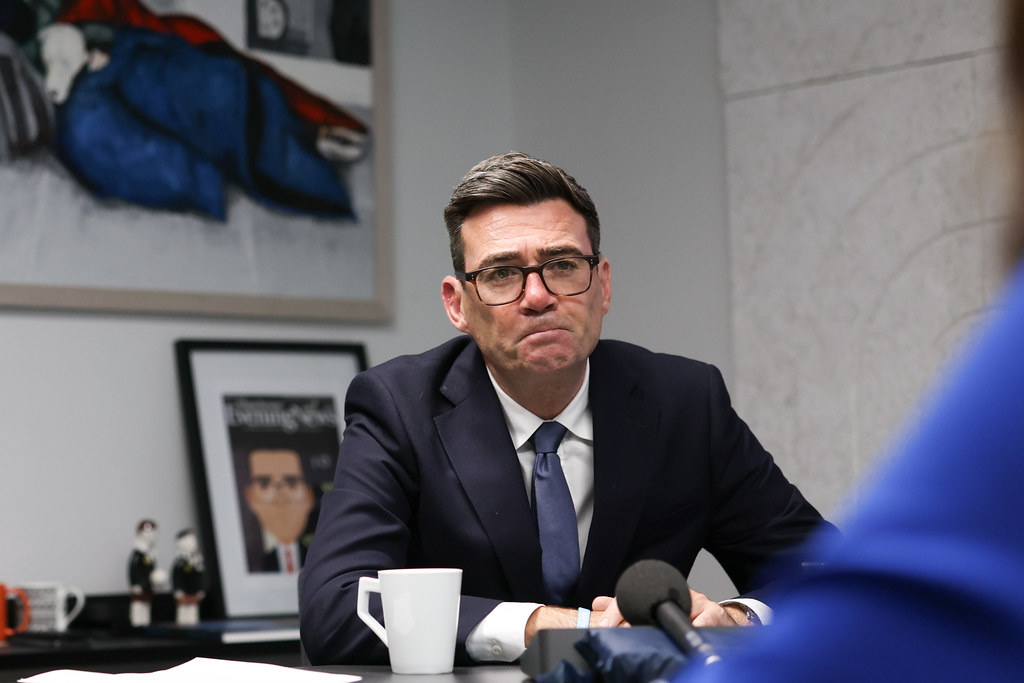
Prime Minister Andrew “Andy” Burnham holds a press conference in his office.
As of July 2026, the job of prime minister is now Andy Burnham’s. With a net approval rating of +8 and raucous support from Labour backbenchers, the former Manchester mayor enjoys a seemingly stellar standing compared to his predecessor. With a plan for increased devolution — the transfer of power from Westminster/London to other centers of power in the country — the “King of the North” has already purged the British government of many Starmer loyalists and directed the government to adopt a batch of new priorities.
However, Prime Minister Burnham is one of seven prime ministers, each with their own agenda, who have all thought they had the answers to remedy problems plaguing the former world power. All his predecessors have seemingly failed, leading to their resignation. So what exactly is broken about Britain that has caused this series of political upheavals? Why have right-wing parties like Reform U.K. and Restore Britain and left-wing ones like the Greens seemingly fragmented the two-party system? Why has British politics deteriorated so much that the country is on its seventh leader in only 10 years?
In this article, I will try to discuss some of the statistics surrounding Britain’s relative decline. As I will mostly be discussing headwinds facing Britain, I want to preface this discussion with an expression of my sincere adoration for the country. Living there for two years left me fascinated by the country’s storied history, appreciative of its traditions and eclectic music (I highly recommend Hard Life, Olivia Dean, Joesef, Loyle Carner, and Sebastian Schub), and grateful to have met some of the cleverest and most industrious people in the world. Britain leads the world in biomedical research, has produced AI companies like DeepMind, and is home to some of the best universities in the world, including Cambridge and Oxford (my alma mater). Friends that I will hopefully have for the rest of my life still live there, and I try to return to the U.K. at least once a year.
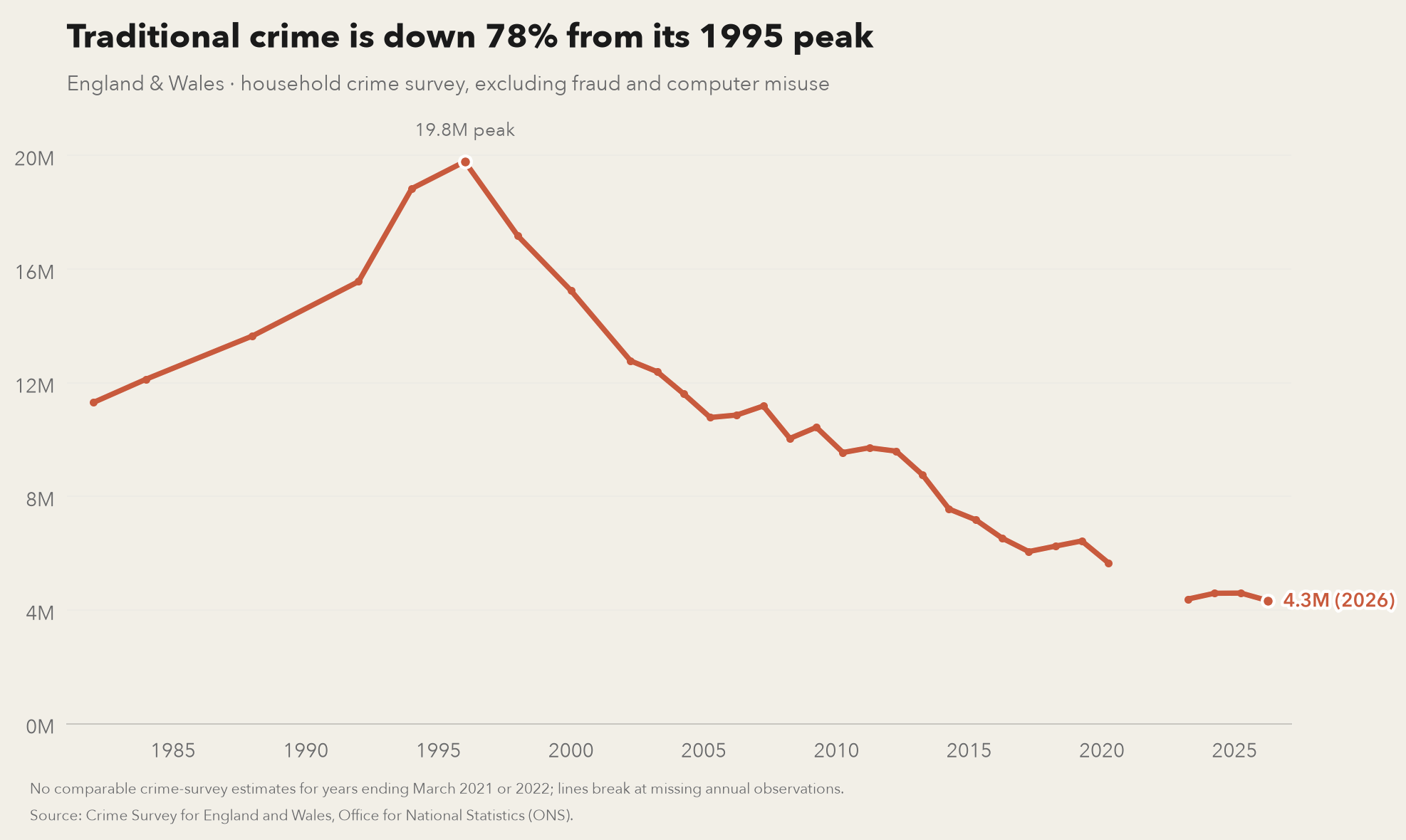
I say all this because, in recent years, particular corners of the Internet have portrayed Britain as a basket case—a country beset by failing governments, rising crime, and deep cultural erosion, with civil war imminent. Much of this is either pure hyperbole or outright false; for example, in the last 20 years, crime in the U.K. has fallen dramatically. As such, in writing this article, I do not wish to continue the dog-piling but rather want to look at some of the genuine issues plaguing the island nation.
While I will highlight some of the headwinds facing the United Kingdom right now, I cannot offer a comprehensive account of the country’s problems in a single blog post. The impact of the Cameron government’s austerity program, the fallout from Brexit, the post-industrial hollowing out of northern England, the growing calls for independence in Scotland, Northern Ireland, and Wales, and the concentration of capital in London each deserve a PhD dissertation examining their complexity.
With those caveats, what exactly are the major problems and issues facing Britain?
Keep Calm and Carry On Falling Behind
Slow growth, high energy prices, insufficient spending on infrastructure and social services, and political divisions have hampered the United Kingdom over the course of the last 20 years. In 2007, in nominal terms, the GDP per capita in the U.K. was 105% of that of the U.S. — by 2025 it stood at only 64%. In real terms, adjusting for inflation and differences in price levels, the U.K.’s GDP per capita was 82% of the U.S. level in 2007; by 2025, it had slipped to 70%. You will sometimes even hear online that the GDP of the U.K. has stagnated so much that the U.K. is poorer than every American state, including Mississippi!
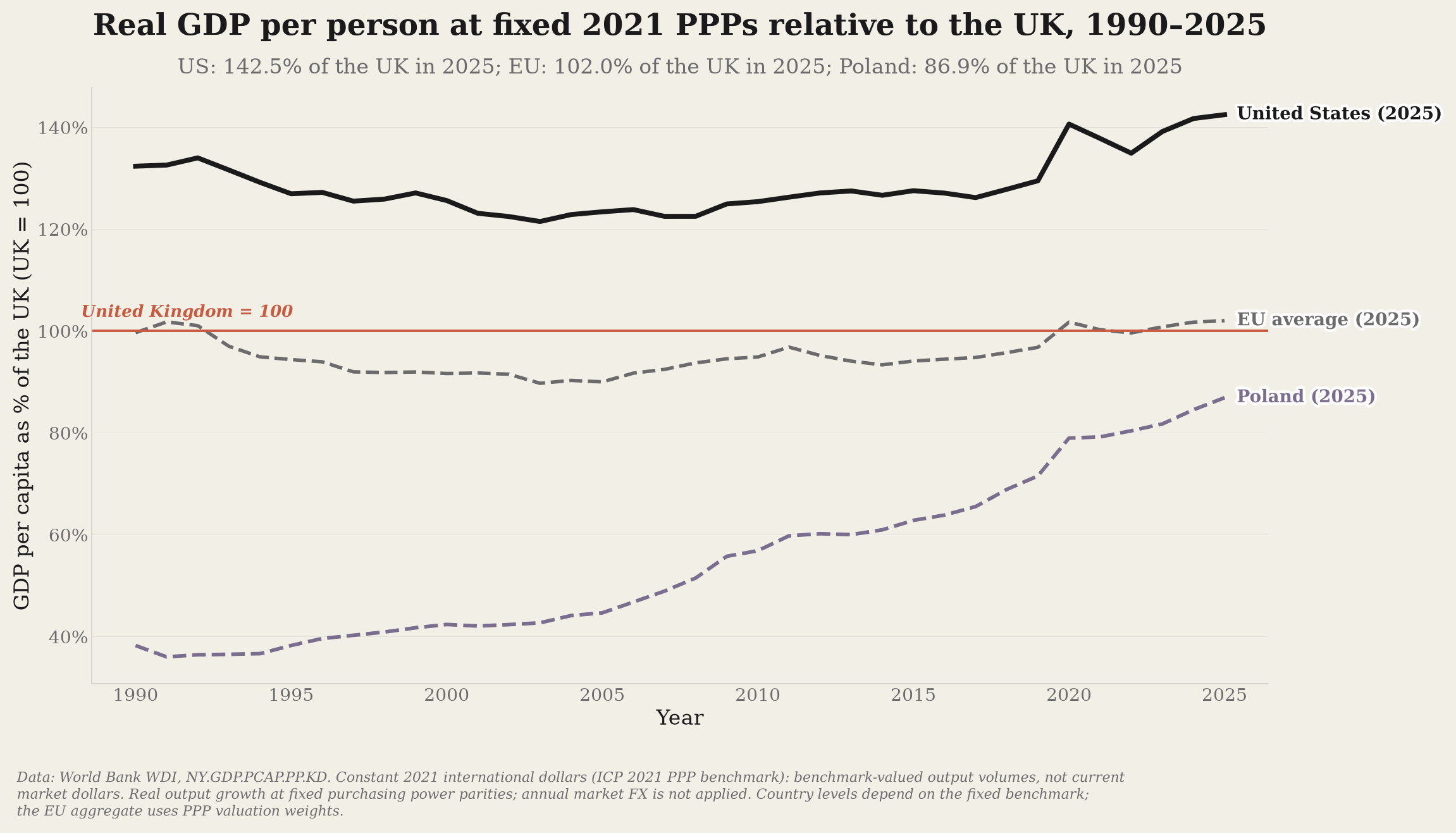
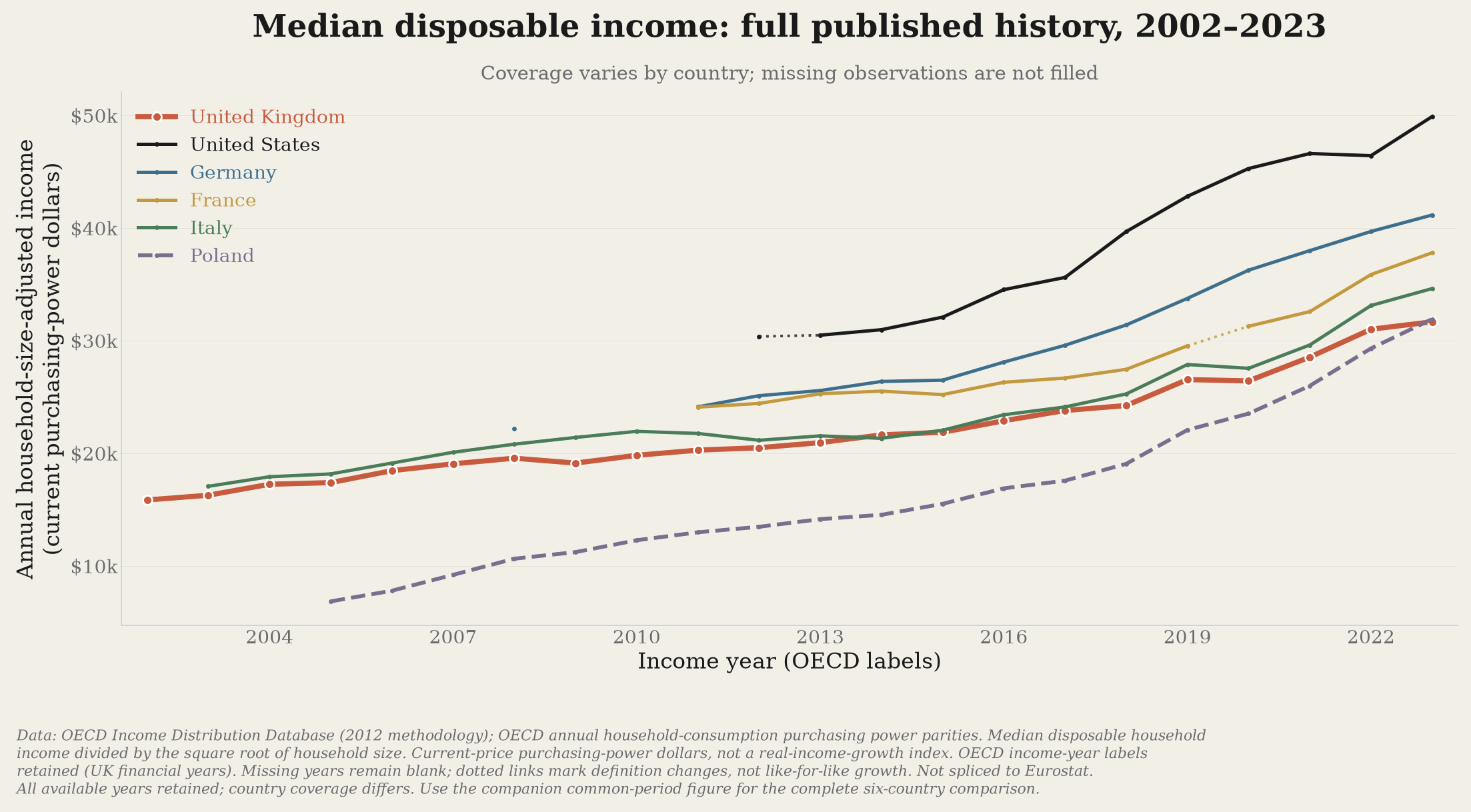
On measures that account for inflation and differences in purchasing power, the U.K. has also become poorer per capita than the E.U. average. While peer nations like Germany and France have also stalled, developing economies like Poland’s are gaining ground, with some optimistic forecasts projecting that the Eastern European economy will overtake Britain’s on some metrics. Indeed, according to OECD metrics adjusted for purchasing power parity (PPP), Poland has overtaken the United Kingdom in terms of median household disposable income.1 Disposable income as measured by the OECD is the money households receive from work, investments, pensions and benefits, minus taxes and social contributions and before paying for housing, food and other living costs. By this metric, the median Brit may already be worse off than the median Pole.
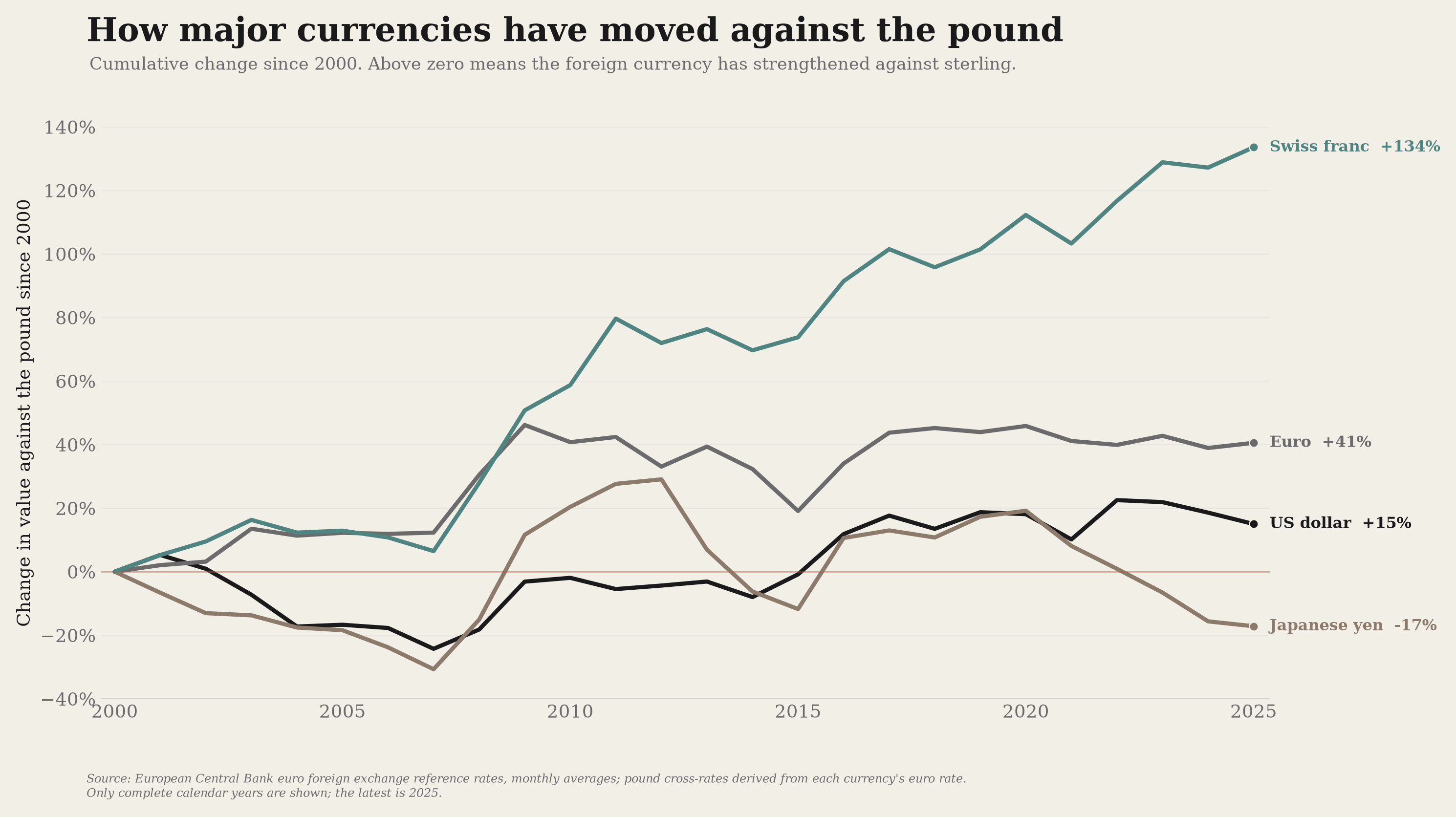
With imports accounting for 32% of U.K. GDP, a weaker pound and new trade barriers following Brexit (the U.K.’s split from the E.U. in 2020 after a 2016 vote) have made goods from abroad more expensive. Indeed, since the Brexit vote, both the euro and the dollar have appreciated against the pound. For a British tourist, a hotel stay in Europe that once cost £100 in 2016 would now cost £110.46, while a £100 stay in the U.S. would cost £112.25 — even if neither hotel raised its local prices.
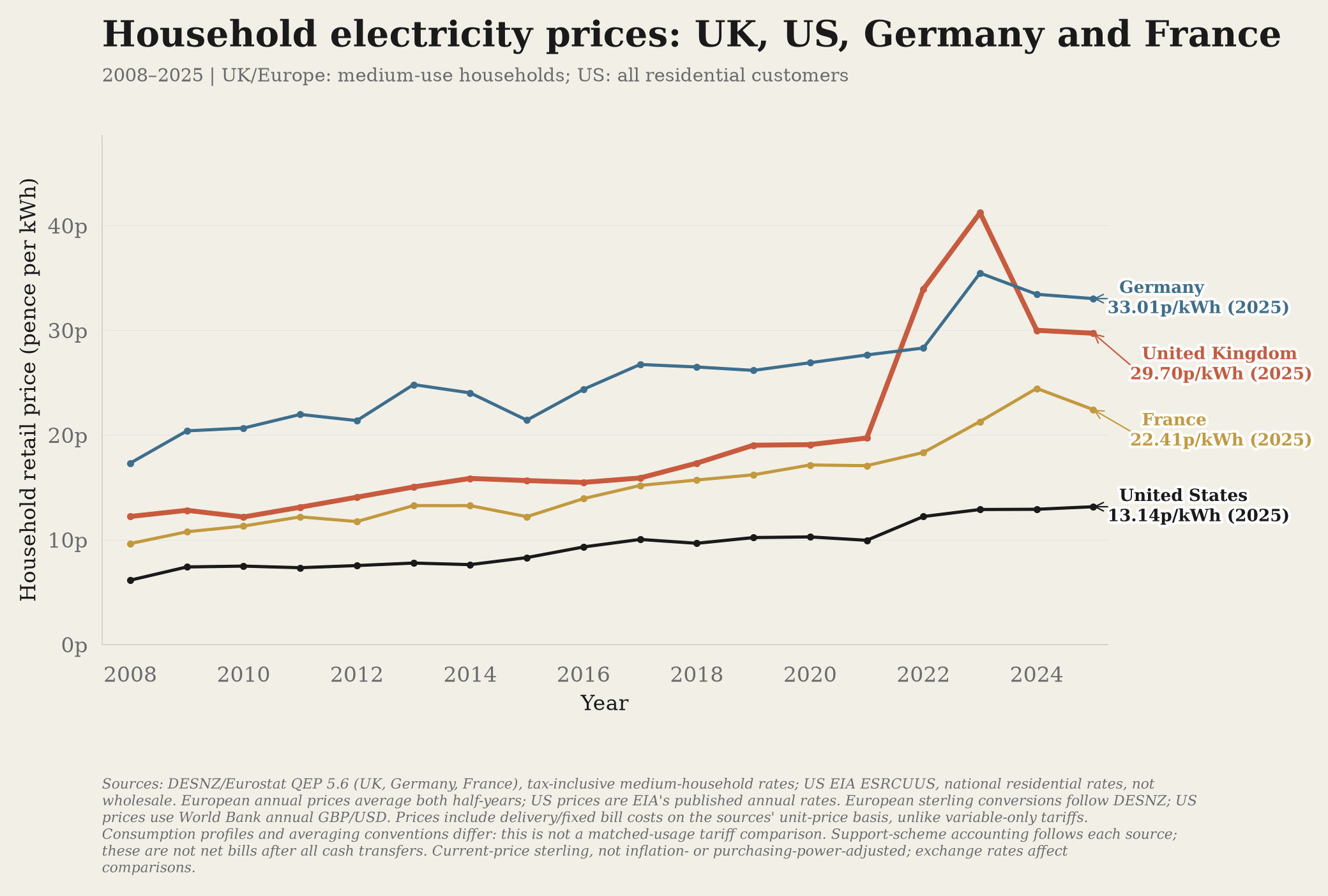
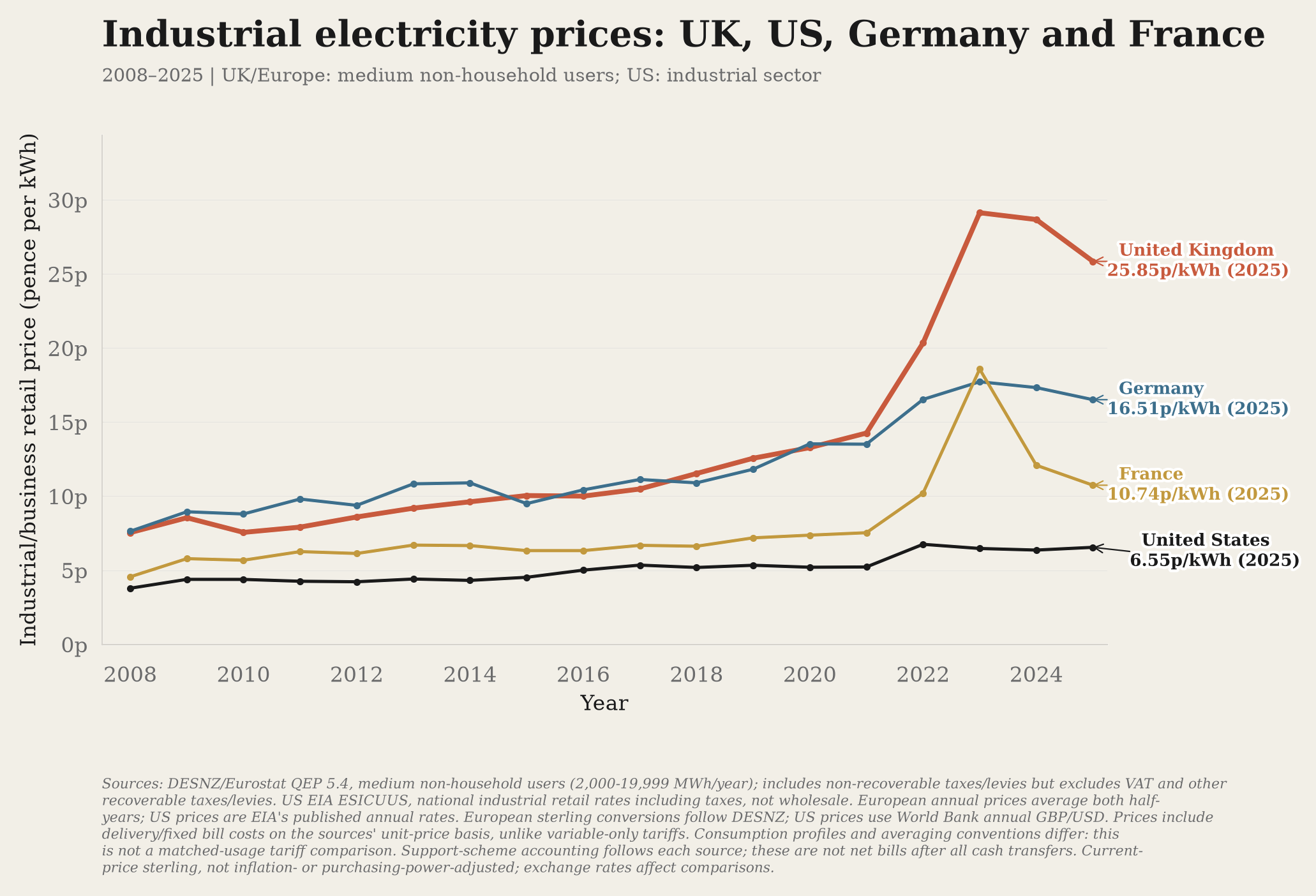
The relative decrease in income and the decreasing value of the pound have been compounded by Britain’s relatively high energy costs, making all other goods more expensive. Per kilowatt-hour, the cost of household electricity in the U.K. is over double that in the U.S.; industrial energy prices are nearly four times those in the U.S. and more than 1.5 times those in Germany.
Services Under Strain
Despite a relatively declining standard of living compared to peer countries, the U.K. still invests heavily in the overall well-being of its residents. U.K. residents can expect to benefit from the National Health Service (NHS) — the country’s publicly funded health service — as well as childcare support, world-class universities, and rail and public transport networks that crisscross the country.
However, when tuition fees are compared across England, the U.S. and the E.U., English students actually pay more each year for their diplomas. In-state students at public universities can indeed expect lower bills in America than in England.
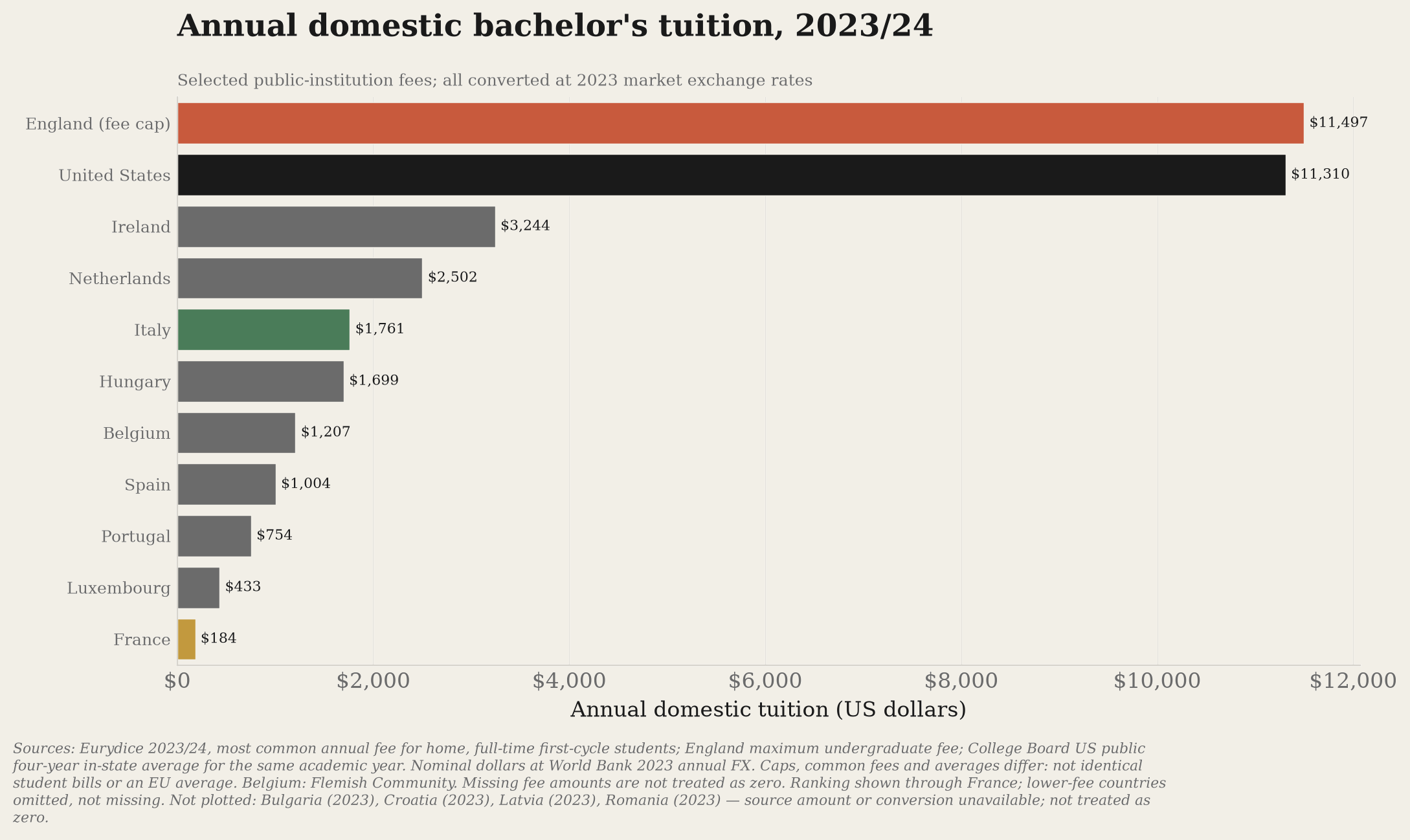
Further, despite recent tuition fee freezes in England — after tuition fees tripled in 2012 — undergraduates in England graduate, on average, with debts of around $60K (compared to an average of $29K in the United States). The increase in costs associated with British universities’ small class sizes, lavish student housing, and substantial research spending makes infamously expensive American degrees — at least degrees offered to in-state students at public universities — seem like a steal.
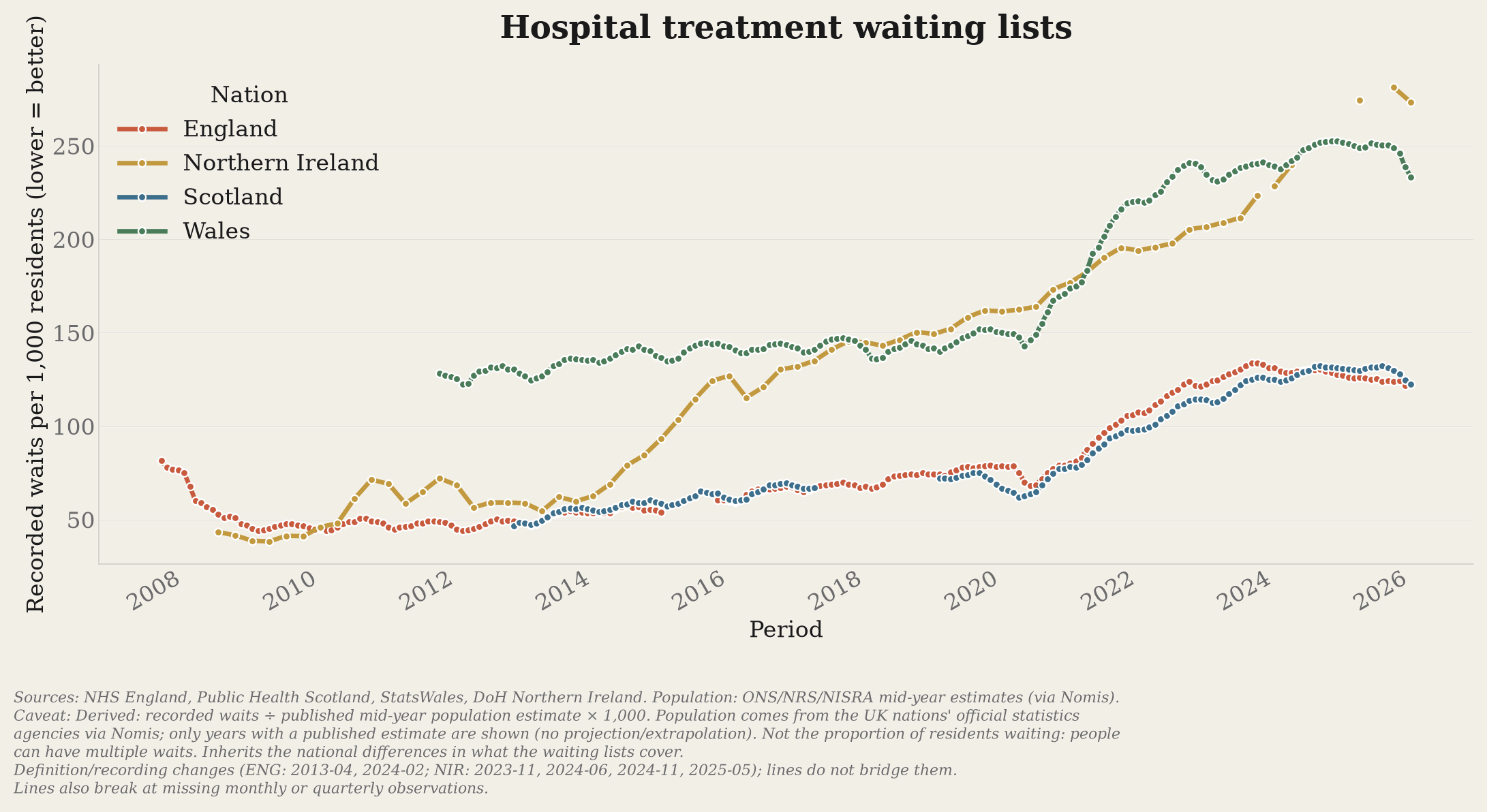
While the National Health Service remains a point of pride amongst the British population, it too has come under significant strain since the COVID-19 pandemic. During the 2024 election between then-Labour leader Keir Starmer and Prime Minister Rishi Sunak, one of the major points of debate amongst Brits was the increased number of patients waiting for treatment — at its peak, over 6.5 million individual patients and 7.77 million appointments were on England’s waiting list alone. As new COVID patients arrived, operations and appointments were postponed, doctors went on strike for increased pay, and only recently has the backlog of patients begun to decrease.
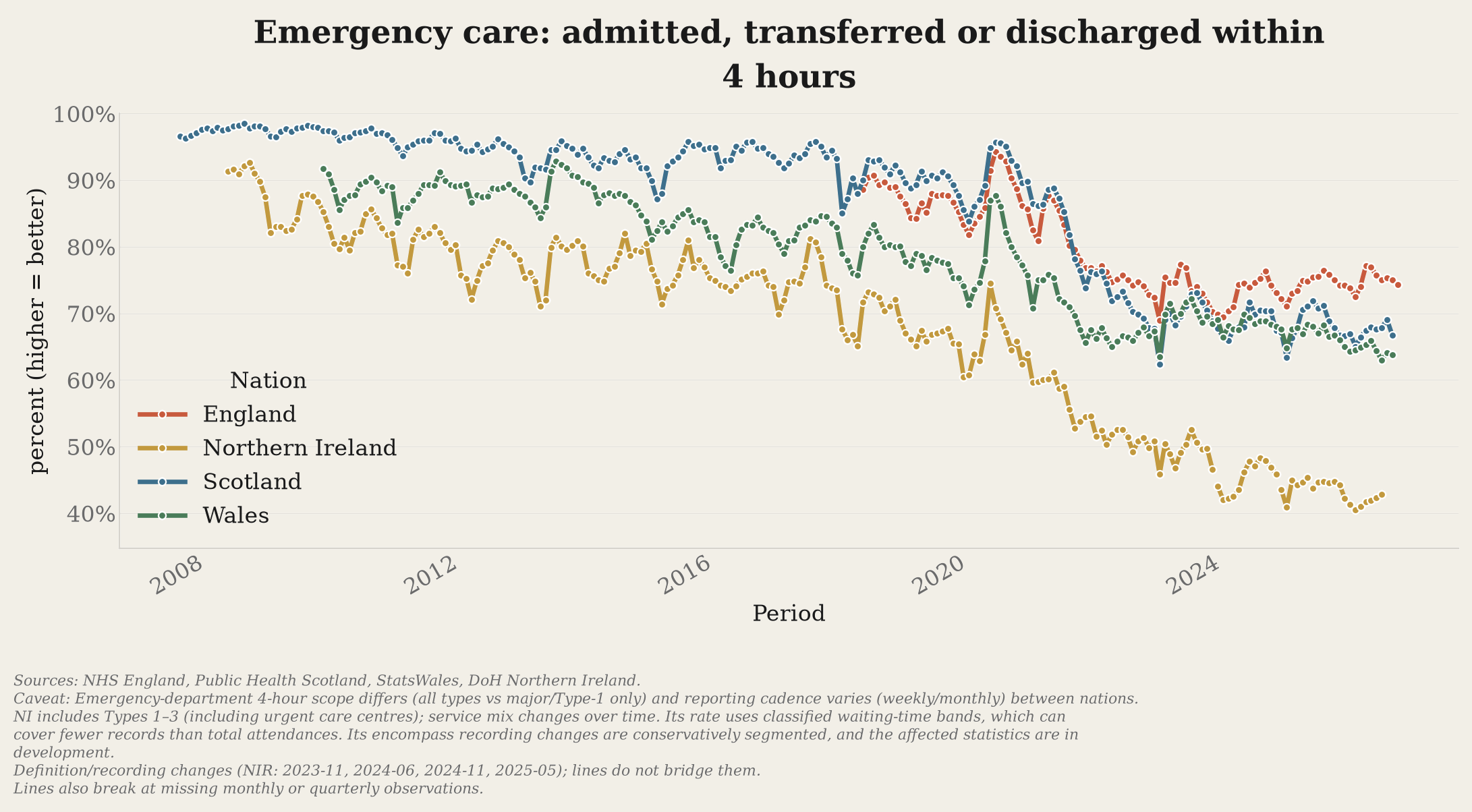
All the while, since the COVID-19 pandemic, the percentage of patients receiving timely emergency care has also suffered large declines. Longer hospital stays, an ageing population, and a lack of capacity have all seemed to thwart attempts at shortening these hospital wait times.
Many attribute much of this decrease in state capacity and increased costs to the U.K.’s period of austerity policies. Following the election of the Conservatives under David Cameron in 2010, the U.K. underwent a decade-long freezing and shrinking of the nation’s budget as the country attempted to recover from the 2008 financial crisis. Despite the low interest rates on borrowing during the 2010s, £30 billion in cuts were introduced to welfare payments and social services by successive Conservative governments. Budgets for housing, policing, and social welfare all seemingly collapsed, while the number of British families regularly using food banks ballooned during the same period.
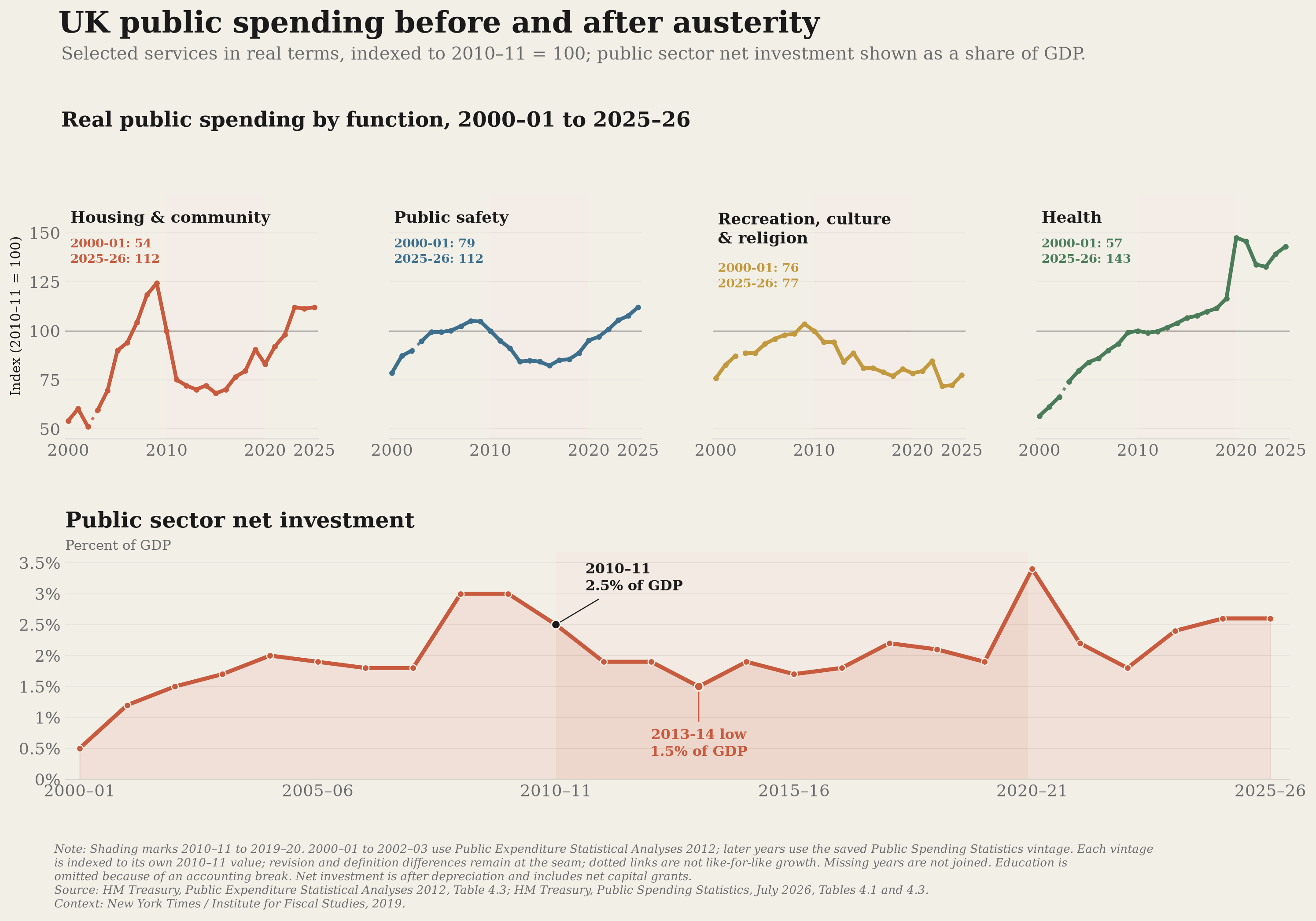
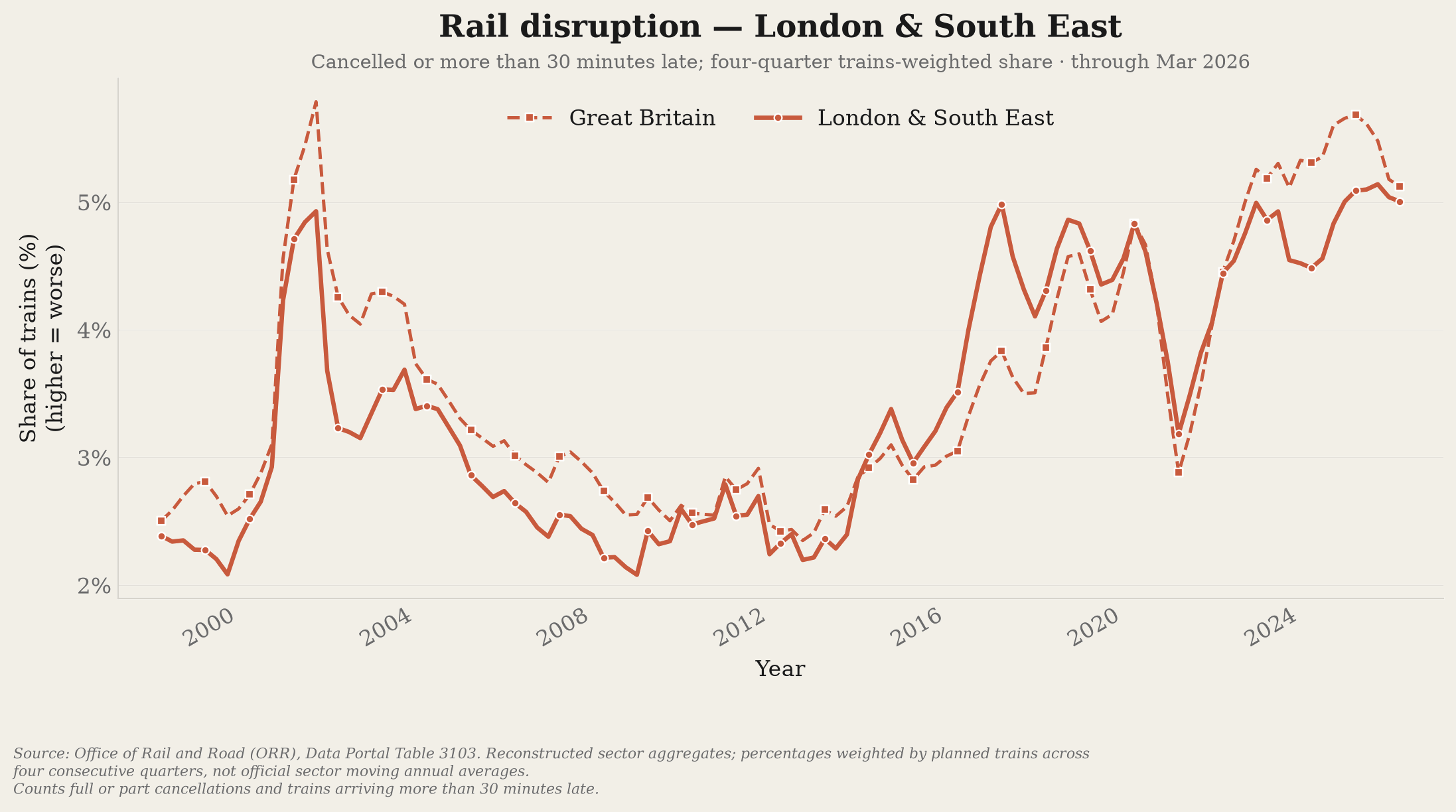
As seen below, the reliability of the rail system in Great Britain also deteriorated during this period. Even after austerity ended following the COVID-19 pandemic, the number of rail disruptions has remained relatively high as infrastructure investment continues to stall. As of 2024, public capital investment in the U.K. remains below that of both the E.U. and the U.S.
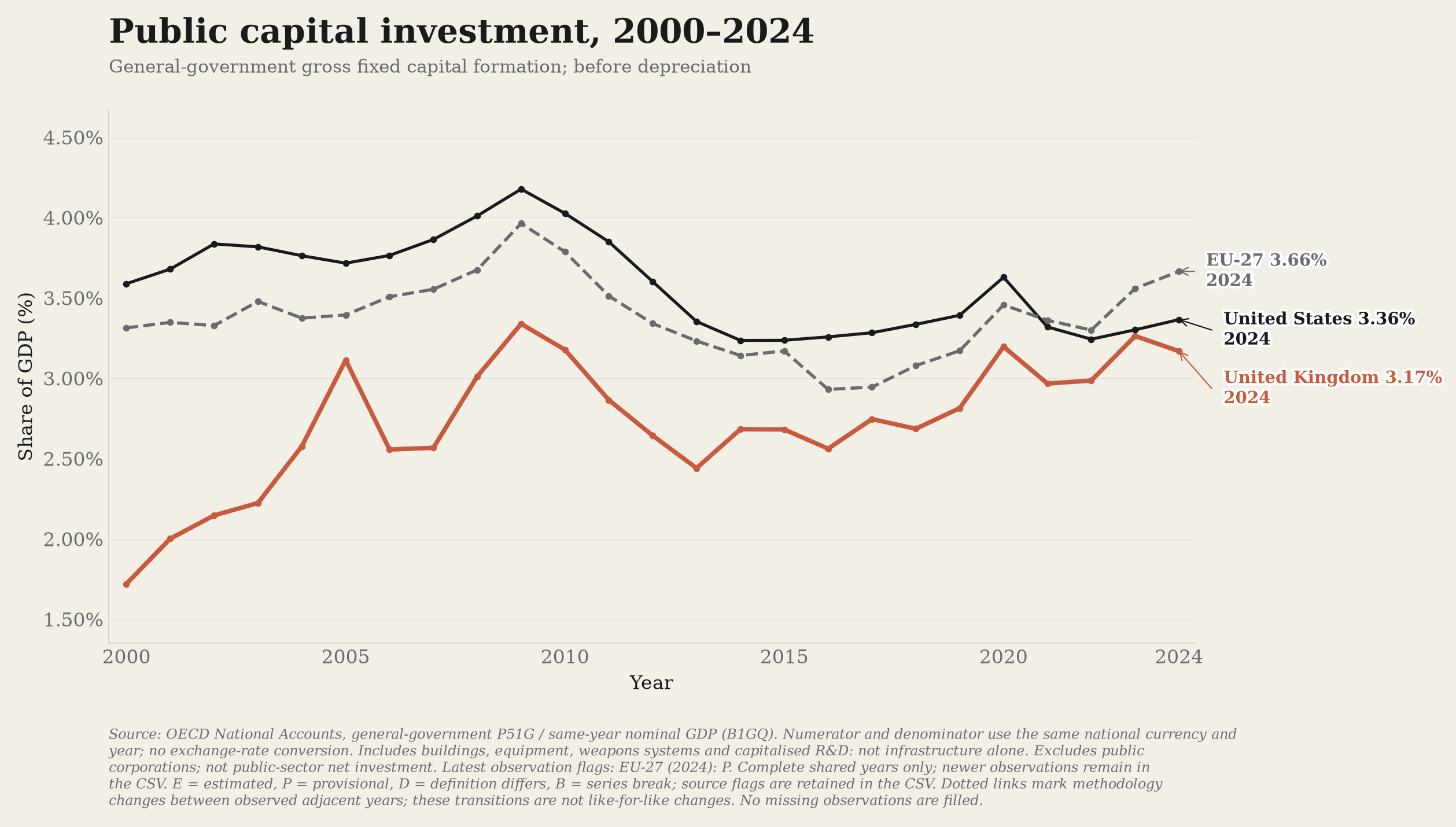
While the United States has, under both the Biden and Trump presidencies, invested heavily in infrastructure, sought to bring critical industries such as semiconductor manufacturing back home, and pursued further tax cuts, Britain has far less fiscal room to pursue comparable policies.
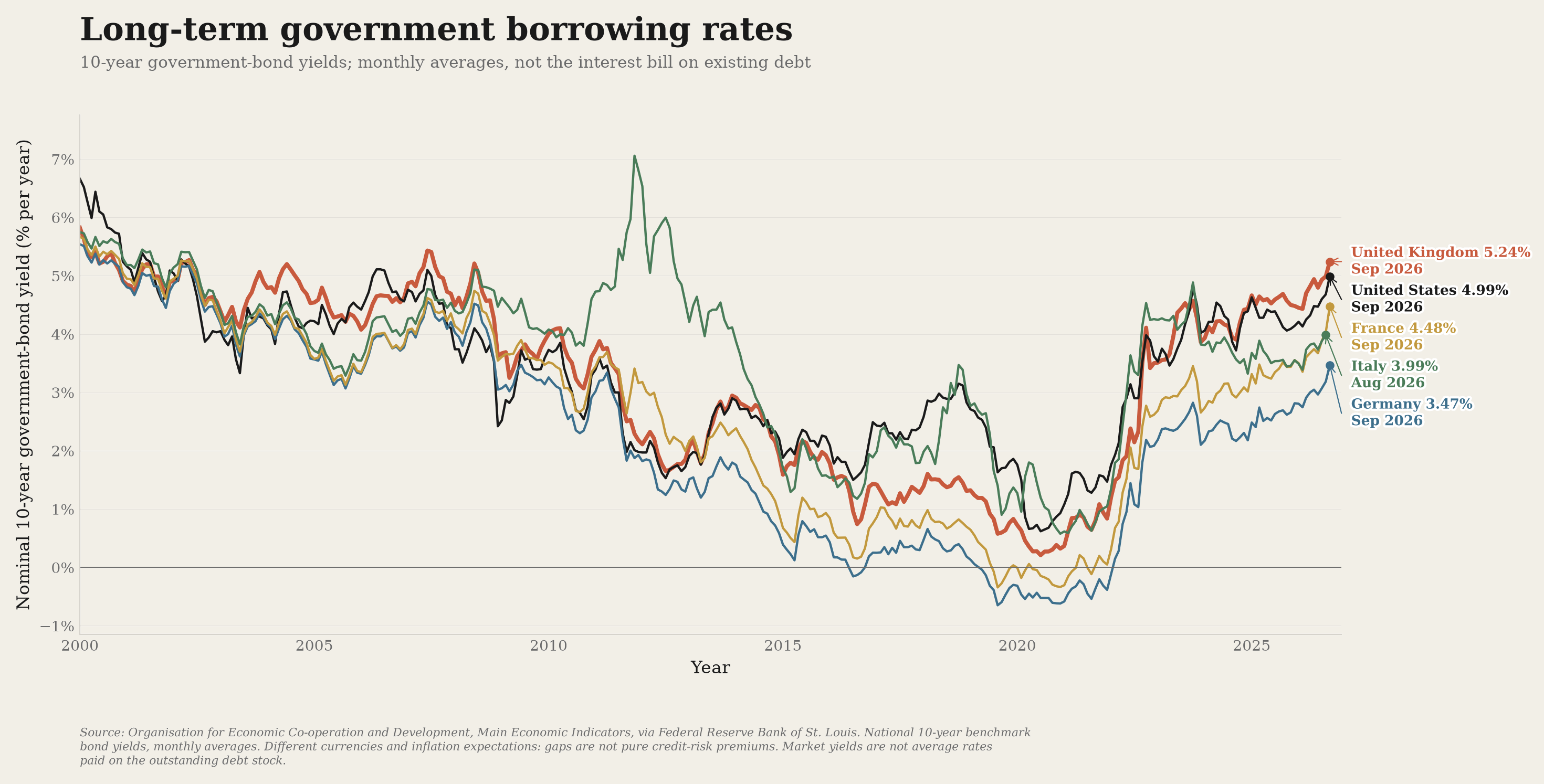
Following Liz Truss’ 49-day premiership in 2022 — during which she attempted to lower taxes while increasing spending — and the subsequent revolt among bond investors, the U.K. has continued to face a high risk premium, ostensibly due to the U.K.’s political dysfunction. Indeed, despite the U.S.’s monumental $40 trillion debt, the U.K. has an even higher long-term borrowing rate (long-term borrowing rates are complex and not determined by one factor).
Mind the Political Gap
Flatlining incomes and deteriorating services have eroded support for Britain’s two-party system. Voters disillusioned with Labour and the Conservatives are increasingly looking elsewhere, opening the door to political movements offering sharply different answers to Britain’s decline.
Against the backdrop of relatively declining living standards, right-leaning politicians like Nigel Farage of Reform U.K. and Rupert Lowe of Restore Britain as well as far-right activists like Tommy Robinson have seized on a potent issue to supercharge their political movements: immigration, both legal and illegal. While Reform U.K. have firmly entered the political mainstream (21% polling average) and have incorporated many former Conservatives (e.g., Robert Jenrick) into their movement, many view Restore Britain as somewhat fringe and Tommy Robinson as an extreme anti-immigrant activist.

Tommy Robinson’s tweets about Afghan “invaders” and about a “two-tiered” justice system.
These right-wing movements have gained strength amid major shifts in migration to the U.K., particularly over the past decade. According to the U.K.’s Office for National Statistics, net migration rose substantially from the Blair premiership (1997–2007) onward, surging in the aftermath of the COVID-19 pandemic — from 48,000 in 1997 to more than 891,000 in 2022. According to a U.K. government report, this surge was largely driven by demand for skilled and middle-skilled workers, particularly in health care, alongside a sharp rise in international student arrivals. The consternation on the Right caused by the sheer number of new residents has only been intensified by the jump in migration from non-E.U. countries like India, Pakistan, and Nigeria, which largely replaced E.U. migration following Brexit.
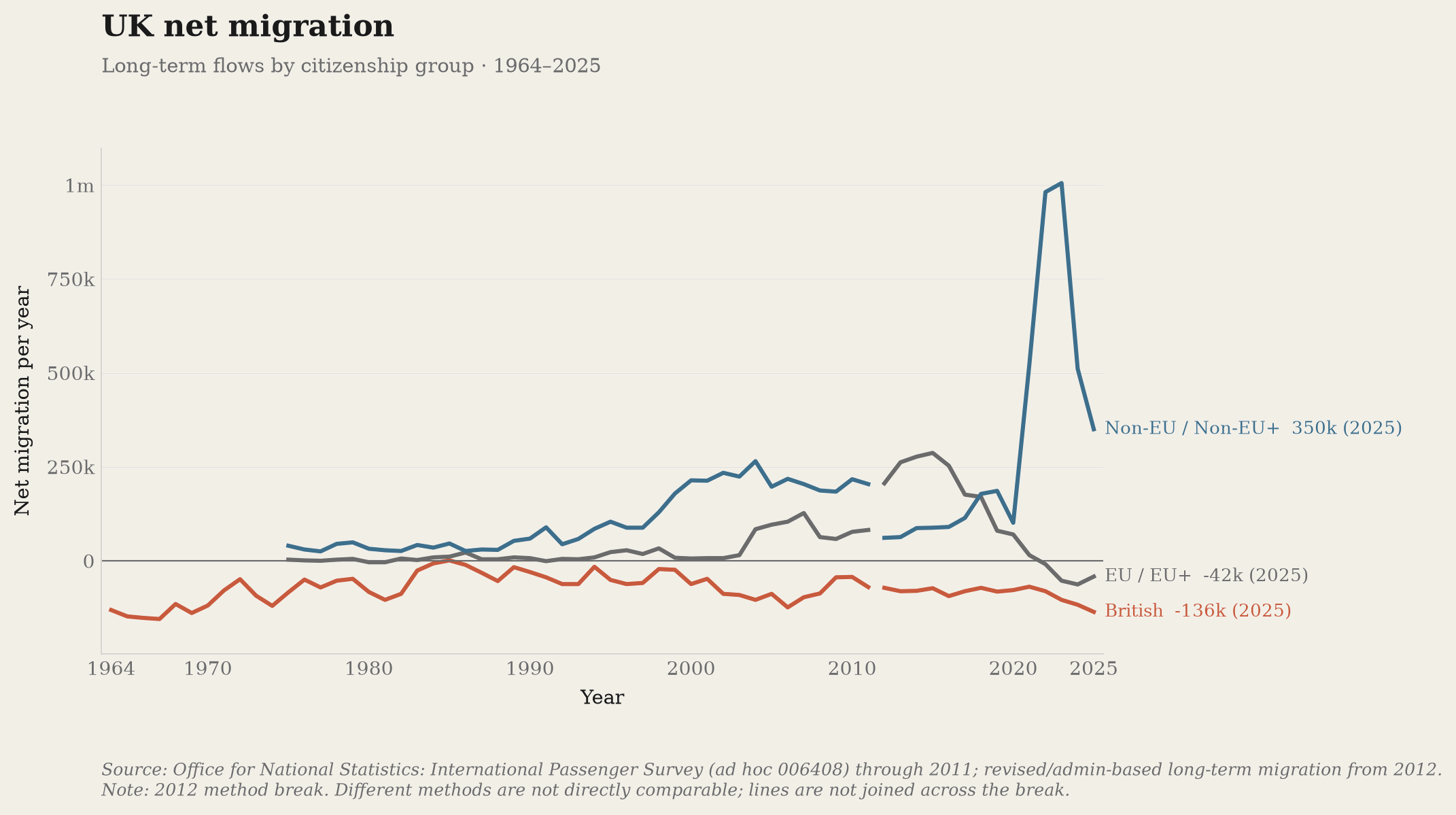
This has all been exacerbated by a seemingly perennial call from the public — not only from those on the Right — for the government to “stop the boats.” These calls largely focus on preventing “small boats” carrying Middle Eastern and sub-Saharan African migrants and asylum seekers from crossing the English Channel from France. The U.K. government even reached a new £662M agreement back in April of this year (2026) to fund work with the French government to stop migrants from crossing the channel. However, regardless of recent declines in immigration to the U.K., as late as May of this year, protests and counter-protests dotted London.
Alongside the rise of Reform and Restore on the right, the Green Party has gained ground on the left, further fragmenting the U.K.’s political landscape long dominated by Labour and the Conservatives (despite occasional challenges from the Liberal Democrats). The Green Party has surged in popularity among young voters disillusioned with Keir Starmer’s Labour government, particularly its stance on the Israel–Hamas war and its lack of investment in social welfare, with the party’s membership tripling since September 2025. As Green Party leader Zach Polanski noted in a New York Times interview in March 2026:
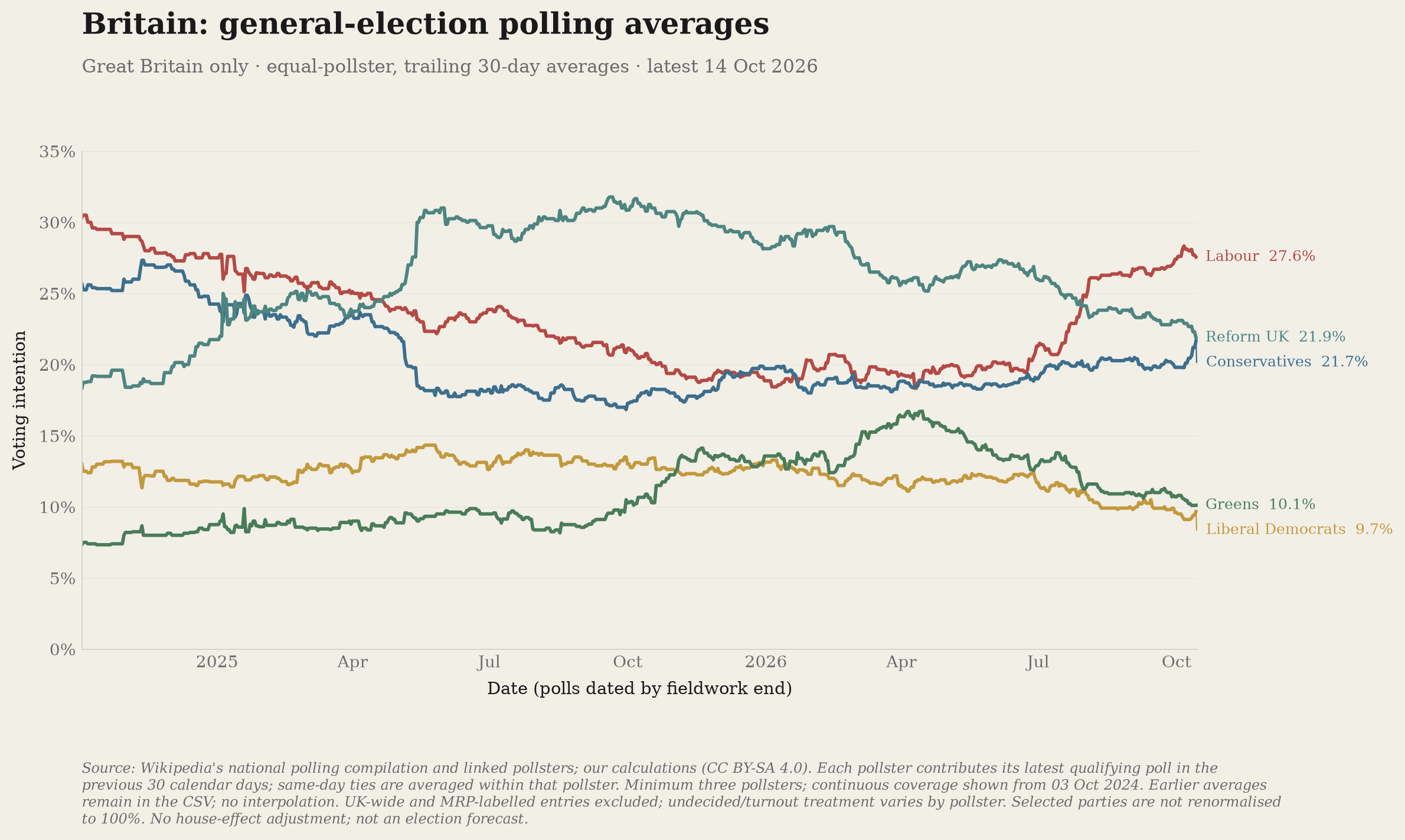
While Polanski may have spoken prematurely, with Labour currently undergoing a resurgence under Andy Burnham and the Conservative Party stabilizing in the polls, the U.K.’s politics has seemingly splintered into a polarized, multiparty political system — at least for now.
Waiting for the Great British Reboot
Stagnant wages, a fraying social safety net, and an increasingly fractured political landscape are far from the U.K.’s only challenges: pressure to increase military spending after years of cuts amid a renewed threat from Russia, a brain drain as young workers seek opportunities abroad, the movement of capital markets from London after Brexit, and growing movements for Scottish independence, Irish reunification, and even Welsh independence, to name a few. Amid growing public discontent and political turbulence, over the course of the last decade, seven different prime ministers have attempted to grapple with these challenges. The newest, Prime Minister Andy Burnham, has some familiar fixes. At the September 2026 Labour Party Conference, Prime Minister Burnham proposed establishing a public grid company to help bring down energy prices, increasing investment in the NHS, and devolving more power to local municipalities.
Are Burnham’s fixes enough to fix Britain? It is hard to say; what is certain is that substantial and sustained reforms are needed to keep Britain great. Having just ousted Keir Starmer without having led Labour to victory in a general election, however, Burnham may not even have the mandate to implement anything substantial. As Burnham prepares to propose a new budget on October 28th, signs point to more muddling through. Unfortunately, the U.K.’s problems may be too complicated to solve simply by swapping prime ministers.
Explore the data behind Britain’s economic and political challenges in interactive graphs, or browse the analysis code on GitHub.